Hotel
Stargard Castle

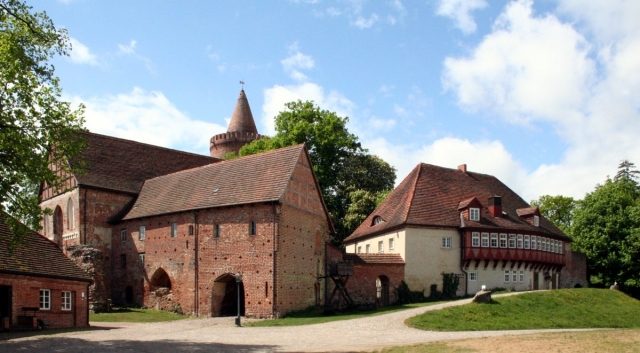
Burg Stargard is the northernmost preserved hilltop castle in Germany and the oldest secular building in Mecklenburg-Vorpommern – also featuring the deepest tower dungeon in Northern Germany. The castle, located on the approximately 90-meter-high castle hill, and the town of Burg Stargard at its foot, are situated south of Neubrandenburg in the federal state of Mecklenburg-Vorpommern. The complex consists of an outer and inner bailey with eleven still-preserved buildings, and with its keep as a landmark, it shapes the appearance of the town.
The castle hill was already inhabited before 3000 BC. When Slavic tribes reached the area during the Migration Period, they found remnants of an earlier fortification or settlement on the castle hill and therefore named the place Stari Gard (old castle).
From the 12th century onwards, the area was conquered and settled by Christian princes. Subsequently, the area of present-day Stargard came under Duke Wartislaw III of Pomerania (-Demmin), who ceded the Land Stargard to the Ascania margraves Johann I and Otto III of Brandenburg in the Treaty of Kremmen in 1236. To secure their northernmost territories, the Brandenburgers began building Burg Stargard from 1236. The town of Stargard received town rights in 1259 from Margrave Otto III. Through the marriage of Margrave's daughter Beatrix of Brandenburg to Prince Heinrich II of Mecklenburg, the Lordship of Stargard, with its town and castle, came into the hands of the Mecklenburgers in 1292 as a dowry.
With the division of the country in 1352, Burg Stargard became the residence of Duke Johann I of Mecklenburg-Stargard. After the extinction of the Stargard line, the (partial) Duchy of Mecklenburg-Stargard reverted to the entire House of Mecklenburg in 1471. Duke Albrecht VI of Mecklenburg had the castle significantly rebuilt and expanded in 1520; for example, the castle chapel was established in the former gatehouse.
During the Thirty Years' War, the castle was General Tilly's headquarters in 1631 during the siege and storming of Neubrandenburg. During this time, the castle was severely damaged. In 1646, the keep was struck by lightning and burned out. Burg Stargard remained the seat of a ducal Mecklenburg administrative office even after the establishment of the (partial) Duchy of Mecklenburg-Strelitz in 1701. For centuries, the castle served as the residence of bailiffs, district administrators, or stewards. In 1726, the last witch trial in Mecklenburg took place at Burg Stargard.
After the Second World War, the castle was used as a state youth school until 1963 and as a youth hostel until 1990. After the closure of the youth hostel, extensive restoration of the entire castle complex began in 1990. Furthermore, a castle museum was established, which is managed by the Diakonische Werkstätten Neubrandenburg. In addition, cultural events are held at the castle, and bridal couples are married there.
Complex+
Burg Stargard is divided into an outer and an inner bailey with a total of eleven buildings. The inner bailey has an approximately oval floor plan and is surrounded by a moat, along with the outer bailey to the east, which houses the Amtsreiterhaus. The keep is the landmark of the town. The high importance of the castle is shown by the fact that all buildings were constructed as brick buildings.
Burg Stargard and the castle garden can be visited. Museum admission and ascent of the keep are subject to a fee.
Keep
The keep was built around 1245 on a foundation of hewn boulders. In the lower section, the walls are over four meters thick and have a circumference of 27 meters. The entrance is nine meters above the ground and was originally accessible via a covered wooden staircase. The tower dungeon, in turn, lies 13 meters below the entrance and thus far below the castle courtyard pavement. Above the dungeon, there were once three tower rooms.
The tower burned out in 1647 after a lightning strike. Grand Duke Georg of Mecklenburg-Strelitz had Friedrich Wilhelm Buttel convert the keep into an observation tower from 1821 to 1823. Including the nine-meter-high spire, the keep measures 38 meters in height. In good visibility, it offers a 30-kilometer panoramic view as far as the windmills of Woldegk. In 1966, the tower was renovated.
Crooked House
On December 18, 1919, the so-called Crooked House burned down to its foundations due to arson and remains a ruin to this day.
Upper Gate (Castle Chapel)
The castle chapel was built between 1240 and 1250 as a three-story gatehouse. The gate was set into the castle's boundary walls but protrudes significantly from them. From 1280, a chapel was initially set up on the upper floor of the gate. Only in 1520 were the drawbridge removed, the passage and the middle window connected and bricked up, and the building redesigned into a double chapel. Sixty years later, the chapel was extended towards the courtyard. In the 17th century, it served as a carriage house and barn. Only between 1758 and 1770 was the building again used for spiritual purposes as a town church. After this period, it was again a storage room.
The building has a central pointed arch window with two side round arch windows. The gable shows 18th-century stone half-timbering. The side pilaster strips and the black glazed round arch friezes of the former gate are preserved.
Lower Gate
The lower gate was built around 1250 as a two-story brick building, which housed a chapel on the upper floor. In the 16th century, the gate was reinforced and in the 17th century, it was rebuilt. Since 1755, it has been partially destroyed; today, only the facade remains. The gable is encompassed by a round arch and once consisted of a stepped three-window group, which is now bricked up. To the side of the bridge, as at the upper gate, there are pilaster strips and round arch friezes with black glaze. The former drawbridge was replaced by a stone dam in the 16th century.
Inn
The building was erected in the 13th century, its outer wall simultaneously forming part of the main castle's ring wall, which supported the battlement. From 1938 to 1944, the restaurant "Zur Alten Münze" was located there, after which a youth hostel moved in. After extensive renovation, the building was reopened as a hotel and restaurant in 1999.
Take Mobile History with you
You are reading this text for free. Premium adds what matters on the road: descriptions read aloud, sites found through your camera, whole regions taken offline.
- Every description, including the ~17,700 Premium sites
- Audio guide: have descriptions read to you on location
- AR finder: see sites through your camera, with distance and bearing
- Unlimited saved sites
14 days free, then from €2.99 a month. Cancel anytime.
Source: Wikipedia · Licence: CC BY-SA 4.0 · Image: http://commons.wikimedia.org/wiki/File:Burg_Stargard_Altes_Tor_und_M%C3%BCnzpr%C3%A4gerei.jpg
This description draws on the facts documented in the linked Wikipedia article; Wikipedia content is licensed under CC BY-SA 4.0. Wording and editing: Mobile History.
Location: 53.4900, 13.3049