To be privately owned
Stein Castle

Burg Stein, of which today mostly only the castle chapel, the former Kemenate (lady's bower), remains, was a very early castle complex of the Walpoten. It is located in the Stein district of the town of Gefrees, Stein 32, in the Upper Franconian district of Bayreuth in Bavaria, Germany.
The spur castle is situated on a forested spur projecting to the southeast, somewhat constricted at the rear, above a loop of the Ölschnitz river, which flows southwest below at just over 420 m above sea level on a larger scale. The associated settlement begins about 100 meters set back from the castle grounds on the widening, higher, and already quite flat slope, extending up to about 500 m above sea level.
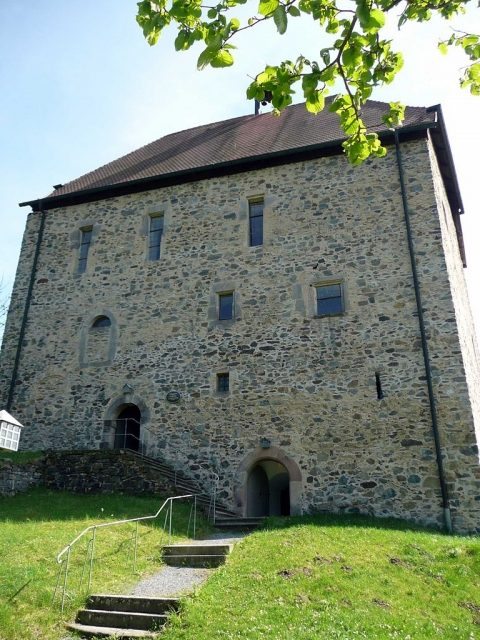
Completely preserved from the former castle is only the Kemenate, a three-story building from the 14th century, which today bears a high half-hipped roof erected in the 17th century. In its upper floors is the Chapel of St. Michael, established in 1686. Parts of defensive walls and fragments of the former castle chapel, the Zwinger (outer bailey), and the Vorburg (outer ward) have been preserved in remnants. A preserved archway is marked with the year 1548.
The Bavarian State Office for Monument Protection has listed Burg Stein in the Bavarian Monument List under number D-4-72-139-26 as an architectural monument (landscape-defining monument). The entire castle hill is registered under number D-4-5936-0068 as an archaeological monument of the Middle Ages and early modern period.
About 2 kilometers further southwest as the crow flies, near Bad Berneck, on a confluence spur above the river, lie the ruins of the Wallenroder Castles.
Stein is primarily known for its castle complex, which probably originated around 1000. In 1028, it was transferred as a free allodial property of the Walpoten to the Prince-Bishopric of Bamberg. Bishop Rupert of Bamberg used the lordship of Stein around 1077 for the foundation of St. Jakob's Abbey in Bamberg. Around 1100, the noble free Poppo "the White" of Stein then appeared as a trustee of St. Jakob's Abbey in the lordship of Stein.
In the 13th or early 14th century, the castle seems to have fallen into ruin, because in 1342 it was rebuilt with the consent of Bishop Leopold of Bamberg by Heinrich, Friedrich, and Heilmann von Hirschberg. At that time, the striking palas, which characterizes the appearance of the castle complex, was built. Stein became a Bamberg border castle against the Burgraves of Nuremberg, who had acquired neighboring Berneck around 1340. In 1363, Stein passed into the possession of Rüdiger von Sparneck. His son Hans I von Sparneck zum Stein entered the service of the Nuremberg Burgraves and appeared in 1360 as their bailiff in Burg Hohenberg.
Towards the end of the 15th century, the Sparnecker were forced to pledge Stein to the Bavarian dukes. Margrave Friedrich I of Brandenburg redeemed the pledges in 1488, so that Stein became a margravial administrative castle. After the Thirty Years' War, the condition of the castle buildings steadily deteriorated. In 1684, the administrative household was dissolved and sold into bourgeois hands.
The cartographer Johann Christoph Stierlein sketched the ruin in detail in 1795. He drew several elongated defensive walls and outlying ancillary buildings that are no longer present today. The remains of the castle stand on a rocky elevation above the Ölschnitz valley. The core of the castle complex is relatively well recognizable through numerous wall remnants.
Legend: The Fiddler of Stein+
It is said that an underground passage leads from the castle ruin of Stein to the ruin in Bad Berneck. According to legend, eerie things happen there at night. One day, a poor fiddler, who earned his money by delighting people with his music, came to Stein. He was very interested in the castle ruin there, so before he checked into his lodging, he went there and had a castle guide show him around. After they had thoroughly examined the old masonry, they came to the cellar vaults, and when the fiddler stopped in front of a huge gate, behind which a ghostly dark chasm stretched, he shuddered. When the castle guide saw the young man's anxious face, he said in a grave voice: "Whoever passes through this gate will experience the most terrifying things. Things even worse than anything he has ever experienced before. Apparitions of the dead and ghosts haunt this place at night, and no one who has ever crossed this door has returned! However, whoever survives the horrors in this passage will be richly rewarded."
Torn between fear and the prospect of a decent reward, the fiddler stood before the gate. Finally, however, the desire for prosperity won, and so he opened the huge door and entered the passage. When the castle guide had closed the gate behind the fiddler, he was immediately enveloped in an eerie blackness. Suddenly, he saw a movement in the darkness of the passage just a few steps in front of him! Terrified to death, the man stopped and realized that the horrifying figures were corpses approaching him with stiff movements! Further back, he recognized a funeral procession with an ancient coffin. The fiddler recoiled, hoping that a redeeming faint would overcome him, but he remained steadfast! Finally, the funeral procession stopped in front of him, the coffin was opened, and he was commanded to get in! But although he could no longer think clearly from fear, he resisted the offer, and when the terrifying figures realized that the young man remained steadfast, a pale figure approached him, clad only in a shroud, and said without moving its lips: "Before you can ever return to the world of the living, you must solve one more task!" He handed the man a bag of gold coins and asked him to divide them into two exactly equal parts. Although the fiddler immediately set to work, he could not solve the task at first, because there was an odd number of coins. He finally took a sharp object from his jacket and scratched one coin so that it could be broken into two parts. When the dead man saw how the man had solved the task, he handed him the bag and released him into freedom, where he was joyfully received by the castle guide. Thus, the man never had to live in poverty again and led a happy life until his death.
Castle Chapel St. Michael+
As early as 1377, a castle chapel erected by Hans I von Sparneck was consecrated in the name of St. Michael. It was located in the area of the Zwinger immediately before the access to the core castle. The ruin of this early chapel can still be seen today on the northeastern edge of the castle complex.
After the population of Upper Franconia was forcibly reformed during the Thirty Years' War, they belonged to the Protestant confession. Almost 40 years later, in 1686, the Protestant church bought the castle ruin of Stein from the Catholic Archdiocese of Bamberg. The upper floors of the completely preserved multi-story building of the castle's palas, the so-called Ritterhaus (Knight's House), were converted by the then bailiff Johann Jakob Baßler von Basel into the St. Michael's Chapel, as it is still preserved today. Since then, only the chapel has been structurally maintained, while the rest of Burg Stein has been left to decay.
The altar of the castle chapel comes from Goldkronach. The organ formerly belonged to a Protestant girls' grammar school in Taufkirchen.
Burg Stein today belongs to the church property of the Deanery of Bad Berneck, and the castle chapel is administered by the Evangelical-Lutheran parish of Bad Berneck. Services and other events take place on special occasions.
Take Mobile History with you
You are reading this text for free. Premium adds what matters on the road: descriptions read aloud, sites found through your camera, whole regions taken offline.
- Every description, including the ~17,700 Premium sites
- Audio guide: have descriptions read to you on location
- AR finder: see sites through your camera, with distance and bearing
- Unlimited saved sites
14 days free, then from €2.99 a month. Cancel anytime.
Location: 50.0621, 11.7031