CastleStolpen

Stolpen Castle

Stolpen Castle

The remains of the Castle can be visited

Stolpen Castle, which in its history was converted from a castle to a palace and later used as a fortress, is located about 27 kilometers east of Dresden, immediately south of the town of Stolpen in the Sächsische Schweiz-Osterzgebirge district. The most prominent resident of Stolpen Castle was Countess Cosel; two bishops of Meissen, who temporarily made the castle their seat of power, also died at the castle.

The basalt mountain of Stolpen was located in the border area of the Margraviate of Meissen with the Slavic-settled areas east of the Elbe and at the same time at the crossroads of important long-distance trade routes. Taking advantage of the favorable strategic location, the first uncertain reports about the fortification of the elevation are known around 1100.

Episcopal Period

Around 1218, Bishop Bruno II of Porstendorf reclaimed the Stolpen fief from the feudal lord Moyko de Stulpen. In the following period, an independent manorial lordship was systematically built up. In 1222, the first documented mention of Stolpen Castle followed, which became the administrative center of the newly formed Stolpen district around 1320. The castle was largely built with the locally available basalt.

During the Hussite Wars, the castle was besieged for the first time by the Hussites. The siege lasted eight weeks and was ultimately unsuccessful. Also at the beginning of the 15th century, a settlement formed on the northern side of the castle, which quickly developed into a town, not least because the Bishops of Meissen moved their residence to Stolpen.

The Wettin Elector August of Saxony recognized the strategically important location of Stolpen and forced the bishop to exchange the castle, as well as the town and the district, for a less important district. This ended the 250-year episcopal period in Stolpen.

Electoral Period

Immediately after taking over the castle, the Elector began extensive construction activities in the Renaissance style, transforming the castle into a fortified palace. The living quarters were splendidly painted, and a menagerie and arboretum were laid out on the southern castle hill.

During the Thirty Years' War, the palace was besieged by imperial Croats in 1632 and successfully defended by the citizens of Stolpen. However, large parts of the castle were destroyed by fires on August 1, 1632. After a rapid reconstruction, another siege by the Swedes in 1639 was repelled.

The expansion into a fortress, carried out in 1675 by Wolf Caspar von Klengel, increased Stolpen's military importance.

During a town fire in 1723, parts of the castle were also affected and partially destroyed.

After its surrender to the Prussian army in 1756, it was razed only a year later, rendering it unusable. A short time later, in 1758, the castle was recaptured by Saxony.

After the end of the Augustan era, the garrison stationed at the fortress was disbanded in 1764, and the fortress was left to itself. In the following period, a natural decay of the unmaintained structure set in, so that by 1773, parts of the building had to be demolished for safety reasons, as they were in danger of collapsing.

Napoleonic Period

In 1806, Saxony sided with Prussia in the war against Napoleonic France. In the double battle of Jena and Auerstedt in October 1806, 22,000 Saxon soldiers also fought. It ended in a catastrophic defeat for Prussia and its allies. Saxony briefly came under French occupation. During the occupation, defensive structures in Stolpen were rebuilt or newly constructed. The well was also uncovered again. After Napoleon's failed Russian campaign, the French army blew up extensive parts of the castle complex on September 25, 1813, during their retreat, and re-buried the well.

Kingdom of Saxony

After the French withdrew from Saxony, the castle again lost its briefly regained military significance. However, as the Middle Ages emerged as an ideal epoch during the Romantic period, the castle became important in a tourist sense. In 1859, King Johann of Saxony ordered extensive restoration measures. One of the main tasks of the castle warden, appointed in 1874, was to guide visitors around the castle, which was opened to the public on June 1, 1877. At the suggestion of the Royal Saxon Antiquarian Society, the basalt well was cleared again in 1883.

20th Century

The tourist use continued into the 20th century. Between 1935 and 1939, the castle was expanded to promote tourism. After World War II, this use continued, with cultural use being further expanded. For example, film recordings for "Saxony's Splendor and Prussia's Glory" took place at the castle. In 1992, the Free State of Saxony took over legal ownership from the city of Stolpen; the castle became a state-run palace operation. In the following period, further parts of the castle were expanded and made accessible to visitors.

The Castle Complex+

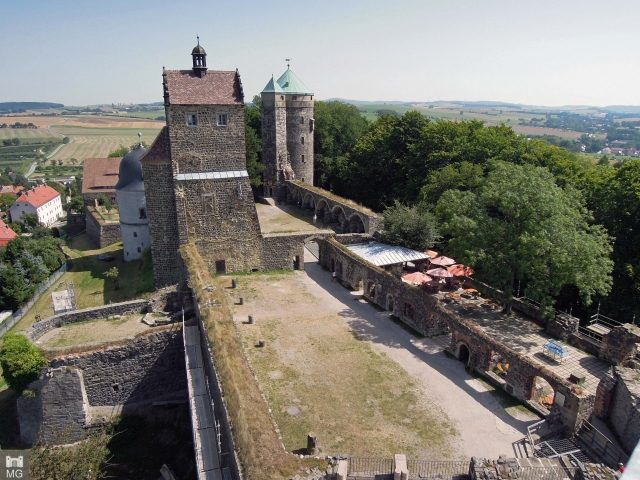
Stolpen Castle corresponds to the type of a sectioned castle. The Stolpen castle complex is divided over a length of approximately 220m into an outer bailey (1st courtyard), the upper outer bailey (2nd courtyard) and the main castle, which in turn is divided into the lower (3rd courtyard) and the upper main castle (4th courtyard).

In the first courtyard is the entrance to the casemates, as well as a 3m deep cistern. The first courtyard is concluded by the granary, built in 1518, where the natural tributes of the serf farmers in the Stolpen district were stored. The granary is 36m long and has three grain storage floors. The granary passage is the only access to the main castle and houses the main guard. Opposite the main guard is the former stable and then the castle's torture chamber.

The upper outer bailey was created by the construction of the granary, which divides the outer bailey into two parts. A stone bridge leads over another cistern into the main castle. The stone bridge was built after the Seven Years' War and replaces a wooden drawbridge that was destroyed in the war. The main areas of the castle are accessed through a portal adorned with the Saxon electoral coat of arms; directly adjacent to this portal is the Schösserturm (Bailiff's Tower), built between 1476 and 1487, which was formerly the seat of the district bailiff. The tower stands out for its large Welsch hood; the hood seen today was reconstructed in 1936, but without rebuilding the second floor, which had been removed in 1787 due to risk of collapse. In the Schösserturm, besides the bailiff's office, there are two dungeons with names reminiscent of the Reformation era: Ketzerloch (Heretic's Hole) and Mönchsloch (Monk's Hole). Between the Schösserturm and the Johannisturm (St. John's Tower) is the Zwinger (outer ward). The battlements of this defensive structure were removed at the end of the 18th century, and further parts were blown up in 1813.

The 3rd courtyard fulfilled core tasks in the defense of the castle complex, which is why it is also called the Cannon Courtyard. On the south side of the courtyard, original 17th-century cannons can still be seen today, standing in front of pentagonal embrasures.

Furthermore, the 3rd courtyard also fulfilled economic functions on the castle complex: here were the bakehouse, forge, stables, slaughterhouse, and a bathhouse. Since the former two-story battlements no longer exist, the Johannisturm and Seigerturm (Clock Tower) dominate this part of the complex as freestanding structures. The Johannisturm, a watch and defense tower, gained fame through Countess Cosel, for whom it, converted into a residential tower, served as a prison in her last years of life. For this reason, the Johannisturm is popularly known as the Coselturm. The upper floors can be reached by a spiral staircase tower, which was added during the Renaissance. The Seigerturm was built around 1455 and raised in height under Elector August in 1560. It received its name from the clock installed in 1562, whose only dial faced the town and had only one hand.

The 4th courtyard could formerly only be reached via a drawbridge; this is no longer to be found today, and the cistern to be bridged has also been filled in. The courtyard was surrounded by representative buildings, mostly residential buildings. By order of Elector August, a large part of the buildings was splendidly furnished. From 1559, a distillery was inserted into the northern castle wall. Furthermore, the upper main castle housed important economic buildings, such as the kitchen and dining rooms, but also the armory and, of course, a castle chapel. Of these buildings, at most only wall remnants remain. The castle chapel, which was splendidly furnished in earlier times, had an access through which the citizens of Stolpen could reach the chapel for worship.

Another component of the upper main castle is the 82m deep basalt well. It was created in the first half of the 17th century and was sunk by miners from Freiberg. At the western end of the castle complex was the high castle. Here were the representative rooms of the Meissen bishops and later those of the Saxon electors. Built at the end of the 15th century and splendidly furnished, the castle was neglected from 1750 onwards, fell into disrepair in the following period, and completely disappeared in 1773 with the demolition of the remaining ruins.

At the same time as the high castle, the Siebenspitzenturm (Seven-Spire Tower) was built. The tower has a square base, but changes its shape upwards to a hexagon. At each corner there was another turret, which, together with the central roof, resulted in seven spires. Although the tower lost this roof structure as early as 1632 during a town fire (only a simple helmet roof was rebuilt), it has retained the name resulting from the spires to this day.

Water Supply+

Cisterns

The castle's location on a basalt mountain inevitably brought problems with water supply. It can be assumed that since the first construction, attempts were made to secure the water supply through cisterns. Over time, a system of cisterns developed that supplied the castle and the town with water. However, since the quality of the water did not meet the desired requirements, alternatives for water supply were already sought during the episcopal period. For example, it was one of the corvée duties of the village of Lauterbach to bring fresh water to the castle by cart.

The Waterworks

After the change of rule at the castle, Elector August ordered an improvement of the water supply. In 1561, the Freiberg mining master Martin Planer was commissioned to build a waterworks.

After one and a half years of construction, the first water was pumped to the castle in 1563. To achieve this masterpiece, 100 meters of elevation had to be overcome. For this, approximately 1,200 tree trunks were processed and a water wheel with a diameter of over 10m was built from Freiberg. After several improvements in the following years, the waterworks could cover the entire water demand of the castle. In 1571, the Elector even allowed surplus water to be given to the citizens of the town.

Due to the high importance of the water supply, the waterworks was a frequent target in military conflicts. Thus, the waterworks was destroyed, among other things, in the Thirty Years' War as well as in the Seven Years' War. It was always rebuilt and technically improved. Only after its destruction in 1813 by Napoleonic troops was the waterworks finally annihilated.

Basalt Well

Due to this vulnerability of the waterworks, Elector Christian II ordered the creation of a deep well in 1608. After 22 years of construction, the specially settled Freiberg miners struck water (corresponding to a daily advance of about 1 cm). They heated the basalt with wood fires and then poured cold water over it to create stress cracks. This required about 2 m³ of wood daily. Two meters of depth cost about 140 guilders. For comparison: the same 2 meters of depth cost only 32 guilders during the construction of the well of Königstein Fortress (at a depth of 152.5 m and a construction period of two and a half years).

The technical problems of water extraction from the well meant that the first water was drawn from the well only 30 years later, and that with an enormous amount of labor (the required rope alone weighed 175 kg). Since the waterworks system could be operated with less labor, water continued to be extracted using the waterworks. After the well was buried twice due to war (1756 and 1813), it was cleared again in 1883 at the suggestion of the Royal Saxon Antiquarian Society.

The well at Stolpen Castle, with a depth of 82 (84.39) m, is considered the deepest well driven into basalt in the world.

The Basalt Mountain+

Stolpen Castle was built on the highest elevation of the Stolpen basalt. Thus, today's natural monument Stolpen basalt formed the basis for the construction of a fortified settlement. The Stolpen basalt, which originated 25 million years ago, is one of the largest volcanic rock occurrences in the Saxon region and is also the first mentioned rock occurrence of its kind in Europe. The first documented mention is known from 1520, the first detailed examination of the rock was carried out in 1546 by Georgius Agricola, who also used the term basalt for the first time in his description. The first known drawings of the Stolpen basalt were made by the Saxon physician and naturalist Johannes Kentmann in 1565. At the end of the 18th century, a fierce dispute finally erupted over the genesis of basalt, which lasted until 1820. Two camps formed, which had fundamentally different opinions on the origin: on the one hand the Neptunists and on the other hand the Plutonists. Several famous scientists visited Stolpen during this time, among them the geologist Abraham Gottlob Werner and Johann Wolfgang von Goethe. The basalt pipe of the Stolpen castle hill was designated in May 2006 by the Academy of Geosciences in Hanover as one of the 77 most important national geotopes in Germany. According to modern petrological classification, however, the Stolpen basalt must today be referred to as olivine-augite-nephelinite. Basalts generally have a low quartz content. In "alkaline basaltic rocks", the mineral nepheline is contained instead of quartz.

Countess Cosel+

In the 18th century, Stolpen Castle served as a prison for Countess Constantia von Cosel, a mistress of August the Strong. After she was brought to Stolpen at Christmas 1716, she spent the rest of her life at the castle. Since she had knowledge of state secrets, the prison conditions were strict at the beginning of her incarceration. Over time, these loosened, and the Countess was able to move freely on the castle grounds. Initially, she lived in the stately rooms of the armory, but as this was no longer suitable as living quarters due to lack of maintenance, she had to move for the last two decades of her imprisonment to the Johannisturm, which had been converted into a residential tower and therefore popularly received the name Coselturm. When the Countess died on March 31, 1765, at the age of 85, she was buried in the Stolpen Castle Chapel.

Take Mobile History with you

You are reading this text for free. Premium adds what matters on the road: descriptions read aloud, sites found through your camera, whole regions taken offline.

  • Every description, including the ~17,700 Premium sites
  • Audio guide: have descriptions read to you on location
  • AR finder: see sites through your camera, with distance and bearing
  • Unlimited saved sites

14 days free, then from €2.99 a month. Cancel anytime.

Source: Wikipedia · Licence: CC BY-SA 4.0 · Image: Mobile Geschichte

This description draws on the facts documented in the linked Wikipedia article; Wikipedia content is licensed under CC BY-SA 4.0. Wording and editing: Mobile History.

Location: 51.0480, 14.0838