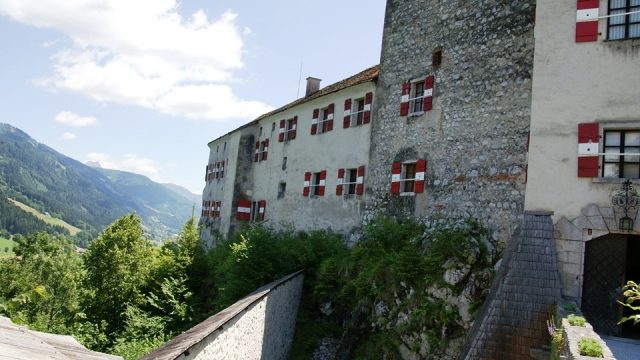
CastleLassing

Strechau Castle

Strechau Castle

The Castle can be visited
Museum


Strechau Castle, also known as Schloss Strechau, is located in the municipality of Lassing in the district of Burgfried and is the second-largest castle in Styria.

Around the second half of the 11th century, the first defensive structure was built on the castle hill of Strechau. It probably consisted only of a tower.

From about 1120, members of a family calling themselves "von Strechau", but also "von Winklern" or "von Ennstal", served as burgraves of Strechau. At the beginning of the 13th century, the brothers Rudolf and Konrad von Trenstein (also "von Kindberg") followed as owners.

At this time, the castle belonged to the Archbishop of Salzburg, and the Trensteins administered it as a fief in his name. At this time, we also hear of two castles on the mountain; an upper and a lower castle.

In 1282, Strechau fell to Duke Albrecht I. It thus became princely property and was administered by the Abbot of Admont. Until the 15th century, the owners of the lordship changed frequently.

Reformation Era and Sale to Admont Abbey+

After further changes of ownership, the von Mosheim family sold the castle in 1528 to Hanns Hofmann von Grünbühel. The Hofmanns lent money to Emperor Ferdinand I for the defense against Hungary and gave their silver tableware for minting new coins. In return, the Emperor pledged, among other things, the toll at Rottenmann to Hofmann and sold him the castle and the lordship of Strechau as "right, pure and unencumbered property".

The Hofmanns appointed preachers from Nuremberg to the parishes of Lassing, Liezen, and Oppenberg, which they administered, to spread the Protestant faith in this area. During this time, the castle was also rebuilt, a Renaissance-style arcaded courtyard was erected, and the famous Mannerist ceiling paintings in the so-called "Protestant Chapel" were painted.

In the course of the Counter-Reformation, the last owner of the castle from the House of Hofmann, Anna Potentiana Jörger, had to sell the castle and leave the country. Admont Abbey, under Abbot Urban Weber "Textor", took over the castle. During the abbey's ownership, the large granary, stables, and administrative buildings were erected. The ceiling paintings and stucco work in the large ballroom, as well as a chapel, were also created in the Baroque style.

From the 19th Century to Today+

The Admont administrator Stary, a friend of Archduke Johann, adapted some rooms for the Archduke's personal and representative purposes after two occupations by French troops. At this time, a very beautiful castle garden was described, which extended to the castle's farmstead. Archduke Johann met his future wife Anna Plochl several times at the castle and wanted to celebrate his wedding there. However, this intention failed due to the refusal of his brother, Emperor Franz I.

After 1848, the administration ended due to the abolition of manorialism, and the castle was left to decay for almost 50 years.

In 1892, it was purchased by the Viennese industrialist Julius Hofmeier (* May 31, 1857, in Prague, † October 30, 1934, in Graz), refurnished, and an estate was established by purchasing adjacent farmsteads with a farmstead at the Nichtlgut.

Due to personal misfortunes, Hofmeier was forced to resell the castle. Adolf Boesch bought the castle and the estate in 1909, which was a good complement to his estate Süßenbrunn near Vienna.

During the inflation period, his son Adolf Egon Boesch lost the property, and the Theresian Academy Foundation in Vienna took over the property. However, the castle remained unused until a major renovation in 1938 for the accommodation of a NAPOLA school and subsequently a children's recreation home. Until 1955, the castle was considered imperial property and was used as a recreation home.

In 1979, the Theresian Academy planned to sell the dilapidated and almost entirely empty castle. Initially, there were plans from an American hotel company, but eventually, the grandson of the former owner, Harald Boesch, bought the castle. Since then, it has been exemplarily renovated and is now owned by the Boesch Private Foundation. Since May 2006, a vintage car exhibition can also be visited.

Take Mobile History with you

You are reading this text for free. Premium adds what matters on the road: descriptions read aloud, sites found through your camera, whole regions taken offline.

  • Every description, including the ~17,700 Premium sites
  • Audio guide: have descriptions read to you on location
  • AR finder: see sites through your camera, with distance and bearing
  • Unlimited saved sites

14 days free, then from €2.99 a month. Cancel anytime.

Source: Wikipedia · Licence: CC BY-SA 4.0 · Image: http://www.wehrbauten.at

This description draws on the facts documented in the linked Wikipedia article; Wikipedia content is licensed under CC BY-SA 4.0. Wording and editing: Mobile History.

Location: 47.5283, 14.3172