To be privately owned
Streichenberg Castle

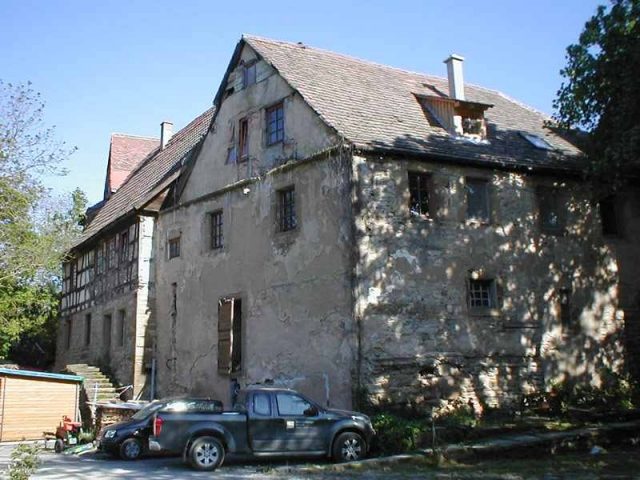
Streichenberg Castle is located near Stebbach, an incorporated district of Gemmingen in the Heilbronn district of Baden-Württemberg. The spur castle, built in the 13th century in the Zimmern district by the Lords of Gemmingen, was probably partially destroyed during the Thirty Years' War. Around 1820, the Counts of Degenfeld built the nearby Schomberg Castle as their new seat of power, after which the castle was used only as a manor farm until the 1960s and was rebuilt several times. Since then, there have been various restoration efforts, which, however, have so far only led to the securing and renovation of a part of the complex, which is partially used for residential and commercial purposes.
The castle stands on the spur of a small hill, at the fork of a former trade route that was used until the 15th century, overlooking Ravensburg and Steinsberg castles as well as the neighboring Schomburg Castle.
In the immediate vicinity of the castle today are the Kraichgau railway line and the Gemmingen quarry. Furthermore, the castle hill is now overgrown with forest trees, so that the once attractively freestanding and clearly visible castle is now largely obscured by the foliage of the trees and leads a shadowy existence near the railway embankment and quarry.
The castle was owned by various Kraichgau noble families and passed through the Palatine Counts to the Counts of Degenfeld.
The Period of Origin
It is very likely that the castle was built between 1282 and 1287 by Swicker (Schweicker) von Gemmingen, who was royal bailiff in Wimpfen under King Rudolf von Habsburg. It was the fourth castle in Gemmingen, in addition to the three ancestral castles of the Lords of Gemmingen that already existed at that time. The castle was built in the district of the village of Zimmern, which, however, has been a deserted settlement since the late Middle Ages. It is assumed that the decline of Zimmern is connected with the construction of Streichenberg Castle. Swicker von Gemmingen left behind two daughters, Elisabeth and Gertrud. Elisabeth married Raban Göler von Ravensburg in 1278 and Gertrud married Albert von Enzberg. Gertrud appears as a widow in 1297, and the sons from her marriage to A. v. Enzberg, Albrecht and Albert, appear as Gemminger. From 1357, an Albrecht von Enzberg the Elder, called von Streichenberg, appears. Documents from 1360 state that Albrecht von Enzberg the Elder and Raven Goler the Younger each opened their part of the "feste Streichenberg" to Palatine Count Ruprecht I. In 1376, the mill below the castle is mentioned for the first time. In 1379, a Ravan Göler zu Streichenberg appears as the castle owner. A Wernher Goler von Streichenberg is mentioned around 1400 as the last "von Streichenberg", although there is no indication that he also resided at the castle.
The Era of the Lords of Mentzingen
The Lords of Mentzingen, a collateral line of the Göler von Ravensburg, received three quarters of Streichenberg as a fief in 1385. The document states: "I, Eberhart von Menczingen, knight, have received as a rightful male fief from Ruprecht the elder Palatine Count by Rhine, the highest seneschal of the Holy Roman Empire, my fortress Strichenberg, my parts thereof, which formerly belonged to old Ravens von Strichberg, Albrecht von Enczberg and Friczen von Urbach and his mother, these are the three parts of the same fortress 1385".
His son, Eberhart the Younger, allied himself in 1387 with his castles Streichenberg and Ravensburg with the city of Wimpfen. In 1391, Streichenberg was pledged by the brothers Eberhart Rafe and Wiprecht von Mentzingen for 3400 guilders to Hans von Gemmingen and his nephew Jörg. Thus, the castle was once again briefly in the possession of the family of its builders. However, already in 1398, a Rafen von Mentzingen the younger was again mentioned as owner.
The Era of the Lords of Angelach and Neipperg
From 1448 to 1560, the Lords of Angelach, such as Wilhelm IV von Angelach-Angelach and Dieter VI von Angelach-Angelach, were the owners of Streichenberg, which they are said to have expanded into a stately fortified castle. They were followed by the Lords of Neipperg. In 1578, they also bought the mill located below the castle and belonging to the fief. However, the brothers Philipp and Engelhart von Neipperg already sold their male fief claim for 39,000 guilders to Elector Friedrich IV in 1596, making Streichenberg Castle the property of the Electoral Palatinate. This administered its property through the Hilsbach cellarage.
The Era of the Counts of Degenfeld
Elector Carl Ludwig enfeoffed his minor son Karl Ludwig zu Pfalz, born from the morganatic marriage with Marie Luise von Degenfeld, with Streichenberg Castle and the village of Stebbach. Carl Ludwig died childless on the battlefield in 1688, just as his brothers died unmarried and childless. His eldest sister Caroline married Count Meinhard, Duke of Schomburg and Leinster, and their youngest daughter married her uncle Count Christoph Martin II von Degenfeld. Since the Duke of Schomburg had no successor, a part of the Schomberg property (including Streichenberg) as well as the name and coat of arms, but without the ducal title, passed to the Degenfeld family through this marriage, who have since called themselves von Degenfeld-Schomberg (also -Schonberg).
The castle presumably suffered destruction during the wars of the 17th century, losing its keep in the process.
Use as a Manor Farm and Decline
From 1818 to 1822, the Counts of Degenfeld-Schomburg built Schomberg Castle on a neighboring hill and moved into it instead of Streichenberg Castle. Since then, the outer bailey has been built over with farm buildings, and in the mid-19th century, the castle was converted into a manor farm. In 1856, a large stable building was erected, and in 1876, the last of the formerly three towers was demolished to make way for further farm buildings. In 1885, a large barn was built within the castle.
Until about 1940, Streichenberg Castle was used as a manor farm and inhabited until 1963. After that, it stood empty for about ten years, until a group of then younger people moved into the castle in the mid-1970s, whose progressive decay they were unable to stop. Also during this time, two dilapidated and roofless residential buildings, which had previously been used as stables, were demolished. In 1993/94, the Counts of Degenfeld-Schomburg had a defensive wall from the 14th/15th century secured and partially rebuilt. Around the year 2000, the castle was for sale for a long time and almost fell back into the hands of its builders, the von Gemmingen family.
Complex+
Some residential buildings of the castle complex have been renovated and are inhabited. A newer farm building has been temporarily prepared for events. However, large parts of the complex, which is only partially publicly accessible, are in great need of renovation or are only preserved as ruins. The ornate Renaissance portal of the former palas is currently (May 2007) being secured with funds from the State Monuments Office.
Take Mobile History with you
You are reading this text for free. Premium adds what matters on the road: descriptions read aloud, sites found through your camera, whole regions taken offline.
- Every description, including the ~17,700 Premium sites
- Audio guide: have descriptions read to you on location
- AR finder: see sites through your camera, with distance and bearing
- Unlimited saved sites
14 days free, then from €2.99 a month. Cancel anytime.
Source: Wikipedia · Licence: CC BY-SA 4.0 · Image: https://commons.wikimedia.org/wiki/File:Streichenberg-wohngeb2.jpg
This description draws on the facts documented in the linked Wikipedia article; Wikipedia content is licensed under CC BY-SA 4.0. Wording and editing: Mobile History.
Location: 49.1574, 8.9585