The remains of the Castle can be visited
CastleŚwiecie (Schwerta)
Świecie Castle
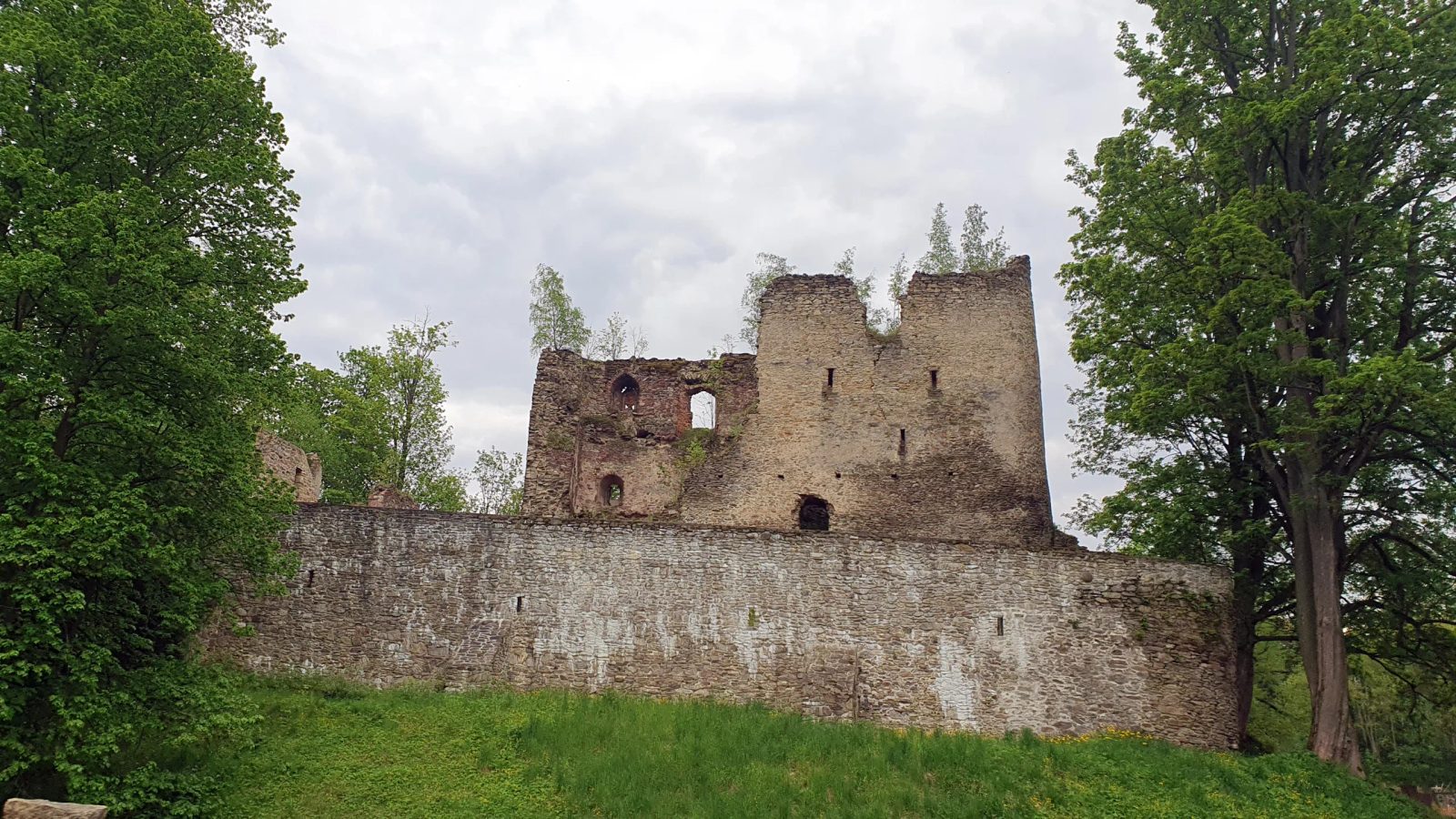
The ruin of Świecie Castle (German: Burg Schwerta, 1937–1945: Schwertburg) in Świecie (Schwerta) has belonged to the urban and rural municipality of Leśna (Marklissa) in Powiat Lubański in Poland since 1945. It is located about five kilometers south of Leśna on a gneiss rock.
History+
The castle "Sweta", which belonged to the Queiskreis in Upper Lusatia, was first mentioned in the treaty of May 3, 1329, in which Duke Henry I of Schweidnitz and Jauer confirmed the return of the Görlitz region to the Bohemian King John of Luxembourg. However, the Queiskreis, which consisted of the districts of the castles "Sweta", "Caychaw" and "Lesna", was to remain in the possession of Henry I. It is not known by whom Schwerta Castle was built. It is possible that it was built before the definition of the Queis border before 1241 and goes back to a complex of the Piast dukes of Silesia, who thus wanted to influence the border demarcation along the Queis. The Schwerta castle district, which consisted of about two fifths of the Queiskreis, initially included the villages and knight's seats of Schwerta, Gebhardsdorf and Meffersdorf. After the death of Duke Henry I in 1346, the Queiskreis fell to the Crown of Bohemia as an escheat. By 1385 at the latest, the castle and lordship of Schwerta came into the possession of the noble family Uechtritz. In 1550, they founded the village of (Alt) Scheibe, which also belonged to the Schwerta castle district. After a fire in 1527, the castle was restored and enlarged by them. After the extinction of the Schwerta branch of the Uechtritz, the lordship of Schwerta disintegrated in 1592 into three parts, which remained in the hands of another family branch of the Uechtritz until 1638:
Schwerta, with about 13 km² Gebhardsdorf with about 15 km² with the exulant settlement Estherwalde Meffersdorf with about 12 km². In 1667, the exulant settlement Wigandsthal was established on Meffersdorf land. In 1635, Schwerta Castle and Lordship, together with the Queiskreis, fell to the Protestant Electorate of Saxony. In 1665, Schwerta was acquired by Daniel von Loeben, who was followed in 1719 by the Saxon Field Marshal Jakob Heinrich von Flemming, who sold it after six years to the Polish-Saxon minister Jan Kazimierz Rayski. In 1729, August the Strong took over Schwerta Castle and Lordship and sold them to Colonel Wolf Adolf von Gersdorff. Schwerta developed into a turnery center; in 1782, 150 craftsmen were engaged in spindle making, and the local spindle dealers sold the weaving articles to Silesia and to surrounding markets in Gebhardsdorf, Meffersdorf, Lauban and other places. After the Congress of Vienna in 1815, Schwerta, together with East Upper Lusatia including Lauban and the Queiskreis, fell to Prussia. The area was incorporated into the Province of Silesia, with which it shared its further history. Schwerta Castle, uninhabited since 1760, burned down in 1820. The ruin was not rebuilt. Ernst Gütschow, the owner of Tzschocha Castle, intended to rebuild the castle, but this did not materialize due to the First World War. As a result of the Second World War, the area was ceded to Poland in 1945 and the urban German population was forcibly displaced.
Take Mobile History with you
You are reading this text for free. Premium adds what matters on the road: descriptions read aloud, sites found through your camera, whole regions taken offline.
- Every description, including the ~17,700 Premium sites
- Audio guide: have descriptions read to you on location
- AR finder: see sites through your camera, with distance and bearing
- Unlimited saved sites
14 days free, then from €2.99 a month. Cancel anytime.
Source: Wikipedia · Licence: CC BY-SA 4.0 · Image: Foto: Jörg Heldt (Community)
This description draws on the facts documented in the linked Wikipedia article; Wikipedia content is licensed under CC BY-SA 4.0. Wording and editing: Mobile History.
Location: 50.9972, 15.2848