Local Authorities
CastleSyke
Syke Castle
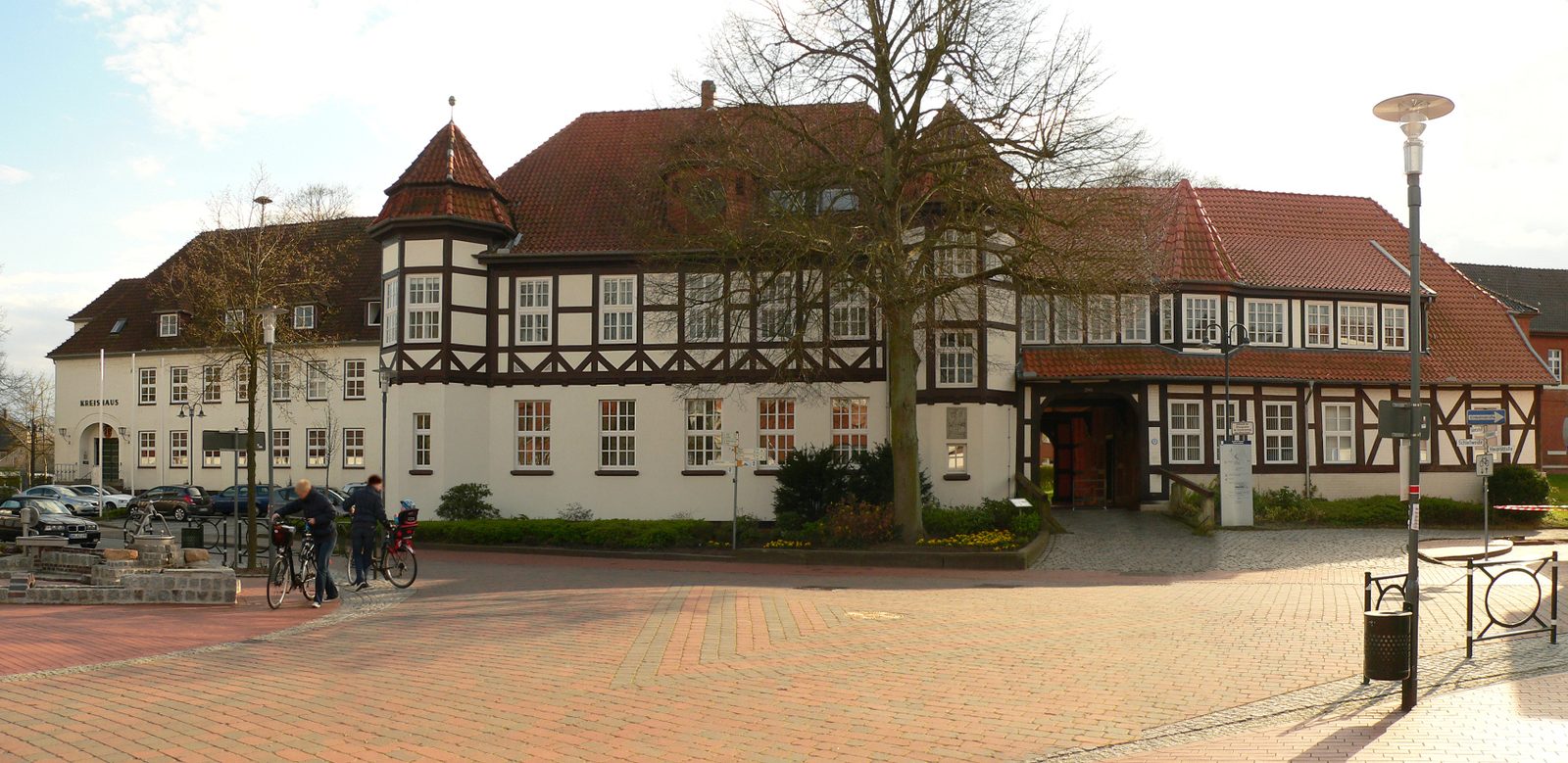
Syke Castle was a castle in Syke in Lower Saxony. It was built around 1270 within an existing ring fort and lost its function as a fortification during the Thirty Years' War due to demolition. Subsequently, a complex of buildings emerged, which became the Amtshof (administrative court) and served as the administrative seat, first for the Amt Syke and later the Kreis Syke. The Kornzinshaus (tithe barn), the gatehouse, the building complex of the Vorwerk (outwork), and the ramparts are listed as historical monuments.
History+
The castle was built by the Counts of Neubruchhausen around 1270, after Syke fell to the Lordship of Neubruchhausen in 1259. Its purpose was to secure their own interests against the Bishops of Bremen. Since then, Syke was the seat of the comital bailiffs and officials. The castle was expanded into an administrative seat. In 1384, the possessions of the Counts of Neubruchhausen passed to the Counts of Hoya. In 1394, the castle, in the possession of the Counts of Hoya, was mentioned for the first time. In 1419, it came into the possession of the Dukes of Braunschweig-Lüneburg and was shortly thereafter reconquered by the Counts of Hoya. In 1423, Count Dietrich of Oldenburg plundered the castle. After that, it was primarily a pawn object and from 1517 the official seat of the Amt Syke. After the extinction of the House of the Counts of Hoya in 1582, the castle came to the Dukes of Braunschweig-Lüneburg. According to a description by the then Amtmann, Syke Castle was surrounded by a double moat in 1589. It consisted of two gatehouses, the Neues Haus (New House) as the main building, an armory, a brewery, and stable buildings. During the Thirty Years' War, the castle was occupied by Danish troops in 1623. They handed over the complex to the imperial troops under Field Marshal Tilly in 1627. In 1633, the fortifications were demolished and the surrounding moat was filled with the rampart material. This was intended to reduce its military value and thus the incentive to capture it. In the early 18th century, the dilapidated and dysfunctional parts of the building were demolished. Only the Kornzinshaus remained.
When, at the beginning of the 18th century, the buildings on the site were no longer sufficient to operate a central farmstead, the Vorwerk Syke, which had existed since 1580, was expanded. The complex on the edge of the Friedeholz received several new buildings.
Description+
The castle area was located within the already existing ring fort. It was enclosed by two moats and accessible via a drawbridge, which was secured by gatehouses. In 1583, there were 18 buildings on the site. Archaeological investigations on the castle area took place in 1968 and 1969 through an excavation with a trench through the ring fort. Further measures followed in 1980 and 2013 through emergency recoveries of finds from the 13th to 16th centuries. Today, a number of authorities and institutions are located on the Amtshof. These include the building constructed in 1845 as a Criminalamt (criminal office), which houses the Syke District Court. In recent times, modern buildings have been erected, which house parts of the Syke Gymnasium and in which an external office of the Diepholz district was located until 2004.
Ring Fort+
The ring fort has a height of up to 2.5 meters and a width of about 9 meters. It was built with heather sods and reinforced internally with a wooden construction. The original diameter was about 125 meters. The construction period could not be determined during an archaeological investigation, but is presumed to be in the Early Middle Ages due to the character of the complex. The northern half of the ring fort was probably already removed in the Late Middle Ages to raise the low-lying terrain with the material. Outside, two moats, fed by water from the Hache, were located in front of the rampart. On the castle area within the ring fort, there was another, inner rampart with a moat.
Neues Haus and Armory+
The Neues Haus was built in 1548 as a representative Renaissance building. It was a brick building with a Kemenate (heated room), hall, armory, and stair tower. The building no longer exists. An armory five meters wide stood on the inner rampart of the castle grounds. The foundations made of boulders, uncovered during an excavation, have been preserved and lie on the lawn behind the modern district house.
Gatehouse+
From 1738 to 1740, the gatehouse was built at the former access to the castle. It contained an official room, guard rooms, and until 1845, prison cells. Since 1885, the gatehouse was the seat of the district administration office of the Kreis Syke and, after its merger with the neighboring Kreis Hoya to form the new Landkreis Grafschaft Hoya, the seat of the district administration. Building extensions to the gatehouse took place in 1915, 1938, and 1960.
Kornzinshaus+
The Kornzinshaus, originally 33 meters long, was built as a tithe barn in 1592 according to an inscription. After 1850, the building was shortened to 24 meters and the half-timbered upper floor was removed. A renovation took place in 1980/82.
Take Mobile History with you
You are reading this text for free. Premium adds what matters on the road: descriptions read aloud, sites found through your camera, whole regions taken offline.
- Every description, including the ~17,700 Premium sites
- Audio guide: have descriptions read to you on location
- AR finder: see sites through your camera, with distance and bearing
- Unlimited saved sites
14 days free, then from €2.99 a month. Cancel anytime.
Source: Wikipedia · Licence: CC BY-SA 4.0 · Image: Axel Hindemith · Wikimedia Commons · CC BY 3.0
This description is a machine translation of an excerpt from the linked Wikipedia article. The source text was written by its authors, the translation is by Mobile History; like the original it is licensed under CC BY-SA 4.0.
Location: 52.9117, 8.8236