Hotel
CastleTangermünde
Tangermünde Castle
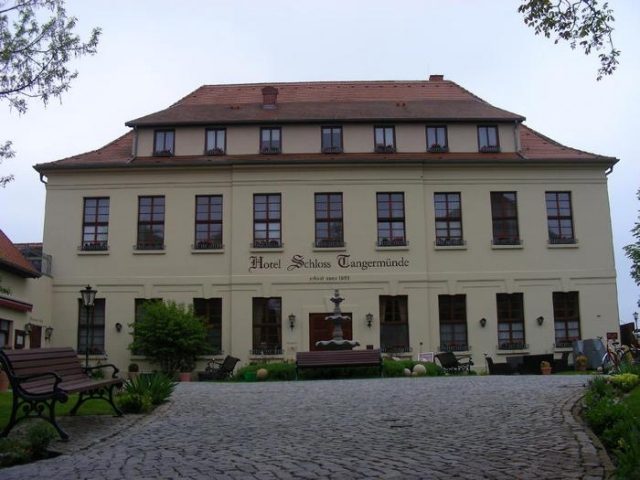
Tangermünde Castle, also known as Tangermünde Palace, is a partially preserved castle in the town of Tangermünde on the Elbe River in the Stendal district of Saxony-Anhalt. It was built as one of the earliest castles in the March of Brandenburg around 925 as a border fortress on the Elbe. Subsequently, it served the Ascanian margraves as a residence or traveling palatinate. Under Emperor Charles IV, it was expanded around 1373 to become the main residence of the March. The first Hohenzollern, Burgrave Frederick of Nuremberg, also resided mostly in Tangermünde after his appointment as Margrave and Elector of Brandenburg in 1415. Afterwards, the castle became the administrative center of the Altmark and Prignitz. In 1640, Swedish troops burned it down during the Thirty Years' War. In 1699, an official residence was built in the only partially preserved complex.
History+
The castle was built around 925 by the Ascanian margraves. It presumably served to monitor the border at the confluence of the Tanger into the Elbe. In 1009, Tanger Castle was first mentioned in a chronicle by Bishop Thietmar of Merseburg. In the 10th and 11th centuries, it was an imperial castle and secured the German imperial border on the Elbe. In the 13th century, the town of Tangermünde was founded. During the time of the March of Brandenburg under the Ascanians, the castle served the margraves as one of the seats of their customary traveling rule, alongside the Altmark castles of Osterburg, Salzwedel, Arneburg, and Werben; east of the Elbe, only Brandenburg an der Havel, which had existed since the 8th century, and Havelberg were stopping points. During their stays at Tangermünde Castle, the margraves began to use the Colbitz-Letzlinger Heide as a hunting ground.
On September 7, 1373, Emperor Charles IV moved into the castle after he had appointed his 12-year-old son Wenceslaus as Elector of Brandenburg. Previously, he had bought the land from the Wittelsbachs; his main concern was the electoral vote of Brandenburg (the Luxembourgers already had the Bohemian one), with the help of which the election of emperors from the House of Luxembourg was to be secured in the future. The emperor had the castle expanded into a palace-like structure the following year. He had chosen Tangermünde, which was easily accessible from his Bohemian homelands and his main residence Prague by ship via the Vltava and Elbe, as the Brandenburg capital instead of the older princely seat of Brandenburg an der Havel, from which the northeastern territories of the House of Luxembourg were to be governed. In 1377, the palace chapel (first mentioned in 1371) was converted into a collegiate church. However, neither Emperor Charles nor his successor Wenceslaus nor his half-brother Sigismund, to whom Wenceslaus ceded Brandenburg in 1378, stayed in Tangermünde Castle for extended periods. After the death of Emperor Charles IV, there was an unsettled development in the March until Sigismund, Roman-German King since 1411, enfeoffed the Hohenzollerns with land and the electoral hat in 1415 against appropriate payment; they were to pacify the March, which was dominated by a rebellious nobility. The Burgrave of Nuremberg, Frederick I, as the new Elector of Brandenburg, also resided mostly in Tangermünde, which, via the Elbe and Saale, already enabled half of the journey to Nuremberg and Cadolzburg by waterway as far as Naumburg.
Source: Wikipedia · Licence: CC BY-SA 4.0 · Image: http://www.wehrbauten.de/thread.php?threadid=894
This description is a machine translation of an excerpt from the linked Wikipedia article. The source text was written by its authors, the translation is by Mobile History; like the original it is licensed under CC BY-SA 4.0.
Location: 52.5428, 11.9775