The Castle can be visited
Trifels Castle

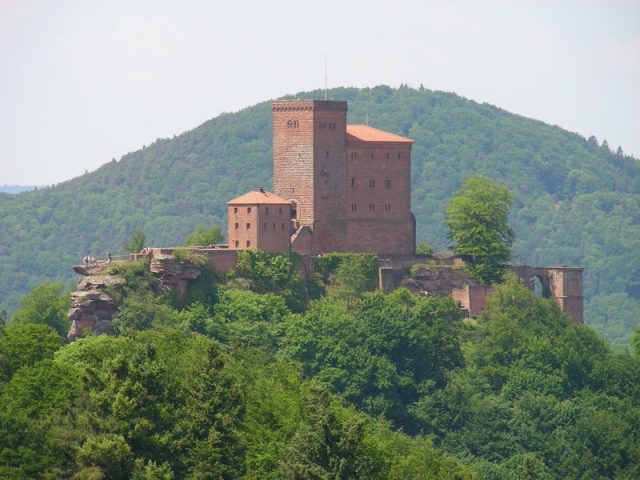
Trifels Castle (German: Reichsburg Trifels) is a restored medieval castle at an elevation of 500 m (1,600 ft) near the small town of Annweiler, in the Palatinate region of southwestern Germany. It is located high above the Queich valley within the Palatinate Forest on one peak of a red sandstone mountain split into three. Trifels Castle is on the peak of the Sonnenberg, and on both of the other two rock elevations there are castle ruins: Anebos Castle and Scharfenberg Castle (demotically called Münz).
Trifels Castle has been gradually restored since the 19th century and today replicas of the Imperial Regalia (Reichskleinodien) of the Holy Roman Empire are on display here. It is—together with Hambach Castle—one of the most popular tourist destinations in the state of Rhineland-Palatinate.
The castle in Rhenish Franconia was first mentioned in a 1081 deed of donation, when it was held by a local noble Diemar, a relative of Archbishop Siegfried I of Mainz. From him Trifels passed to the Imperial Salian dynasty. Emperor Henry V in 1113 made it a Reichsburg (Imperial Castle), rejecting the inheritance claims raised by Archbishop Adalbert of Mainz. The archbishop, allied with Henry's opponent Lothair of Supplinburg, had to spend several years of imprisonment at Trifels.
Upon the death of Emperor Henry V in 1125, his nephew Duke Frederick II of Swabia made the castle a place of safekeeping for the Imperial Regalia of the Hohenstaufen emperors until in 1220 Frederick II of Hohenstaufen moved them to Waldburg Castle in Swabia.
Trifels Castle is also famous as the site where Richard the Lionheart, King of England was imprisoned after he was captured by Duke Leopold V of Austria near Vienna in December 1192 on his return from the Third Crusade. Handed over to Emperor Henry VI of Hohenstaufen, a period of three weeks of captivity at Trifels from 31 March to 19 April 1193 is well documented. According to one legend, Richard was found by the trobador Blondel de Nesle, who reported the king's location to his friends; in fact, Richard's location was not a secret.
After the fall of the Hohenstaufen dynasty, the castle was pledged several times; it finally fell to the Dukes of Palatinate-Simmern and Zweibrücken in 1410 and decayed after the Thirty Years' War. From about 1840, the Wittelsbach kings of Bavaria had the castle rebuilt. It was significantly enlarged during the Nazi era, supervised by the Bavarian prime minister Ludwig Siebert.
The present-day castle is in large parts not true to the medieæval original. It is characterized by a large well tower outside the ring wall, linked to the castle by a bridge. The surrounding rocky landscape is a popular venue for mountaineers.
Take Mobile History with you
You are reading this text for free. Premium adds what matters on the road: descriptions read aloud, sites found through your camera, whole regions taken offline.
- Every description, including the ~17,700 Premium sites
- Audio guide: have descriptions read to you on location
- AR finder: see sites through your camera, with distance and bearing
- Unlimited saved sites
14 days free, then from €2.99 a month. Cancel anytime.
Source: Wikipedia · Licence: CC BY-SA 4.0 · Image: http://www.wehrbauten.de/thread.php?threadid=1456
This description draws on the facts documented in the linked Wikipedia article; Wikipedia content is licensed under CC BY-SA 4.0. Wording and editing: Mobile History.
Location: 49.1965, 7.9785