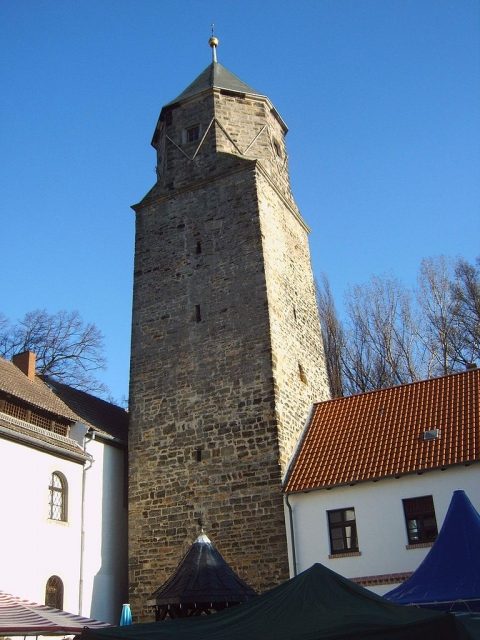
CastleUmmendorf

Ummendorf Castle

Ummendorf Castle

School
Museum

Ummendorf Castle is a castle located in the village of Ummendorf in the Magdeburg Börde in Saxony-Anhalt.

The origins of the castle date back to Archbishop Friedrich I von Wettin of Magdeburg, who had a castle built here in 1178 to secure the border with what is now Lower Saxony. Ministeriales were entrusted with its administration. In 1180, the Lords of Ummendorf are referred to as collegiate vassals. In the middle of the 14th century, the castle belonged to the knights Hildebrand and Volbrecht von Oebisfelde. On April 13, 1389, Archbishop Albert of Magdeburg acquired the castle and large parts of the village. The administration was carried out by appointed captains. In the 15th century, the von Veltheim family received the castle as a fief. Under the rule of Ludolf von Veltheim, the castle became a base for robber knights. After raids on traveling citizens of Magdeburg, the castle was stormed by Magdeburg troops in 1430. The castle remained occupied by Magdeburgers until atonement was made. From this medieval period, the Romanesque keep and the granary on the west side are preserved.

In 1463, the castle, probably as a fief, fell to the von Meyendorff family. Johann von Meyendorff then acquired the castle from the Archbishop of Magdeburg in 1535. The von Meyendorffs carried out extensive renovations between 1535 and 1581. The largely preserved, irregular, three-winged complex built in the Renaissance style was created. Under Andreas von Meyendorff, the castle developed into a local center for the implementation of the Reformation. The castle remained in the family's possession until the extinction of the von Meyendorff line in 1650, other sources state 1667.

During the Thirty Years' War, the castle complex was occupied and devastated in 1623 by the Protestant Christian of Brunswick. In 1625, it was occupied by the Catholic imperial troops under Wallenstein. Colonel Pechmann had the valuable book collection located in the castle transported to Bohemia with nine wagons. In 1644, a Königsmark regiment was stationed in the castle.

After the extinction of the von Meyendorff family, the castle reverted to the Archbishopric of Magdeburg. The complex was continued as an office and manor. During the French occupation and the Kingdom of Westphalia at the beginning of the 19th century, the castle had come as a gift to the French Marshal Soult. After Napoleon's defeat, the complex was then managed as a Prussian state domain until it was purchased by the municipality of Ummendorf in 1912. In 1924, the Börde Museum, which still exists there today, was established in the castle.

Architecture+

Particularly noteworthy is the keep, dating from the castle's foundation, long popularly known as the "Prison Tower". The lower floors of this tower are dated to the second half of the 12th century. The upper part with the octagonal tower room dates from the 16th century. The 20-meter-high tower is publicly accessible.

Current Use+

In addition to the Börde Museum with an agricultural technology exhibition, a primary school is located in the south wing of the castle. An extensive herb garden, comprising more than 500 herbs, has been laid out in the vicinity of the castle.

Take Mobile History with you

You are reading this text for free. Premium adds what matters on the road: descriptions read aloud, sites found through your camera, whole regions taken offline.

  • Every description, including the ~17,700 Premium sites
  • Audio guide: have descriptions read to you on location
  • AR finder: see sites through your camera, with distance and bearing
  • Unlimited saved sites

14 days free, then from €2.99 a month. Cancel anytime.

Source: Wikipedia · Licence: CC BY-SA 4.0 · Image: http://commons.wikimedia.org/wiki/File:Burg_Ummendorf.JPG

This description draws on the facts documented in the linked Wikipedia article; Wikipedia content is licensed under CC BY-SA 4.0. Wording and editing: Mobile History.

Location: 52.1551, 11.1827