CastleKreuzau - Untermaubach

Untermaubach Castle
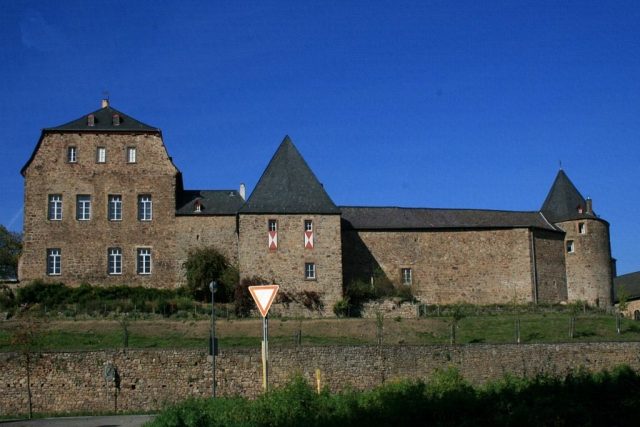
Untermaubach Castle

To be privately owned

Untermaubach Castle is located in Untermaubach, a district of Kreuzau, above the Rur in the Düren district, North Rhine-Westphalia.

Untermaubach Castle is an irregular, polygonal hilltop castle made of quarry stone. It rises above the Rur and can be seen from afar. Count Adalbert von Nörvenich, who lived around the middle of the 12th century, can be considered the founder of Untermaubach Castle.

In addition to the County of Nörvenich, he also held the old County of the "lower forest", to which Untermaubach belonged, as a fief. From 1153, he called himself Count of Molbach (Maubach). After Adalbert's death in 1177, his son-in-law Count Wilhelm II von Jülich inherited his possessions. However, Untermaubach Castle quickly became insignificant, as Wilhelm soon after the inheritance began the construction of Nideggen Castle, where he moved the comital residence in 1191.

Around 1350, Edmund von Engelsdorf, a powerful vassal of the Jülich comital family, who was lord of Engelsdorf Castle near Aldenhoven, owned the castle. Significant parts of the essentially Gothic complex, such as the residential tower, date from this period. This large, square ashlar building with two-and-a-half-meter thick walls now forms the western part of the manor house.

Around 1399, Edmund von Engelsdorf died, and all his possessions, including Untermaubach Castle, fell to his daughter Alveradis, who was married to Werner von Palant. After his death in 1455, Edmund von Palant, who lived until 1534, inherited the castle. Further expansion of the complex dates from the 15th century. The gate tower, the defensive wall, and the round prison tower are witnesses of this time.

Edmund von Palant died childless. His three brothers-in-law von der Leyen, von Heiden, and von Nesselrode inherited the property jointly. In 1617, the von Heiden family, who had in the meantime become the sole owner, ceded the castle to Baron Wilhelm von Efferen. At this time, the buildings were in poor condition, with some roofs completely missing. Wilhelm von Efferen rebuilt Untermaubach Castle. The medieval complex was long militarily obsolete, as it could no longer withstand the gunpowder weapons that had existed in Europe since the 15th century. Therefore, Wilhelm von Efferen did not need to consider such aspects in his construction measures. The walls of the residential tower were broken through, and it was extended eastward to form a manor house. In this way, the Baron increased the available space and thus the living comfort.

Wilhelm von Efferen's nephew, who succeeded him as lord of the castle, could not hold the property and mortgaged it in 1649 to the von Dunckel family, who became owners in 1653. The von Palant family, meanwhile, sought to reacquire it due to their old rights. This was achieved in 1717 by Johanna von Kolff, the widow of Marsil von Palant.

The manor house subsequently received its current Baroque appearance. The mansard roof and the simple rectangular windows date from this construction phase. The farm buildings also date from the 18th century. With Johanna's son Adolph Wilhelm, this line of the von Palant family died out in the male line, and Adolph Wilhelm's brother-in-law Ferdinand von Spies von Büllesheim inherited the castle. His grandson Franz Hugo sold the property, which was partially parcelled out around 1840, into bourgeois hands. The brothers Peter and Christian Hassert owned Untermaubach Castle for a longer period before Count Wilderich von Spee bought it in 1874.

The estate was then in a ruinous state and was restored by the von Spee family, who still own Untermaubach Castle today. During the fighting in the Hürtgenwald in World War II, the complex suffered severe damage from artillery and aircraft shelling. During the removal of the destruction, some of the Baroque additions, for example on the gate tower, were removed and the Gothic original state was restored.

The current lord of the castle, Mariano Graf von Spee, was awarded the Rhenish Monument Prize in 1998.

Take Mobile History with you

You are reading this text for free. Premium adds what matters on the road: descriptions read aloud, sites found through your camera, whole regions taken offline.

  • Every description, including the ~17,700 Premium sites
  • Audio guide: have descriptions read to you on location
  • AR finder: see sites through your camera, with distance and bearing
  • Unlimited saved sites

14 days free, then from €2.99 a month. Cancel anytime.

Source: Wikipedia · Licence: CC BY-SA 4.0 · Image: http://de.wikipedia.org/wiki/Datei:Kreuzau-Untermaubach_Denkmal-Nr._56,_Burgplatz_6_%281035%29.jpg

This description draws on the facts documented in the linked Wikipedia article; Wikipedia content is licensed under CC BY-SA 4.0. Wording and editing: Mobile History.

Location: 50.7261, 6.4544