CastleNeuhaus an der Pegnitz

Veldenstein Castle
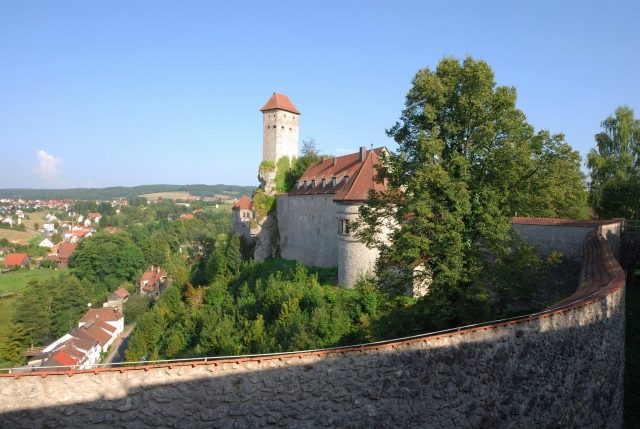
Veldenstein Castle

The Castle can be visited

Veldenstein Castle is a large, well-preserved medieval hilltop castle above Neuhaus an der Pegnitz at the southern end of the Veldensteiner Forst, approximately 50 kilometers northeast of Nuremberg.

The year of construction of Veldenstein Castle and the name of its builder are not confirmed. However, much points to the Bishop of Eichstätt, who, in 1008, on behalf of Conrad II, had border fortifications built on the northern border of his diocese.

In 1269, the castle was first mentioned in a document as novum castrum (the new house). At that time, the castle already belonged to the Diocese of Bamberg and was an official castle, i.e., the administrative seat of the Bamberg bishops for the surrounding lands. In 1323, the castle was first called Veldenstein.

Initially, simple farmers served as bailiffs at the castle, who also owned the farmhouses on the castle hill, known as Burghutungen. At this time, the castle was barely larger than the area of the keep. From the 14th century onwards, nobles first came to Veldenstein as representatives of the bishop. The secular lords of Stör, von Egloffstein, and later von Wiesenthau received the bishop's administrative castle and the office as a fief. Hans von Egloffstein then built the inner castle at the beginning of the 15th century.

After Bishop Georg I von Schaumberg (1449–1475) redeemed the castle from the Egloffsteins, his successor Philipp von Henneberg (1475–1487) undertook enormous expansions for the time, building the outer castle and the battlement zwinger. He made the castle the bishop's residential castle for the first time, and subsequently, every bishop came to Veldenstein at least once to receive the hereditary homage of his subjects.

Although the castle was strongly fortified and withstood many attacks, in the 16th and 17th centuries, ownership changed several times due to cessions and (re-)conquests, so that the castle was temporarily occupied by Brandenburgers, Nurembergers, and finally, in the Thirty Years' War in 1632, by the Swedes, who were followed three years later by the Bavarians.

Finally, the Bamberg bishops resided again at Veldenstein until the castle was largely destroyed in 1708 by a lightning strike in the powder tower. The bishops' interest waned, and the ruin fell into increasing disrepair.

In 1807, the Oberamt Veldenstein was dissolved. Neuhaus fell to Bavaria as a result of secularization after the Peace Treaty of Lunéville with Napoleon Bonaparte, with the administrative area being divided between Prussia and Bavaria, whose border ran through the middle of the present-day market town until 1972.

Since the dilapidated castle was of no interest to Bavaria, it was sold to private individuals and changed hands several times again.

On October 8, 1861, Wolfgang Brunnhuber sold his entire property at Veldenstein Castle for 1300 guilders and 44 guilders loan purchase to the retired district court official Carl Heinrich Friedrich August May, who had served as a district judge there from October 8, 1853, to 1862. Due to or despite disputes with May, Anna Sturm sold him the tower, the former Oberamt residence, the main portal, and all walls on September 15, 1863, for 300 guilders, so that the castle was once again in one hand. In 1863, a suitable residential building was expanded at the castle. The granary was replaced, and in its place, a manor house in the 19th-century style was erected. District Judge May died at the castle on June 8, 1873. His widow Anna Regina May, together with her five children, inherited the castle. A construction section from 1871–1878 under engineer G. C. Hennch carried out renovations, aimed to preserve the castle, and provided Widow May with a construction grant for the restoration of the tower, which was completed in 1875. In 1890, she also had the outer wall renovated. On November 29, 1897, she sold the castle to staff physician Dr. med. Hermann von Epenstein, estate owner in Berlin, for 20,000 marks. Epenstein endeavored to restore the castle to its former appearance and spent one million marks on its restoration until 1914. He commissioned the Nuremberg master stonemason Johann Gröschel with the expansion of the castle; over a construction period of almost ten years, the walls, towers, and gates were repaired.

During this time, the friendly family of Heinrich Göring also lived in the manor house of Veldenstein Castle. Their sons Hermann and Albert, whose godfather was Hermann von Epenstein, attended school in Neuhaus and Velden.

After her husband's death, the widow Elisabeth von Epenstein, née Schdrowicz, sold the castle in 1939 to the then 'second man' of the National Socialist regime, Hermann Göring. He had previously provided her with Julius Fromm's market-leading condom company at a ridiculously low price as part of the "Aryanization" of Jewish businesses. Göring also had the castle renovated and, in 1942, had a bomb-proof bunker with its own electricity, air, and water supply built under the manor house. The self-proclaimed "Reichsjägermeister" regularly came to Veldenstein for hunting and had the Pegnitztalstraße asphalted. However, he rejected the Neuhaus residents' wish for a swimming pool with the words, "If I could put my ass in the Pegnitz, the Neuhaus residents can too."

In 1945, Neuhaus and the castle were conquered by the Americans after a brief skirmish. They took quarters in the castle and searched it for treasures with pneumatic hammers. The 'gold rush' had broken out due to the rumor that Göring had sent the art treasures from his estate to Veldenstein in the last days of the war. However, only a box with 36 old table candlesticks, as well as wine, sparkling wine, and cognac, was found.

When the Americans withdrew, up to 100 refugees found shelter in the castle. The clearly visible trace of a partition wall in the northeast tower, recognizable in the parquet, also dates from this period.

In 1950, the Free State of Bavaria became the owner of the castle and placed it under monument protection.

From 1968, the complex was used by a falconry, before the local Kaiser Bräu became the tenant of the castle in 1972. The former manor house was converted into a hotel-restaurant, and the castle complex was made accessible to the public in 1974; furthermore, there are some private apartments on the premises.

Since 2002, the Veldensteiner Festival has taken place annually at the castle at the end of July, where various bands play in the castle courtyard over the weekend. A medieval market is also held as part of the festival.

On December 31, 2012, the lease agreement between Kaiser Bräu and the Free State of Bavaria expired. The hotel and apartments were vacated, and the castle has been closed and empty ever since. The Free State has since been examining how the castle will be used in the future.

In May 2013, 300 tons of rock material and parts of the castle wall collapsed into the valley, damaging a house. 16 residents were subsequently evacuated.

Take Mobile History with you

You are reading this text for free. Premium adds what matters on the road: descriptions read aloud, sites found through your camera, whole regions taken offline.

  • Every description, including the ~17,700 Premium sites
  • Audio guide: have descriptions read to you on location
  • AR finder: see sites through your camera, with distance and bearing
  • Unlimited saved sites

14 days free, then from €2.99 a month. Cancel anytime.

Source: Wikipedia · Licence: CC BY-SA 4.0 · Image: Peter Schneider

This description draws on the facts documented in the linked Wikipedia article; Wikipedia content is licensed under CC BY-SA 4.0. Wording and editing: Mobile History.

Location: 49.6293, 11.5492