To be privately owned
CastleVichtenstein
Vichtenstein Castle
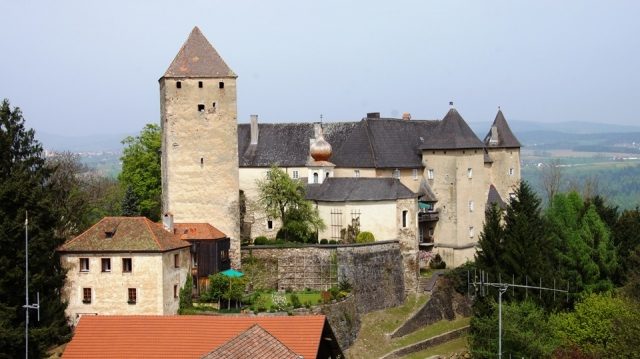
Vichtenstein Castle, a prominent hilltop castle, rises high above the Danube Valley in the Upper Austrian Sauwald.
History+
The origins of Vichtenstein Castle are presumed to be around the year 1100, and it once belonged to the County of Formbach. The first documented mention occurred in 1116, when the Counts of Formbach also called themselves “of Vichtenstein.” Hedwig of Vichtenstein, from the Formbach family, brought the lordship of Vichtenstein as a dowry into her marriage with Engelberg, Count of Hall and Wasserburg. Her grandson Konrad pledged to participate in a crusade in 1218. To cover travel costs, he mortgaged his property to the Diocese of Passau, on the condition that it would fall to the diocese if he did not return or remained childless. After his return, the Diocese of Passau refused to return the castle, leading to a protracted feud. Konrad blocked the Danube and levied tolls, which resulted in his excommunication and temporary imperial ban. A settlement in 1224 granted him the palace, while the keep remained under Passau administration. In 1245, Count Konrad finally renounced the castle and its associated lordship in favor of the Diocese of Passau. The Diocese of Passau administered the castle through stewards or burgraves. In 1367, the Passau city judge Andreas Haller sold the castle to Friedrich von Puchberg, which sparked another feud. Later, the Bishop of Passau mortgaged the castle to the nobles of Schaunberg.
Source: Wikipedia · Licence: CC BY-SA 4.0 · Image: http://www.wehrbauten.at/ooe/oberoesterreich.html
This description draws on the facts documented in the linked Wikipedia article; Wikipedia content is licensed under CC BY-SA 4.0. Wording and editing: Mobile History.
Location: 48.5290, 13.6524