CastleHeimbach - Vlatten

Vlatten Castle
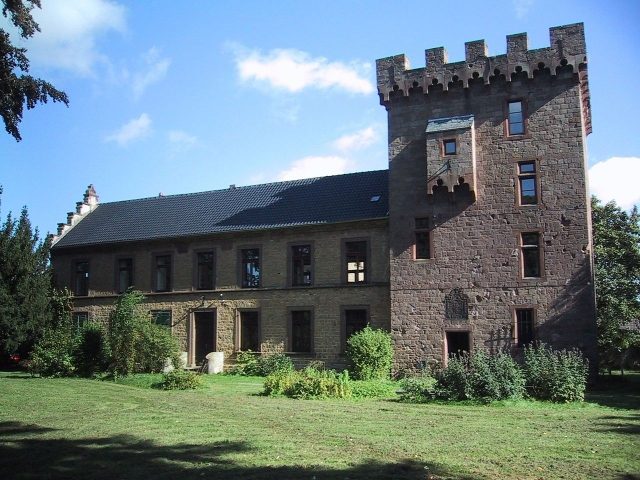
Vlatten Castle

To be privately owned

The moated castle Burg Vlatten is located in Vlatten, a district of Heimbach (Eifel) in the district of Düren, North Rhine-Westphalia.

In the vicinity of today's parish church, there was a Carolingian royal palace, where Louis the Pious demonstrably stayed in 838 and Lothair I in 846. In the Middle Ages, two castles were built in Vlatten, each located a few hundred meters north and south of the royal palace on the Vlattener Bach. The palace itself, which for centuries was the center of forest administration, lost its significance due to the donation of the southern and most valuable part of the forest district by Henry IV to Archbishop Anno of Cologne.

Johann I von Vlatten-Merode acquired the Oberburg, the southern of the two castles, in 1331. After the purchase, the Merode family in this line later called themselves only "von Vlatten" after their new seat.

Johann or one of his heirs built a castle complex in the 14th century, of which remains are still preserved today. It must have been a rectangular main castle fortified with towers, with an irregular outer bailey. The entire complex was surrounded by moats. Today, parts of the surrounding walls, towers of moderate height, a two-story round tower, and the barrel-vaulted basement of a short wing on the west side are preserved as remains of the old main castle.

The Oberburg remained in the sole possession of the von Vlatten-Merode family until the 15th century. After the death of Reiner I von Vlatten in 1448, his widow Ida Schall von Bulich married Sybert von Schwarz-Bongard in the same year in a second marriage. The couple concluded an inheritance contract with Ida Schall's children from her first marriage. The Oberburg was divided between the families von Vlatten and von Schwarz-Bongard.

Through the marriage of Katharina von Vlatten, the only child of Sybert von Vlatten, to Werner von Gymnich, the Vlatten share of the Oberburg fell to this family in the first half of the 16th century. In 1705, Johann Arnold von Bocholz zu Lobberich married Anna Maria Amalia von Gymnich and thus came into possession of a part of the Oberburg. The other half was owned by the von Syberg family at that time.

The Bocholz share came to the von Mirbach-Harff family in 1729 through marriage. The other half fell to the von Bentinck family in 1739. Johann Wilhelm von Mirbach-Harff and Maximilian von Bentinck sold the Oberburg in 1787 to Clemens August von Syberg zu Eicks, who thus reunited the property. In 1808, Peter Brewer from Cologne acquired the estate, which he sold back to Clemens August von Syberg in 1833.

In 1834, Heinrich Floer from Düren and Johann Engelbert Hahn from Merzenich bought the Oberburg. Since 1835, Floer was the sole owner. In 1882, the indebted property was auctioned by Julius Rütgers from Berlin. Rütgers gifted the Oberburg to his daughter Emilie, who was married to Major General Ernst Freiherr von Gagern. Even today, the Oberburg is still owned by the von Gagern family.

The main castle of the Oberburg from the 14th century seems to have already fallen into ruin in the 18th century. Until the 19th century, the medieval complex, although dilapidated, remained without profound changes. Then, in the first half of the 19th century, the castle was transformed into a representative manor house. Parts of the outer bailey buildings were incorporated into the new farm complex. The manor house was located at the southwest corner. Since the Oberburg had long ceased to be inhabited by its owners, the building served as a tenant's residence until the end of the 19th century.

At that time, the von Gagern family, who wanted to re-inhabit the Oberburg themselves, began to redesign the complex. The residence and the farmyard were separated again. The tenant's house was converted into a representative two-winged residence and received a square, historicizing tower on its east side in 1908. In 1913, a dividing wall was built between the farmyard and the residence. A new tenant's residence was created on the farmyard grounds.

Of the second Vlatten castle, the so-called Unterburg, only the remains of a tower wall are preserved. The Unterburg is mentioned in documents in 1401. Its creation is probably due to an inheritance division of the older Oberburg. Balduin von Vlatten divided his Vlatten assets among his children Konrad and Margaretha in the 14th century. Margaretha married Johann Muyl von Sinzenich. In 1605, the Unterburg fell to Adam von Gymnich, who was also the owner of the Oberburg. The Unterburg thus seems to have lost all significance and already fell into ruin during the 17th century.

Take Mobile History with you

You are reading this text for free. Premium adds what matters on the road: descriptions read aloud, sites found through your camera, whole regions taken offline.

  • Every description, including the ~17,700 Premium sites
  • Audio guide: have descriptions read to you on location
  • AR finder: see sites through your camera, with distance and bearing
  • Unlimited saved sites

14 days free, then from €2.99 a month. Cancel anytime.

Source: Wikipedia · Licence: CC BY-SA 4.0 · Image: http://de.wikipedia.org/wiki/Datei:Burg-Vlatten.jpg

This description draws on the facts documented in the linked Wikipedia article; Wikipedia content is licensed under CC BY-SA 4.0. Wording and editing: Mobile History.

Location: 50.6507, 6.5487