To be privately owned
Wartenstein Castle

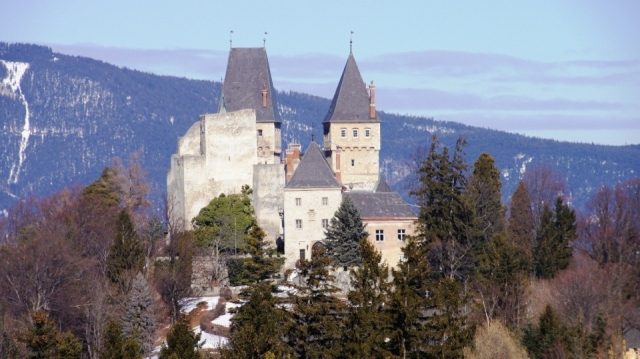
Wartenstein Castle is a well-preserved castle complex in the cadastral community of the same name, Wartenstein, in the municipality of Raach am Hochgebirge near Gloggnitz in the district of Neunkirchen in southern Lower Austria. The hilltop castle is prominently visible above the Schwarzatal valley on an elevated position (765 m) in front of the Großer Otter, between Grasberg and Raachberg, directly on provincial road 134.
The original construction dates back to the 12th century and comprised only the keep, palas, chapel, and a small courtyard. In the middle of the 13th century, a first expansion of the complex took place. The first lords of the castle were Hermannus de Wartenstein, first mentioned in a document around 1190, and the ministerialis Chunradus de Wartenstaine, who is mentioned in a document from 1220. In 1287, Heinrich von Stubenberg acquired the castle. He was followed as owner by Erchengerus de Wartenstein.
In the 14th century, the castle came into the possession of the sovereign and was subsequently pledged several times until the 15th century, for example by Leopold III to the Counts of Cilli. Around 1470, Emperor Frederick III handed over the complex to the Order of St. George. After Hungarian King Matthias Corvinus had taken over the castle without a fight in 1487, it fell back to the Habsburgs after his death in 1490.
In 1529, Wartenstein Castle was destroyed during the First Siege of Vienna by the Turks. The entire dominion of Wartenstein was acquired by purchase in 1609 by Georg Bernhard von Urschenbeck, who had already been leasing the castle complex since 1547. Subsequently, significant renovations took place in the 1640s under the new owner Georg Andreas von Petschowitz (also Petschowitsch).
In 1720, the Counts Stella acquired the complex, followed by the Caracciolo family. Under Princess Franziska von Liechtenstein, it was restored in 1870.
In April 1945, the Russian-German front approached the castle; it was heavily damaged by combat operations. In 1957, the Swedish industrialist Axel Leonard Wenner-Gren bought it from the Liechtensteins and dedicated it to his Wenner-Gren Foundation for Anthropological Research of New York, for which it was once again restored and modernized. Today, Wartenstein Castle is privately owned.
Complex+
The elongated castle courtyard, entered through a round gate in a gate tower, is bordered by an east wing that has a tower at both ends; the northern one is designed as a strong watchtower. Furthermore, a square, Romanesque keep, a Gothic chapel, the palas, and the bastion systems are still well preserved.
Miscellaneous+
According to legend, Wartenstein Castle is said to have been connected by an underground passage, possibly an escape route, to the former Benedictine monastery of Gloggnitz – today Gloggnitz Castle. Underground passages were discovered there, but they have since collapsed.
Take Mobile History with you
You are reading this text for free. Premium adds what matters on the road: descriptions read aloud, sites found through your camera, whole regions taken offline.
- Every description, including the ~17,700 Premium sites
- Audio guide: have descriptions read to you on location
- AR finder: see sites through your camera, with distance and bearing
- Unlimited saved sites
14 days free, then from €2.99 a month. Cancel anytime.
Source: Wikipedia · Licence: CC BY-SA 4.0 · Image: http://www.wehrbauten.at/noe/niederoesterreich.html
This description draws on the facts documented in the linked Wikipedia article; Wikipedia content is licensed under CC BY-SA 4.0. Wording and editing: Mobile History.
Location: 47.6506, 15.9191