CastleWegberg

Wegberg Castle

Wegberg Castle

Restaurant
Hotel

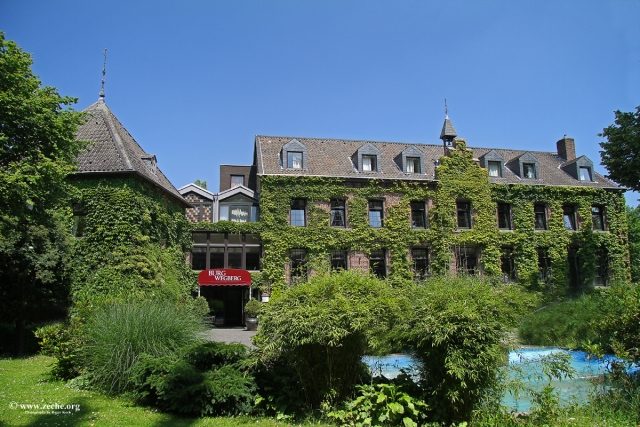
Wegberg Castle, in the center of the North Rhine-Westphalian city of Wegberg, formerly also known as Haus Potz, dates back to a foundation in the 14th century. However, only a few remains of the former moated castle are still present. The manor house dates from the end of the 19th century and is now used as a hotel-restaurant. It has been a protected monument since April 15, 1985.

Wegberg Castle is a water-surrounded complex, whose moat encloses the castle area in a semicircular shape to the south, while it takes on a regular U-shape to the north.

The center of the castle complex is the two-story brick manor house with a high plinth and neo-Gothic decorative elements. In the middle of its gabled roof is a roof turret with a small bell inside. The building is structured into nine axes by windows, whose sills are made of bluestone, with the central axis particularly emphasized by a risalit with a small stepped gable. A double-flight open staircase leads up to the centrally located entrance.

Southwest of the manor house stands a square brick tower with two stories and a pyramidal roof. It guards a basket-arched gate passage and dates from the 16th/17th century.

With the knight Johann von Berck, mentioned in a document in 1343, the last scion of a family died whose ancestral seat was a castle at the confluence of the Fußbach and Beecker Bach streams. The moated complex was therefore called Burg Berck in the Middle Ages. Johann's daughter brought it to the family of her husband, Sibodo von dem Bongar(d)t.

Sophia, daughter of Sibert von dem Bongar(d)t zu Vlatten und Wegberg and his wife Sophia von Wachtendonk, inherited Wegberg Castle upon her father's death in January 1524. Through her marriage in 1547 to Johann von Nesselrode zu Ehreshoven, the complex came into his family's possession. The Counts of Nesselrode-Ehreshoven remained its owners until 1869. In that year, they sold the castle along with 600 acres of land to a Mr. Kaufmann-Asser from Cologne. He parceled out the land and sold the castle complex again. Subsequently, its buildings were almost completely demolished to make way for the construction of a modern residential house and a factory building.

After a fire in 1972, in which the manor house partially burned out, the building was rebuilt and supplemented with modern extensions. It now houses a hotel-restaurant.

Take Mobile History with you

You are reading this text for free. Premium adds what matters on the road: descriptions read aloud, sites found through your camera, whole regions taken offline.

  • Every description, including the ~17,700 Premium sites
  • Audio guide: have descriptions read to you on location
  • AR finder: see sites through your camera, with distance and bearing
  • Unlimited saved sites

14 days free, then from €2.99 a month. Cancel anytime.

Source: Wikipedia · Licence: CC BY-SA 4.0 · Image: http://www.zeche.org/

This description draws on the facts documented in the linked Wikipedia article; Wikipedia content is licensed under CC BY-SA 4.0. Wording and editing: Mobile History.

Location: 51.1425, 6.2748