Museum
Wendelstein Castle
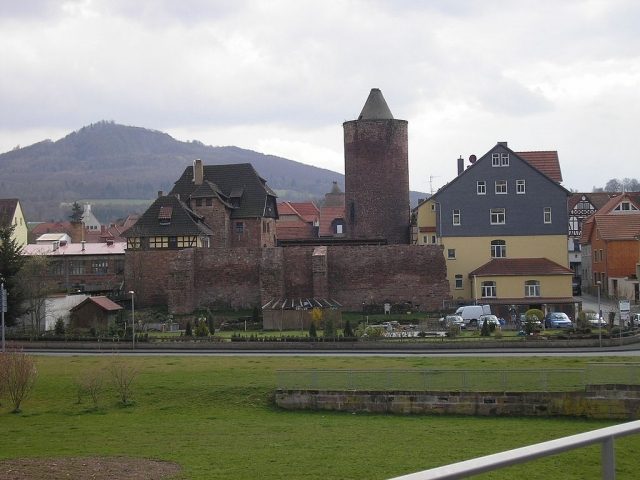
Wendelstein Castle is a medieval castle located in the town of Vacha in the Wartburg district of Thuringia.
As a town castle, the complex is situated on the northern edge of the old town, about 100 meters from the current bank of the Werra River. The castle regulated and protected access to the Werra bridge.
In the Middle Ages, Vacha was an important staging post in the network of Hessian-Thuringian long-distance roads. The river crossing (fords) present here was significantly promoted, probably from 1186 by the construction of wooden bridges and from 1346 by one (or two) stone bridge structures. This simultaneously enabled the emergence of a market and urban settlement and necessitated the construction of a fortification on the town-side bank. Under Abbot Heinrich IV of Fulda, this castle complex was founded and militarily equipped. Its first mention was in 1294. The castle complex was integrated into the town's fortifications and formed the northeastern bulwark. The castlemen were obliged to build residences within the town. The following are mentioned in collections of documents and the town chronicle:
- Heinrich von Bienbach (mentioned in 1321 as a castellan)
- Albert von Gunthausen (mentioned in 1335 as a castellan, when he transferred land in Herfa to the Kreuzburg monastery)
- Ludwig von Leimbach (mentioned in 1342 as a castellan)
- Heinrich von Rasdorf (mentioned in 1347 as a bailiff)
- Friedrich von Völkershausen (mentioned in 1348 as a castellan)
- Berthold and Apel von Buttlar (mentioned in 1360 as castellans)
- Kraft von Rasdorf and Johann von Bienbach (mentioned in 1363 as castle people)
- Wolfram von Ostheim (mentioned in 1388 as the "Stieffts Borgmann"),
- Eberhard and Gottschalk von Buchenau (mentioned in 1390 as pledge officials with the sub-bailiff Hans Schade von Leiboldes)
- Fritz von Herda (mentioned in 1396 as a castellan)
- Johannes von Bibra (mentioned in 1399 as a castellan).
From the permanent pledging of the castle and town of Vacha (two-thirds of the town) to the Hessian Landgrave Hermann II, beginning in 1406. Wendelstein Castle now became a Hessian administrative seat. Gottschalk von Buchenau held the remaining third of the pledge of the town and castle. The transfer was made to the Knights of Buchenau as castellans. Further followed:
- Simon von der Thann (mentioned in 1413 as a bailiff)
- Hans von Baumbach (mentioned in 1415 when he received the castle fief in Vacha and Pferdsdorf)
- Hans von Bibra (mentioned in 1429 as a castellan, later also at Biberstein)
- Ludolf von Weiblingen (mentioned in 1529 as chamberlain and administrator of the cellarage)
- Alexander von der Thann (mentioned in 1549 as an official)
The castle complex fortunately survived the great town fire of 1467. Vacha was captured multiple times during the Thirty Years' War; the castle complex had little military significance at that time. From 1648 to 1816, the town and castle permanently passed to the Landgraviate of Hesse-Kassel, then to the Grand Duchy of Saxe-Weimar-Eisenach. In the 19th century, various buildings in the castle temporarily served as a spinning mill. Further buildings were added, and a renewed simple wall with a courtyard gate was built towards the town.
Complex+
The castle complex has a rectangular footprint and currently measures approximately 60 by 80 meters. The massive outer walls have been preserved in remnants; the moat in front and the inner moat towards the town have been filled in. The town-side walls were demolished or relocated in the 19th century; in the castle's overview plan from 1911, these are referred to as the New Wall. The castle had a town-side access in the south and a separate access in the east. Immediately west of the castle was the lower gate of the town fortifications; the main access to the bridge passed here and could be monitored from the castle.
A round tower in the southwest corner of the castle, about 20 m high and with a wall thickness of 2 m, has been preserved. Access to it was possible through a small gate at a height of about 10 m. The tower has a brick spire as its roof. The main building is the Kemenate (stone house), a largely preserved structure from around 1600. Several utility and ancillary buildings leaned against the inner ring wall; these were gradually renewed or removed. The medieval gatehouses, barriers, and fortifications along the access road to the Werra bridge and into the castle were also considered traffic obstacles and were demolished as early as the 19th century. Some townhouses were built in their place.
Current Situation and Use+
The castle complex is a designated architectural and cultural monument of the town of Vacha. In 1986, on the occasion of the 800th-anniversary celebration, the Vacha Local History Museum was established on the castle grounds, using the rooms of the Kemenate. The round tower is currently without function. The castle grounds are freely accessible.
Miscellaneous+
Meaning of the Name
The derivation of the name Wendelstein is not handed down; a Wendelstein refers to a spiral staircase tower on a castle or church building. A plausible origin would be from the name Wendelin - short Wendel. The name Winterstein is also known for this castle.
Memorial Plaque Hans Sippel
A memorial plaque on the castle wall commemorates Hans Sippel, a citizen of Vacha and leader of the Werrahaufen of rebellious peasants. He was captured in Eisenach in 1525 and executed.
Take Mobile History with you
You are reading this text for free. Premium adds what matters on the road: descriptions read aloud, sites found through your camera, whole regions taken offline.
- Every description, including the ~17,700 Premium sites
- Audio guide: have descriptions read to you on location
- AR finder: see sites through your camera, with distance and bearing
- Unlimited saved sites
14 days free, then from €2.99 a month. Cancel anytime.
Source: Wikipedia · Licence: CC BY-SA 4.0 · Image: http://commons.wikimedia.org/wiki/File:Burg_Vacha.JPG?uselang=de
This description draws on the facts documented in the linked Wikipedia article; Wikipedia content is licensed under CC BY-SA 4.0. Wording and editing: Mobile History.
Location: 50.8291, 10.0232