CastleWienerwald-Sittendorf

Wildegg Castle
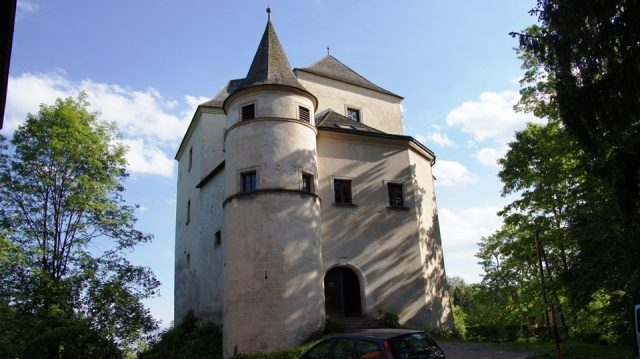
Wildegg Castle

To be privately owned

Wildegg Castle is a castle located near Sittendorf, south of Vienna, which is used as a youth camp. It is owned by the Catholic Children's Movement of the Archdiocese of Vienna.

Wildegg Castle was probably built between 1136, the founding of Heiligenkreuz Abbey, and 1188, when it was first mentioned in a document as Burg Wildekk. The first Wildegger, Heinrich, is believed to have built the castle. However, where the Wildeggers came from is still unknown today. The building belonged to the chain of castles on the edge of the Vienna Woods, which served as protection against the Hungarians who often invaded from the east. Therefore, it was also built as a rock castle. The part with the tower and the chapel was built later. The original moat was later filled in. The castle was only single-story.

However, it was only in the possession of the Wildeggers until 1261. The last of the lineage was Konrad von Wildegg, who was buried in Heiligenkreuz Abbey. Through inheritance to his daughters, the castle fell to the Altenburger family. In 1346, however, the Altenburger-Wildeggers probably lost the castle. The forester Leutold Veusel then appears as the owner. The lord of the castle's property also included Sparbach and parts of Alland. Until 1486, the owners changed frequently, such as the mercenary leader Hans Holuber, until it was sold to the Neideckers. Under the Neideckers, the castle was converted into a Renaissance palace. Wildegg has the first triangular Renaissance courtyard north of the Alps. At the time of the Reformation, the Neideckers converted to Protestantism. This also led to repeated power struggles with Heiligenkreuz Abbey. Thus, the Neideckers were no longer buried in the abbey, but in the nearby church in Sittendorf.

In 1621, the castle was greatly expanded. However, it was severely damaged again by the increasingly invading Turks, especially during the Second Turkish Siege in 1683. The Neideckers could not raise the financial means for the necessary repairs. Therefore, the now palace was sold to the abbey on the advice of Emperor Leopold I. The emperor was interested in the hunting grounds of the palace, but did not have the means himself to acquire it. But the abbey also had to sell other properties nearby to have the necessary money.

Abbot Clemens Schäfferm immediately began with renovations, a new roof, and more. Until 1776, numerous administrators sent by the abbey, which regained strength in the Counter-Reformation, lived there. Under them, the castle reached its current size.

In 1923, the castle was leased by a Catholic hiking club and renovated in the following years. In 1945, it was temporarily occupied by units of the Schutzstaffel. In 1947, the Catholic Children's Movement was founded there.

Take Mobile History with you

You are reading this text for free. Premium adds what matters on the road: descriptions read aloud, sites found through your camera, whole regions taken offline.

  • Every description, including the ~17,700 Premium sites
  • Audio guide: have descriptions read to you on location
  • AR finder: see sites through your camera, with distance and bearing
  • Unlimited saved sites

14 days free, then from €2.99 a month. Cancel anytime.

Source: Wikipedia · Licence: CC BY-SA 4.0 · Image: http://www.wehrbauten.at/noe/niederoesterreich.html

This description draws on the facts documented in the linked Wikipedia article; Wikipedia content is licensed under CC BY-SA 4.0. Wording and editing: Mobile History.

Location: 48.0861, 16.1652