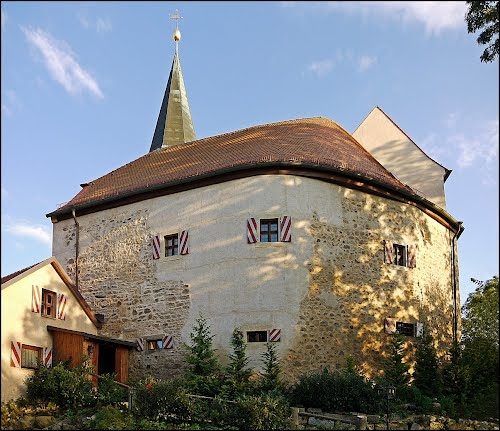
CastleWildenau

Wildenau Castle

Wildenau Castle

To be privately owned

The history of Wildenau dates back to the 10th century. The Wildenauer family was first mentioned in documents in the 12th century with Otto Wildenauer, who resided in his ancestral castle, and Heinrich von Wildenau, who was a Deutschordenskomthur (Teutonic Order Commander) at St. Gilg in Regensburg.

In 1379, 1394, and 1412, the Pleisteiner family is named as the owners of Wildenau. During the Palatine division of the country in 1410, Wildenau fell to Duke Johann's share. He temporarily mortgaged the seat in 1424 to Countess Anna von Truhendingen and enfeoffed Konrad Ermesreuther in 1432.
Around the middle of the 14th century, Plößberg came under the Bohemian crown. Wildenau was also located on the "Golden Road" between Prague and Nuremberg, which under Emperor Charles IV (1316-1378) was a main thoroughfare to and from Bohemia. The Golden Road was of great political, but also economic importance. From Bohemia, hides, wax, spices, copper, tin, iron, herring, tallow, ham, salt, loden, and oxen came along it. To Bohemia, Flemish cloths, seeds, grain, wine, wool, and iron goods were delivered.

On this Golden Road, Johannes Hus also passed through Wildenau on his journey to Konstanz on October 15 or 16, 1414. Later, the Hussites invaded this area, plundered Wildenau around May 28, 1428, and burned down the castle.

The subsequent period is characterized by frequent changes of ownership among noble houses. The relationship between the Hofmark lords and their subjects was not always good, and disputes and quarrels repeatedly arose. Reinhart Ermesreuther finally sold Wildenau in 1503 to Sigmund and Veit von Reitzenstein. Although the ownership of the "Häuslein Wildenau" was disputed by Anarg von Wildenfels zu Schönkirch, the dispute was decided in favor of the Reitzenstein family in 1515.

After 1543, the three towns of Plößberg, Schönkirch, and Wildenau embraced Luther's Reformation, and in 1556, the Evangelical-Lutheran parish of Plößberg was established. In 1627, the Counter-Reformation began. On February 22, 1652, the Cologne Agreement was reached, leading to the introduction of the Simultaneum. This Simultaneum existed in Wildenau until 1911 and meant that both denominations used the same house of worship for over 250 years.

During the Thirty Years' War, troop movements and sieges were not uncommon. The Swedes as well as the imperial troops harassed the people of Wildenau. After the Swedes withdrew, an even worse enemy appeared: "The Plague." At that time, distress, misery, and terror were immensely great in our region. From the end of June to the end of July 1649, the Swedish troops poured over our territory for the second time, coming from Weiden. Wildenau Castle is said to have been shelled by them at that time.

During the Thirty Years' War, the estate came into the possession of Baron Anton de Burry around 1630 through foreclosure, who sold it in 1653 to Christoph Alberecht von Satzenhofen. In 1782, the Satzenhofen family died out. The last feudal lord and master of Wildenau was Elector Maximilian IV Joseph of Bavaria (King Maximilian I of Bavaria since 1806).

In 1808/1809, he sold Wildenau Castle into private hands. The Baierlip family became the owner, who resold the estate in 1852 to the Wild family. In 1860, the latter had the upper floors of about two-thirds of the castle removed so that the new schoolhouse and other houses could be built with them. In the 20th century, ownership passed to the Gollwitzer family, and since 1988, it has been owned by the Ackermann family, who renovated the castle again.

Take Mobile History with you

You are reading this text for free. Premium adds what matters on the road: descriptions read aloud, sites found through your camera, whole regions taken offline.

  • Every description, including the ~17,700 Premium sites
  • Audio guide: have descriptions read to you on location
  • AR finder: see sites through your camera, with distance and bearing
  • Unlimited saved sites

14 days free, then from €2.99 a month. Cancel anytime.

Source: Wikipedia · Licence: CC BY-SA 4.0

This description draws on the facts documented in the linked Wikipedia article; Wikipedia content is licensed under CC BY-SA 4.0. Wording and editing: Mobile History.

Location: 49.7761, 12.2578