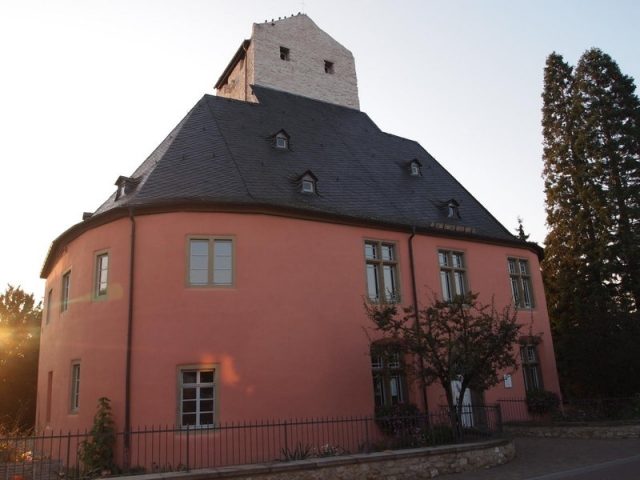
CastleHeidesheim

Windeck Castel

Windeck Castel

The Castle can't be visited

Windeck Castle is located in the center of the municipality of Heidesheim in Rheinhessen, between Mainz and Ingelheim in the district of Mainz-Bingen in Rhineland-Palatinate.

The lowland castle was built around 1209 by the knight Herdegen von Winternheim as a Romanesque refuge castle.

Windeck Castle is a small castle complex from the 13th century in the style of a tower castle with Gothic residential buildings. Windeck Castle appears to have originally been a moated castle with a ring moat (water moat) and at least one ring wall.

The castle is not open for viewing; renovation measures are largely complete.

The Lords of Winternheim and Lords of Winterau+

Windeck Castle is located in the north of the municipality, south of the train station. For centuries it stood on the northern edge of the village - hence its name Wintereck or Windeck. The widespread belief that the castle was built in or around the year 1209 needs to be corrected. Herdegen I von Winternheim likely built the square defensive tower in its center before 1150. The arbitration award from 1209, however, mentions land and buildings that his namesake son Herdegen II took from the brothers of Eberbach in Heidesheim and on which he built the wall and moat of his house. In 1209, therefore, it was about an expansion of the castle district; the castle itself already stood.

A note from the years 1211 to 1234 records a further expansion of the castle area. At that time, Herdegen - probably a son of Herdegen II and thus the third of that name - and his brother (?) Embricho exchanged part of a vineyard with Eberbach Abbey, on which they built the moat of their castle. By then at the latest, the Windeck probably looked roughly as Karl Bronner reconstructed it: in the center, the square tower with an entrance and a wooden battlement at a height of eight meters, surrounded by an inner wall with a moat and an outer wall, past which the Sülzbach or the flood ditch flowed. Between the walls stood residential and farm buildings. The core probably only served as a refuge; this is supported by the limited footprint of the tower and its difficult access.

Whether the Lords of Winternheim came from Groß-Winternheim or Klein-Winternheim must be reserved for future investigations. In 1235 they are first mentioned as Lords of Winterau, thus by the name they subsequently bore. Father Hermann Bär cautiously expressed the assumption, since elevated to certainty, that the property of the Lords of Winterau temporarily fell to the Lords of Leien before the middle of the 13th century through a daughter of the house. In doing so, he refers to a document with which the brothers Philipp, Friedrich, and Heinrich von Leien ceded all rights to the Sandhof Kloster Eberbach for themselves and their heirs, which in turn waived all dues it had collected from them and their father.

Hermann Bär and those who follow him must be countered: Firstly, it is uncertain whether the document in question actually reads milites in Leien and not rather an abbreviation mark above the i to be resolved to milites in Leheim - at least according to a later note on the back of the document. Secondly, it is not specified what rights were involved at all. In any case, the Lords of Winterau had already ceded the Vogt rights they held over nine and a half hides of the Sandhof to the monks of Eberbach in 1209. Above all, however, Herdegen III von Winterau is mentioned as a witness in documents issued in the years 1242 and 1255.

The Lords of Winterau owned and inhabited Windeck Castle from its beginnings before 1150 until the extinction of the family in the second half of the 14th century. In 1326, Altmünster Abbey in Mainz enfeoffed them with its Vogtship in Heidesheim. In a judgment of April 12, 1372, Wilhelm von Scharpenstein is named as Vogt of the court of Heidesheim and as a neighbor of the late Wernher von Wynthirauwe. The lineage of the Lords of Winterau had died out.

The 15th to 20th Century+

To whom Windeck Castle fell after the demise of the Lords of Winterau remains unknown. Perhaps it passed to Altmünster Abbey, which then in 1414 would have passed it on, along with a third of the Heidesheim court, to the Archbishop of Mainz, Johann II von Nassau. In 1481, the archiepiscopal bailiff of Heidesheim, Johann Langwert von Simmern, resided in the castle. His successor, Heinrich von Stockheim, had his own official residence built after 1577 with the castle mill. Whether his successors returned to the castle is uncertain. In any case, the Windeck remained in the possession of the Electoral Court Chamber, which in 1629 granted the castle, manor, and the associated eighth of the Heidesheim tithes as a hereditary lease to Samuel Becker, cellar master of Martinsburg in Mainz.

In the description of the parish of Heidesheim in the Dioecesis Moguntina, written between 1667 and 1677 by Johann Sebastian Severus, it states: "On the edge of the village towards the Rhine, one can also see the castle house of Wintereck, which in 1626 Samuel Beck, chief cellar master in Mainz, acquired for himself and his family with forest, meadows, fields, and grain taxes for 800 guilders, and has today furnished with an attractive building and fruit trees." Towards the end of the Thirty Years' War, the notorious cavalry general Johann von Werth is said to have temporarily resided in Windeck. After 1650, it passed to the Barons von Bockenheim, who subsequently held it in hereditary lease for about 150 years. The family had a claim to pews and burial in the parish church.

When the French occupied Kurmainz on October 21, 1793, Windeck Castle was confiscated as ecclesiastical and noble property. The von Bockenheim family emigrated to Austria. Only Katharina Elisabeth von Bockenheim remained in Heidesheim, where she died in 1844 at the blessed age of 95. The Windeck was auctioned or sold as state property between 1802 or 1803. The new owner was a citizen of Wackernheim named Radicke. His widow passed the property on to the Mainz entrepreneurs Reinach and Popp, who operated a tannery there in the second quarter of the 19th century. In the 1860s, the Krebs family acquired the Windeck. Otto Krebs operated a winery with a restaurant in it. From Christmas 1908 onwards, the Protestant community held its services in the hall on the first floor. In 1984, the castle was still inhabited.

At the time of the Lords of Winterau, the outer ring wall of the castle encompassed a spacious area, of which the field names "Hinter den Ziunen" or "Hinter den Zäunen" (Behind the Fences) and "In der Zingel" or "In der Ringmauer" (In the Ring Wall) still bear witness today. After the 30 Years' War, the citizens of Heidesheim began to use this wall as a quarry and demolish it. Andreas Trauttner's map from 1754 already shows the Windeck in its present form: The originally open space between the tower and the inner ring wall is covered with a gable roof and thus used for a stately residential building that surrounds the tower to the north, east, and southeast. To the southwest and west, the ring wall has been demolished, moving the tower to the western edge of the building. Samuel Beck probably gave it this shape after 1626. The pointed arch portal and the large-format mullioned windows in Neo-Gothic style date from after 1860, as does the interior room layout. The outbuildings shown in the cadastral plans of 1812 and 1841 to 1843 have disappeared.

When the municipality of Heidesheim acquired Windeck Castle in 1993, it was in a ruinous state. Since then, the municipality has made great efforts to restore the building to a presentable condition: First, it renewed the elaborate roof truss and the roof, then the entrance door and windows. It had the building re-plastered, given a coat of paint in the Mainz Red of the late Middle Ages, and the tower whitewashed in natural colors. Finally, it installed a staircase in the tower that safely leads to the former roof plateau with its impressive view. In its efforts for the Windeck, the municipality is tirelessly and enthusiastically supported by the "Heimatmuseum Burg Windeck e.V." association. The maintenance of the still considerable property is handled by volunteer helpers.

Take Mobile History with you

You are reading this text for free. Premium adds what matters on the road: descriptions read aloud, sites found through your camera, whole regions taken offline.

  • Every description, including the ~17,700 Premium sites
  • Audio guide: have descriptions read to you on location
  • AR finder: see sites through your camera, with distance and bearing
  • Unlimited saved sites

14 days free, then from €2.99 a month. Cancel anytime.

Source: Wikipedia · Licence: CC BY-SA 4.0 · Image: http://www.wehrbauten.de/thread.php?threadid=899&sid=246e8c9fdbfa80ccf9a3497b2adfd6ed

This description draws on the facts documented in the linked Wikipedia article; Wikipedia content is licensed under CC BY-SA 4.0. Wording and editing: Mobile History.

Location: 49.9959, 8.1126