Museum
Wolfsegg Castle

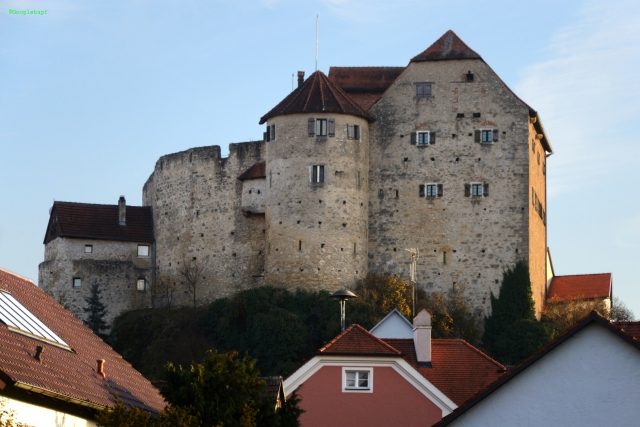
Wolfegg Castle is a hilltop castle on a 420 m above sea level rock cone above the village center of Wolfsegg in the district of Regensburg in the Upper Palatinate, Bavaria. The castle was, probably thanks to its remote location, never destroyed and still has continuous Gothic building fabric.
The castle was probably built around 1278 by Wolf von Schönleiten, its presumed namesake. In the 14th century, around 1419, in the 16th century, around 1721, and in the 19th century, the castle was expanded or rebuilt. It was first mentioned in a document in 1358, when Ludwig, Duke of Bavaria and Margrave of Brandenburg, enfeoffed the daughters of the deceased builder with the castle. In 1367, the castle was sold to the Lords of Laaber, in whose possession it remained until the extinction of the family in 1475. Later, the castle came under the rule of Pfalz-Neuburg, then in 1575 to the Regensburg patrician family Thumer, owners of the house at Heuport. After numerous other changes of ownership, the castle increasingly fell into disrepair. In 1886, it came into the possession of the municipality of Wolfsegg, which used it partly as a school and home for poor families. It was not until 1933, with the purchase of the castle by Georg Rauchenberger, that the decay was stopped and, through great personal commitment from Georg Rauchenberger, restoration began, which was completed in 1989. In 1970, the Kuratorium Burg Wolfsegg e. V. was founded to maintain and preserve the complex.
Description+
The castle consists of a core castle with a three-story, tower-like palas, but without a separate keep. Paintings from 1400 are still preserved on the upper floor of the palas. The brick stair tower dates from the 16th century. The curtain wall with a semicircular wall tower is fully accessible. There is a cistern in the castle courtyard. The core castle is surrounded by an arched zwinger. South of the castle, already outside the walls, is the former castle chapel. The castle site is now an archaeological monument.
Wolfsegg Castle Cave+
Below the entrance to the castle is the approximately 500-meter-long Wolfsegg Castle Cave. In the Cave Register Franconian Alb (HFA), the cave is registered as G 2.
Castle Museum+
The castle now houses a museum with permanent exhibitions on life in a castle, minnesang in the region, and the position of women in the Middle Ages. Weapons and armor from the 14th to 18th centuries are exhibited in the Knight's Hall. The Landsknecht cellar houses a cave museum about the stalactite cave in the castle rock.
Legends+
The legend of the White Lady, who is said to haunt the castle, is also handed down. The legend probably dates back to the 15th century. There are speculations that it concerns the wife of the lord of the castle Ulrich von Laaber, Klara von Helfenstein, whom he had killed after she had engaged in an affair with his adversary Georg Moller von der Hammermühle von Heitzenhofen. In the 1960s, a Regensburg weekly newspaper also picked up on the legend. In 1968, the New York parapsychologist Hans Holzer traveled there with his medium Edith Riedl from Vienna, who believed she could identify the granary as the scene of the murder. Reports of light phenomena are also made. In the inaccessible stalactite cave in the rock under the castle, in addition to waste and other remains, the skull of a five-year-old child was found. Unexplained noises from the cave were repeatedly perceived in the castle, presumably coming from poachers who hid their prey there and cultivated the reputation as a ghost cave for their own benefit.
Take Mobile History with you
You are reading this text for free. Premium adds what matters on the road: descriptions read aloud, sites found through your camera, whole regions taken offline.
- Every description, including the ~17,700 Premium sites
- Audio guide: have descriptions read to you on location
- AR finder: see sites through your camera, with distance and bearing
- Unlimited saved sites
14 days free, then from €2.99 a month. Cancel anytime.
Source: Wikipedia · Licence: CC BY-SA 4.0 · Image: Google Hupf
This description draws on the facts documented in the linked Wikipedia article; Wikipedia content is licensed under CC BY-SA 4.0. Wording and editing: Mobile History.
Location: 49.1068, 11.9764