Museum
CastleZiesar
Ziesar Castle
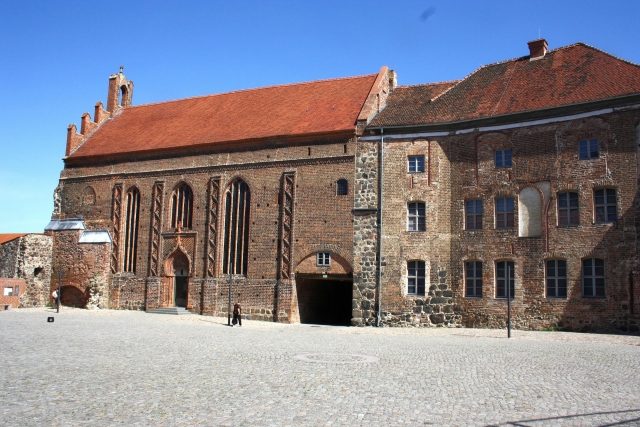
Ziesar Castle is one of the few surviving bishop's residences in Brandenburg. It is located in the town of Ziesar.
It was first mentioned in the foundation charter of the Diocese of Brandenburg (948) as "civitas ezeri". At that time, it was given to the Bishop of Brandenburg as property. After the Slavic uprising of 983, the fortress was lost. Only after 1150 was Margrave Albrecht the Bear able to regain possession of the lost territories, including Ziesar. Ziesar Castle became a secondary residence of the Bishops of Brandenburg. From 1213, Bishop Balduin had the castle rebuilt in brick.
Expansion into a Bishop's Residence
Under Bishop Ludwig Schenk von Reindorf, Ziesar Castle became the residence of the Bishops of Brandenburg and the administrative center for the Diocese of Brandenburg after 1327. However, the most significant renovation of the castle to date was carried out by Bishop Dietrich IV von Stechow (1459–1472). During his reign, the castle chapel was built (consecrated 1470), and the residential buildings were converted into palace-like structures. Around 1535, Bishop Matthias von Jagow had the so-called Bishop's Mitre placed on the keep as a sign of the castle's ecclesiastical use.
After the Reformation, the castle became the widow's seat of the Brandenburg-Electoral family and the seat of an electoral office.
Time of the Reformation
Since 1691 – after the Edict of Tolerance of the Great Elector Friedrich Wilhelm in 1685, the "Edict of Potsdam" – Calvinist refugees from France, the Huguenots, used the castle chapel. To do this, they painted over the medieval paintings with white lime paint. Today, it is believed that this saved the medieval paintings over the centuries. After the Calvinists moved out in 1830 (Church Union of 1817 in Prussia) and attended services in the town church of St. Crucis, the castle chapel temporarily served as a storage room.
The Castle in Private Ownership
In 1819, the castle was sold to private owners. In 1829, the already heavily damaged buildings of the outer bailey were demolished. Only the so-called Stork Tower and a small side gate of the original access to the outer bailey remained. In 1917, Ziesar Castle, together with the surrounding lands, was acquired by Privy War Councillor Paul Schneider from the manor owner Sachsenberg and managed as an agricultural enterprise until its forced expropriation by the Russian military administration in 1945.
Source: Wikipedia · Licence: CC BY-SA 4.0 · Image: Gottfried Hoffmann
This description draws on the facts documented in the linked Wikipedia article; Wikipedia content is licensed under CC BY-SA 4.0. Wording and editing: Mobile History.
Location: 52.2626, 12.2868