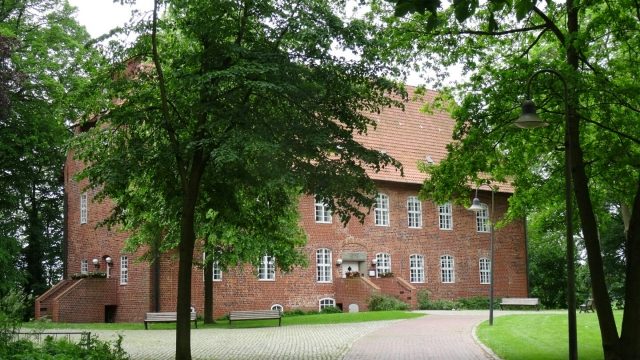
CastleHagen im Bremischen

Hagen Castle

Hagen Castle

Cultural center

The castle in Hagen im Bremischen, also known as Burghagen, is a castle in the municipality of Hagen im Bremischen in the Lower Saxon district of Cuxhaven. It is one of numerous fortifications built by Bremen archbishops in the vicinity of the city of Bremen. Already mentioned in the 12th century, the current two-story brick building was erected in the early 16th century. The oldest paintings date from this period. The building was restored from 1985 to 1988 and now houses a cultural center.

The Episcopal Fortress

Between 900 and 1000, the first church in the vicinity of the castle, the Bramstedt Church, was built. The village of Dorfhagen is first mentioned in a document in 1110.

The castle was probably built under Archbishop Hartwig II (1184–1207) to combat the rebellious Stedinger farmers. It was initially referred to as "Castrum Hagen," and popularly received the name Burghagen. This distinguished it from the neighboring village of Hagen, which was called Dorfhagen.

Its location at the edge of the geest, but already in the river valley of the Drepte, allowed for the complete flooding of the area, making the castle almost impregnable. A roughly 140 m long causeway was built for this purpose, between 5 and 10 m high. At the end of the path, a circular mound (warf) was piled up, with a diameter of about 100 m. Farmers subject to corvée had to haul clay and siltstone from the area around Lehnstedt and from the Wesermarsch, on which the current castle stands, and dig a 5 m wide moat around the warf. The excavated material was used to build a high rampart, which rose 4 m above the surrounding meadow. A stream, the Aue coming from Dorfhagen, supplied the moat with water, which could be crossed by means of a drawbridge. In addition, the Drepte flowed very close through the surrounding meadows, so that, in conjunction with palisades, the castle was well secured like an island in a lake.

In 1212, the rebellious Osterstade farmers besieged the castle, which was probably still a half-timbered building. Whether it was conquered is unclear. After the archbishop had to cede the Witteborg fortification on the Weser, built after 1200, to the city of Bremen on March 28, 1221, the Osterstade farmers were defeated in 1233, and the West-Stedinger farmers in 1234 in the Battle of Altenesch.

The first brick castle was probably built in the first half of the 13th century. It was already 30 m long and 10 m wide. A village settlement, initially called Dammhagen, emerged near the castle. From it, today's Hagen developed. In 1987, during an excavation, piles were found, the oldest of which dated from 1333. In this castle, Gerhard II appointed a Vogt, who was responsible for administration and jurisdiction. He enlarged this Vogt district by acquiring the Börde Bramstedt and its Vogt rights from Count Gerbert II of Stotel for 150 silver marks in 1248. These later formed the core of the Amt Hagen. As chief dike count in Osterstade, the Vogt also exercised market jurisdiction.

Now the house served the archbishops for their hunting stays. The archiepiscopal Vogt lived very close by, in the later forester's house. The old oak tree there, the Staleiche (Staleke), is mentioned in a document from 1248. This document was drawn up to settle the dispute with the Counts of Stotel. In that year, they had to cede the Vogt district of Bramstedt to Archbishop Gerhard II. The document was given (actum) "iuxta castrum Hagen prope quercum vulgariter staleke nuncupatum," meaning 'near the castle by the oak popularly called "Staleke".'

A whole series of Vogts are known, for example from the family of the neighboring "von Wersebe" in the village of Cassebruch. In 1307, when the people of Bremen expelled the nobility of the archdiocese from the city, they also took the castle.

In 1389, Archbishop Albert II (1359–1395) had to pledge the castle to the Count of Oldenburg, for which he received the considerable sum of 500 gold guilders. Already in 1362, Archbishop Albert, a son of Duke Magnus of Braunschweig, had defeated the administrator of the archdiocese, Moritz von Oldenburg. The latter retreated to his seat at Hagen Castle. Similarly, in 1434, Archbishop Nikolaus, Count of Oldenburg, was instructed to live in the castle after his bankruptcy. However, Nikolaus preferred to go to Delmenhorst.

In the 14th century, a first stone tower probably emerged. The rising damp repeatedly caused the castle owners to install new floors and raise the cellar.

The Current Castle

The current castle was built approximately from 1502 to no later than 1507. The client for the new building was Archbishop Johann Rode, who lived in the castle from 1506 to 1511.

A steep tiled roof rises above two approximately 4 m high floors and a cellar. The cellar walls are 1.60 m thick, further up about 1.30 m. The large hall is on the second floor. It faces south and overlooks the adjacent garden. In the eastern gable, there was originally a chapel. Its partially preserved interior decor, visible again for several years, dates from 1535 onwards. To these Gothic paintings around the windows and in wall niches, curtain paintings in white, gray, and black were added around 1570. In addition, there was an external staircase that led into the chapel through one of the current windows.

In front of the entrance is a large horse chestnut tree, which possibly dates from the 16th century, making it one of the oldest representatives of this tree species introduced from Constantinople from 1553 onwards.

During the Schmalkaldic War (1546–1547) and the Münster Feud (1547), the castle was besieged several times.

The 25-year-old Bremen Archbishop Heinrich von Sachsen-Lauenburg was one of the first bishops to profess Protestantism and wanted to be the first bishop to marry. He chose the castle for his marriage to Anna von Broich, the daughter of the second Cologne mayor, on October 25, 1575. The corresponding document was signed by the castle preacher Gade. The curtain painting in the chapel can possibly be understood as part of the wedding preparations, possibly also the no longer existing wooden staircase. The wedding took place in the smallest circle, especially since, as a multiple Catholic bishop, he was not entitled to marry. Heinrich had been Bishop of Osnabrück since 1574, and in 1577 he also succeeded in becoming Archbishop of Paderborn, which was Protestant at that time. Only the intervention of Pope Gregory XIII prevented him from also becoming Bishop of Münster. But in 1585, the controversial holder of several bishoprics, both Catholic and Lutheran, fell from his horse and died in his residence in Beverstedtermühlen. Clerics accused his wife of poisoning him, but she was acquitted.

Around 1600, besides the Vogt, who was now called Amtmann, a house Vogt, wardens, gatekeepers, fishermen, servants, and shepherds lived in the castle. 86 hereditary farmers belonged to the castle. The two attics served as storage for their tributes, which were predominantly paid in kind. Behind the gable oriel on the east side, there is still a winding wheel for the crane. In addition, there was a large tithe barn, which was demolished in 1948. The current outbuilding was created from the remains.

Sweden

In 1644, four years before the end of the Thirty Years' War, 200 Swedes were stationed in the castle. Imperial troops conquered it and captured the Swedes. The fortress had long become unusable due to modernized siege technology. It became the seat of a Swedish Amtmann after Queen Christina of Sweden gifted the castle in 1647 to her favorite Andreas Güldenklau (also Gyldenklou, Anders Mansson Gylle, 1602-65). He was probably never present himself and had the estate managed by a local administrator.

In 1680, the Swedish crown revoked the gift and sold the castle to the Kingdom of Hanover in 1720. An official residence (Amtshaus) was already built in 1698, and official business was now conducted there. The castle was repurposed as a prison, but church services continued to be held in the chapel.

Kingdom of Hanover

In 1720, Hagen became an Electoral Hanoverian Amt and carried the Staleke in its coat of arms until the Prussian era. The place was now called "Amthagen." The castle served as a courthouse and prison, and as accommodation for junior officials. The Amtmann himself did not live there. Only from 1846 did he live in the castle again, after a new official building with a prison had been built between the Staleiche and the castle. This was due to the separation of administration and jurisdiction, which had been decreed in the kingdom. The castle became the official residence of the district judge.

The windows were enlarged, and the paintings were whitewashed. The path to the castle, later lined with oaks, was cleared in the 1830s, and the felled trees were replaced by lime trees. From 1846 to 1978, the castle housed apartments for the employees of the district court of Hagen im Bremischen. From 1820, the Domain Chamber no longer employed its own preacher, and only devotions were held in the chapel.

Prussia

In 1866, the area came under Prussian rule, and in 1886, the chief forester of Axstedt near Lübberstedt took up his official residence in the service building next to the Staleiche. In 1897, a neo-Gothic church was consecrated next to it. The castle and park were inaccessible to the public and were maintained by the judicial administration of the state of Lower Saxony. Walls were erected, ceilings installed, and heating systems built in the castle.

Restoration and Cultural Center

In 1976, the district court was dissolved, and the castle was to be sold. In response, an alliance was formed between the state of Lower Saxony, the district of Cuxhaven, and the Samtgemeinde Hagen, but above all by citizens' associations, such as the Heimatverein Burg zu Hagen im Bremischen e. V. and the regional newspaper Unter der Staleke, which first appeared in spring 1965 and reported on the castle's restoration in several series. From 1985 to 1988, the castle was restored for five million Deutschmarks. On January 1, 1990, the district of Cuxhaven took over the sponsorship of the castle. It houses a cultural center with changing exhibitions.

Take Mobile History with you

You are reading this text for free. Premium adds what matters on the road: descriptions read aloud, sites found through your camera, whole regions taken offline.

  • Every description, including the ~17,700 Premium sites
  • Audio guide: have descriptions read to you on location
  • AR finder: see sites through your camera, with distance and bearing
  • Unlimited saved sites

14 days free, then from €2.99 a month. Cancel anytime.

Source: Wikipedia · Licence: CC BY-SA 4.0 · Image: Jörg Heldt

This description draws on the facts documented in the linked Wikipedia article; Wikipedia content is licensed under CC BY-SA 4.0. Wording and editing: Mobile History.

Location: 53.3525, 8.6391