CastleBreitnau

Falkenstein Castle

Falkenstein Castle

The remains of the Castle can be visited

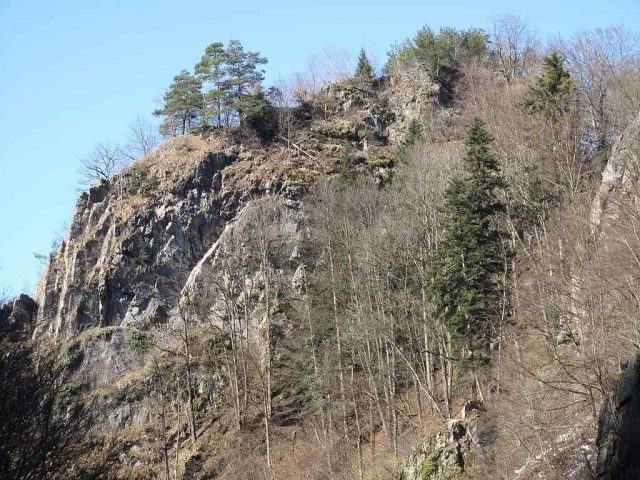
Falkenstein Castle is the ruin of a hilltop castle near Freiburg im Breisgau in the area of the present-day municipality of Breitnau in the district of Breisgau-Hochschwarzwald in Baden-Württemberg, (Germany). The castle site is located in the triangle between the entrance of the Höllental – the "Lower Höllental" – and the Engenbachtal, not far from the Buchenbach district of Falkensteig, 617.6 m above sea level on a rock outcrop that is difficult to access today. Only a few wall remains of the castle can still be found. It is one of the less well-preserved ruins in the Breisgau.

The castle was probably built around the year 1200 by a Zähringen ministerial family on a steep hill at the lower entrance of the Höllental, which was also known as "Falkensteige". The builders probably descended from the Lords of Weiler and Blankenberg from the Wittental and are first attested as the Lords of Falkenstein between 1137 and 1148. In the following period, they rose to the circle of important noble families in the Breisgau. The valley was named Falkensteiner Tal after them and their castle; the name Höllental only came into being later. The castle was intended to protect the important trade route through the valley, which connected the Breisgau with the Baar and Lake Constance. The castle's dominion soon extended up the valley to Hinterzarten and Titisee. Other castles built by the Falkensteins include Falkenbühl Castle, Bickenreute near Kirchzarten, and the ruin of Bubenstein, also known as Neufalkenstein.

After the route, which had brought the Falkensteins considerable customs revenues, faced competition from the route through the Wagensteigtal, built between 1310 and 1379, the knights are said to have increasingly acted as robber barons, according to legend. In the conflict of a noble coalition led by Count Eberhard II of Württemberg against the Swabian League of Cities, Werner von Falkenstein, on behalf of his lord, blocked the roads and plundered their citizens. Affected by the economic decline of the lower nobility in the late 14th century, it was probably financial difficulties that drove the Falkensteins to extend this practice to uninvolved travelers. This behavior is said to have been the reason why the people of Freiburg attacked and destroyed Falkenstein Castle on December 6, 1388. Other historians, however, attribute the destruction to the power ambitions of the people of Freiburg. The castle chapel apparently survived the end of the castle. First mentioned in 1460 as St. Nikolaus Chapel, it was moved to the valley to the Höllenbach, today's Rotbach, in 1606.

Layout+

The irregular and elusive castle area rises in four levels of elevation. For simplification, four subdivisions can be described. A lower castle (A), whose up to 6 m high and 3 m thick wall remains extend fragmentarily from the southwestern castle rock side to the northern flank - with further very massive, deeply staggered wall remains and the presumed former access area with castle gate (5) above the Engenbachtal as well as the current access at the western tip. (1) A subsequent approximately 20 m long, 4 to 6 m wide and up to 12 m deep neck ditch (D), which breaks through the ridge to the northeast. A small middle castle (B) on a rock step about 6 m high all around, which adjoins the upper castle rock to the west and north above the lower castle and extends to the northeast above the neck ditch. An upper castle or core castle (C) on the rising, elongated rock ridge, which has a maximum extent of 55 m in length along the southwest-northeast axis and a width between 12 and 16 m. Among other things, larger wall remains are preserved at the south and southwest tip - including an approximately 10 m long and 3 m high wall of the presumed castle kitchen (10) facing the valley, another 6 m wide and approximately 2.5 m high wall remain (11), which could be the location of the castle chapel; a tooth-like wall remain in the middle section on the southeastern rock edge, clearly visible from the Höllental towards Hirschsprung, as well as the remains of an approximately 9 x 9 m large square wall - the presumed keep at an elevated position at the northeastern end of the castle rock.

Take Mobile History with you

You are reading this text for free. Premium adds what matters on the road: descriptions read aloud, sites found through your camera, whole regions taken offline.

  • Every description, including the ~17,700 Premium sites
  • Audio guide: have descriptions read to you on location
  • AR finder: see sites through your camera, with distance and bearing
  • Unlimited saved sites

14 days free, then from €2.99 a month. Cancel anytime.

Source: Wikipedia · Licence: CC BY-SA 4.0 · Image: http://commons.wikimedia.org/wiki/File:02,_Falkenstein_-_H%C3%B6llental.JPG

This description draws on the facts documented in the linked Wikipedia article; Wikipedia content is licensed under CC BY-SA 4.0. Wording and editing: Mobile History.

Location: 47.9407, 8.0168