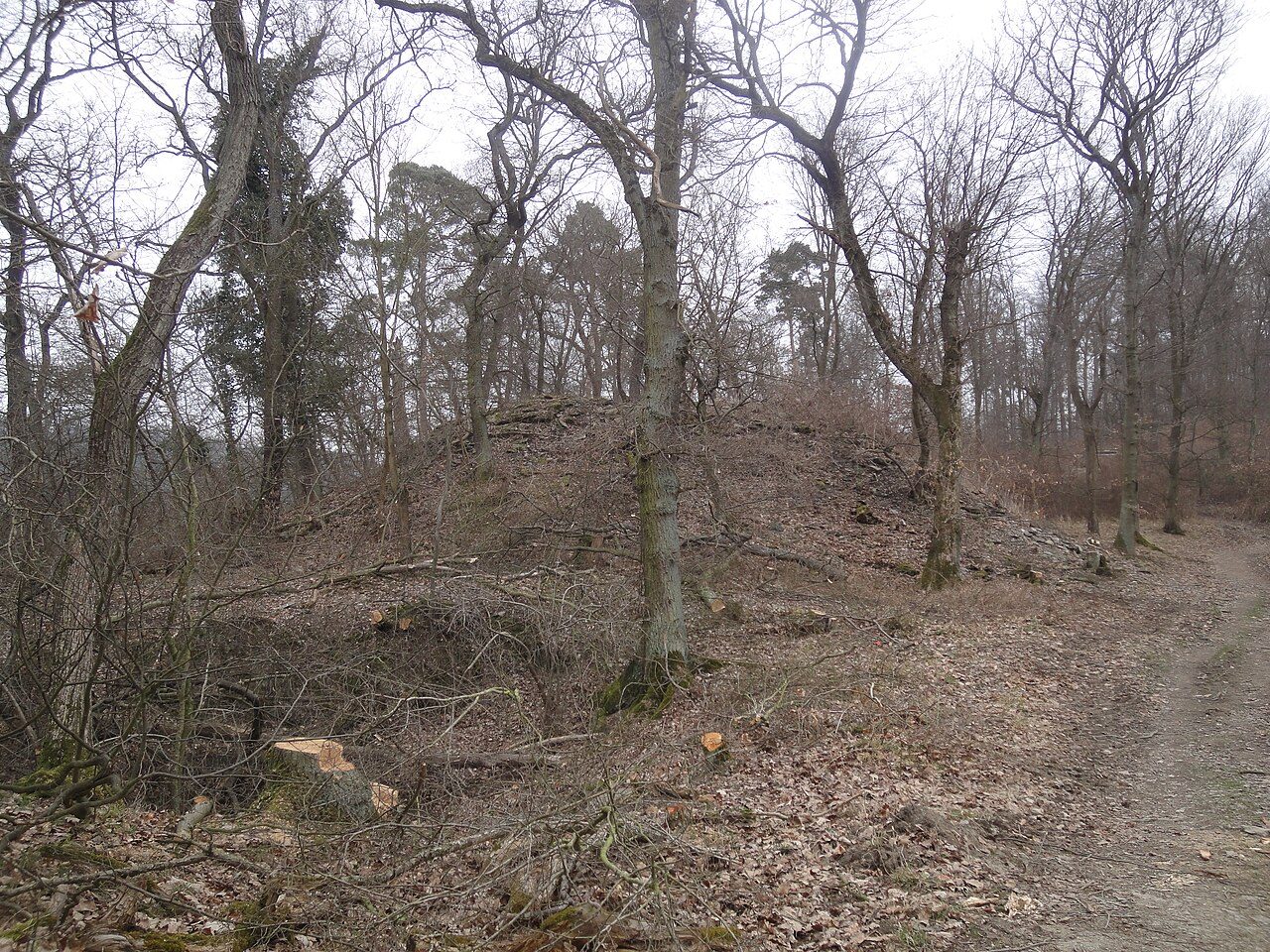
The remains of the castle can be visited
Herzogenstein Castle

Herzogenstein Castle, also known as Rheineck - at the time called R(h)ineck, is a medieval, never-completed spur castle from the 14th century, located five kilometers southwest of Bornich on the right bank of the Rhine - on the Roßstein near the village of Dörscheid in the Rhein-Lahn district in Rhineland-Palatinate.
The field name "Alte Burg" (Old Castle) in the area of the ruins still indicates the presence of the former complex - comparable to Heppenheft Castle. North of it, 2.6 km away, lies the Loreley rock, southwest on the left bank of the Rhine is Oberwesel with the island of Tauber Werth downstream.
Complex+
Today, only a few remnants of the unfinished castle remain. The remains of a tower, a building between eight and ten meters wide, and some walls can be identified.
The ruin is freely accessible. Access is possible via Dörscheid, then via the farm track to the ruin.
The Rheinsteig and Rheinburgenweg hiking trails also pass by the ruin.
The acquisition of the town and castle of Kaub (Gutenfels Castle) with the villages of Weisel, Nieder- and Oberdörscheid (until 1640, today Dörscheid) brought the Palatinate its first possession on the right bank of the Middle Rhine in 1277. To secure this, Count Palatine Ruprecht I planned in 1359 the construction of a spur castle on a group of rocks - the Roßstein - on the Rhine heights northwest of Dörscheid, favorably and effectively located directly on the Urbach valley, the border stream to the County of Katzenelnbogen. The Archbishop of Trier, Boemund II, with the support of the city of Oberwesel, then still called Wesel, intervened against the construction plan, as they felt disadvantaged and cut off from Rhine traffic if the new castle were to become a toll station. Initially, Ruprecht I yielded through the mediation of Count Wilhelm II of Katzenelnbogen (construction halt on January 6, 1360), but continued work on the new castle complex. Armed conflicts and quarrels with Oberwesel dragged on throughout the year until Emperor Charles IV finally intervened and in the autumn of 1360 was able to convince the Count Palatine to abandon his construction project. In the following year, the planned Herzogenstein Castle was missing from the list of Palatine state castles in the right-bank possessions (Kaub, the Pfalzgrafenstein in the Rhine, the Sauerburg), which suggests that the construction of Herzogenstein Castle had been stopped, possibly the construction site was destroyed. The already appointed castellan took over Kaub Castle in 1362 or 1364.
Take Mobile History with you
You are reading this text for free. Premium adds what matters on the road: descriptions read aloud, sites found through your camera, whole regions taken offline.
- Every description, including the ~17,700 Premium sites
- Audio guide: have descriptions read to you on location
- AR finder: see sites through your camera, with distance and bearing
- Unlimited saved sites
14 days free, then from €2.99 a month. Cancel anytime.
Source: Wikipedia · Licence: CC BY-SA 4.0 · Image: Frank Winkelmann / CC BY 3.0 via Wikimedia Commons
This description draws on the facts documented in the linked Wikipedia article; Wikipedia content is licensed under CC BY-SA 4.0. Wording and editing: Mobile History.
Location: 50.1169, 7.7289