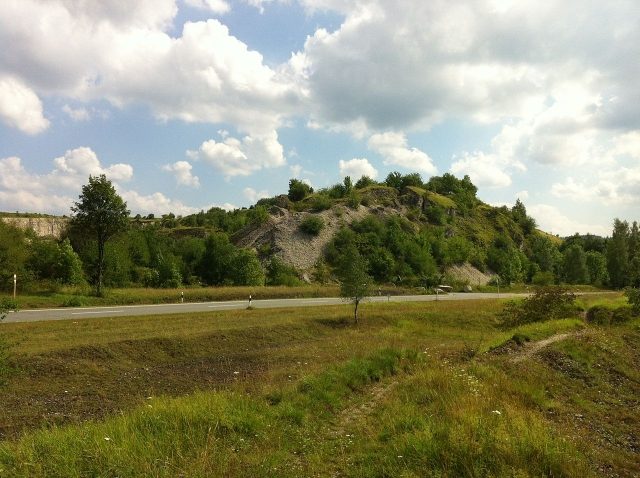
The remains of the castle can be visited
Kansteinburg Castle
The Kansteinburg (also called Hindenburg on the Kanstein) near Langelsheim is a vanished hilltop castle from the Carolingian period (8th to 9th century) on the Kanstein, about 30 m above the Innerste river valley at its exit from the Harz mountains.
The castle was probably built as a staging post and refuge. It was located in the immediate vicinity of the ford of the "Alte Straße" or "Königsweg" (Hellweg between Hildesheim and Werla) through the Innerste, as well as near the confluence with the Rennstieg or Fastweg from the Harz. The two important trade routes met near Langelsheim.
The castle was first mentioned in the 13th century. By this time, however, it had already lost its significance. Large parts of the complex have since disappeared due to limestone quarrying in a quarry on the Kanstein.
Archaeological evidence has confirmed an oblique-angled quadrangular main castle with a ring wall about 1.4 to 1.6 m thick and about 4 m high, measuring 130 m (east-west) by 150 m (north-south). The total length was about 450 m. The wall was built with sandstone ashlar blocks. In front of it was a berm up to 4 m wide and a 5 m wide and about 2.5 m deep moat. To the west, directly in front of the castle wall, was the steep slope down to the Innerste valley.
The castle had two gate systems. The gate in the northeast allowed access from the plateau and the one in the southeast from the Innerste valley. At the southeast gate, the castle wall was curved inwards, forming a gate passage about 6 m long and 4.5 m wide, at the end of which was the actual gate. Inside the castle was a palas about 10 m by 20 m. Its approximately 80 cm thick wall shows no access interruption, which suggests a higher access via a staircase.
In addition, there was probably an outer bailey, but this was only constructed in the north, about 70 m in front of the main castle, as a rampart and ditch system with a length of about 100 m.
Around 1311, a smelter for Harz metals is mentioned at the foot of the castle on the Innerste. Copper ores from the Rammelsberg in Goslar were probably smelted there from as early as 1285 until 1615.
Two strictly stylized bone crucifixes, only about three centimeters in size, presumably from the Carolingian period, were found in the castle and are now in the Goslar City Museum. A model of the castle complex is on display in the local history museum of the city of Langelsheim.
Take Mobile History with you
You are reading this text for free. Premium adds what matters on the road: descriptions read aloud, sites found through your camera, whole regions taken offline.
- Every description, including the ~17,700 Premium sites
- Audio guide: have descriptions read to you on location
- AR finder: see sites through your camera, with distance and bearing
- Unlimited saved sites
14 days free, then from €2.99 a month. Cancel anytime.
Location: 51.9404, 10.3495