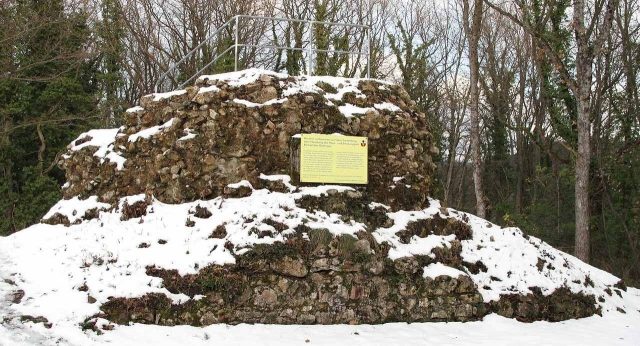
The remains of the castle can be visited
Kastelberg Castle
Burgrest Kastelberg refers to a castle ruin on a 439.5 m above sea level high mountain cone, the Castellberg, belonging to Ballrechten-Dottingen. It is located 1200 meters north of the church of the town of Sulzburg in the Breisgau-Hochschwarzwald district in Baden-Württemberg.
Shard finds on the Castellberg prove "settlements during the Bronze Age, the Urnfield culture and the Hallstatt period" there, and already "in prehistoric times, the entire mountain was fortified with a rampart system". Contrary to other internet texts, a Roman settlement of the mountain could not yet be confirmed (according to information from the Department of Provincial Roman Archaeology at the University of Freiburg, external office Villa urbana in Heitersheim).
Middle Ages
The hilltop castle was built in the 12th century, possibly (due to lack of preserved evidence) by the Lords of Üsenberg, who at least in connection with the castle on the "Schlössleberg" of Sulzburg at that time might have owned a castle on the Kastelberg. The documentary mention of a "Rudofus de Castilhovin" in 1203 also suggests the existence of a castle on the Castellberg, which was then mentioned as a castle site in the Tennenbach property book in 1342. The construction of the castle was preceded by a presumably prehistoric, Bronze and Early Iron Age hilltop settlement, possibly a Celtic refuge castle, evidenced by a section rampart with an outer ditch in the terrain not far from the castle site. The medieval castle site lies on the gentle summit of the Castellberg ridge. Enclosed by a moat about 7 m deep and up to 8 m wide, the rectangular castle plateau, measuring about 36x16 m, rises. In its northern part, a roughly five-meter-high stump of a tower, with a base area of about 10x10 m and 3.6-meter-thick masonry, has been preserved. The interior of the tower still shows the inner casing, made of regular quarry stone blocks up to 0.5 m in size. Records from the 19th century confirm another, residential tower-like building at the southern end of the complex.
In the immediate vicinity of the castle remains is the Castellberg Tower, a steel observation tower on the Castellberg, which was inaugurated on September 2, 1962, by the Schwarzwaldverein, Sulzburg local group, with a good view of the Rhine plain and the Markgräflerland, but not a panoramic view. Castle remains and observation tower are freely accessible.
Castellberg and Fohrenberg+
The Castellberg is one of the Black Forest foothills, as is the similarly vegetated neighboring peak called Fohrenberg, 432.3 m above sea level, located about 1 km as the crow flies north of the Castellberg. A circular path about 2.5 km long leads around the Castellberg. The panoramic circular path around the Fohrenberg, however, measures about 6 km in length. The Castellberg summit is a nature reserve and covers about 10 hectares. It is forested, and the sunny south and west slopes of the Castellberg are vineyards. Viticulture has been documented there for over 1000 years. The vineyard areas have remained largely the same since and through Margrave Karl-Friedrich from 1784 to today. 16.5 ha of the vineyard area on the Castellberg is steep slope, the rest, 148.5 ha, is hillside. The soil is medium-heavy, consisting of sandy, calcareous loam. Grape varieties include Gutedel, Müller-Thurgau, Burgundy varieties, and Gewürztraminer.
Dry stone walls and partly relatively long, steep stone stairs can be found on the southern slopes of the mountain. The working group for nature and environment and the municipality in Ballrechten-Dottingen extensively renovated the dry stone walls and stairs, especially in 2009. Especially in the uncultivated area, rare "shrub and semi-dry grassland communities, such as downy oaks, spurge, bugle, columbine, daphne, wild service trees, and whitebeam" can be found. Also from the orchid family: bird's-nest orchid, military orchid, red and white helleborine, pyramidal orchid, marsh orchids, fly orchid, and common twayblade.
The praying mantis is said to be observable in late summer. There are often occurrences of rare bird species such as warblers, red-backed shrikes, and wrynecks. The Castellberg is well developed with paths and circular routes, in the vineyards with beautiful views of the surroundings.
Court Oak+
A tourist highlight is the Court Oak at the hiking parking lot and forest playground at the Castellberg Hut, near the Castellhöfe, about 500 m northeast of the castle. The oak is over 400 years old and - because it is diseased - has been shortened to about 7 m in height and artistically designed by the Freiburg artist and wood sculptor Thomas Rees, using its natural forms (completion by May 1, 2007). "The trunk has a circumference of 7 m and a diameter of 2 m, the lower 2 m are hollow". Depicted are a hanged man, flanked by his executioner, a cross and a grieving woman, a waiting raven, and a dragon with a bifurcated tail, carrying the black souls away from the execution site, the spirit of the tree as a face on the east side, devil and snake, apple, chalice as biblical symbols, a winemaker reaching for grapes with his hand, as well as stairs, caves, gates, windows, huts, towers, and battlements at the top of the tree, as a reminder of the early settlement of the area by Celts and Romans with their fortifications and castles.
Take Mobile History with you
You are reading this text for free. Premium adds what matters on the road: descriptions read aloud, sites found through your camera, whole regions taken offline.
- Every description, including the ~17,700 Premium sites
- Audio guide: have descriptions read to you on location
- AR finder: see sites through your camera, with distance and bearing
- Unlimited saved sites
14 days free, then from €2.99 a month. Cancel anytime.
Source: Wikipedia · Licence: CC BY-SA 4.0 · Image: http://commons.wikimedia.org/wiki/File:Burgrest_Kastelberg_02.JPG
This description draws on the facts documented in the linked Wikipedia article; Wikipedia content is licensed under CC BY-SA 4.0. Wording and editing: Mobile History.
Location: 47.8510, 7.7049