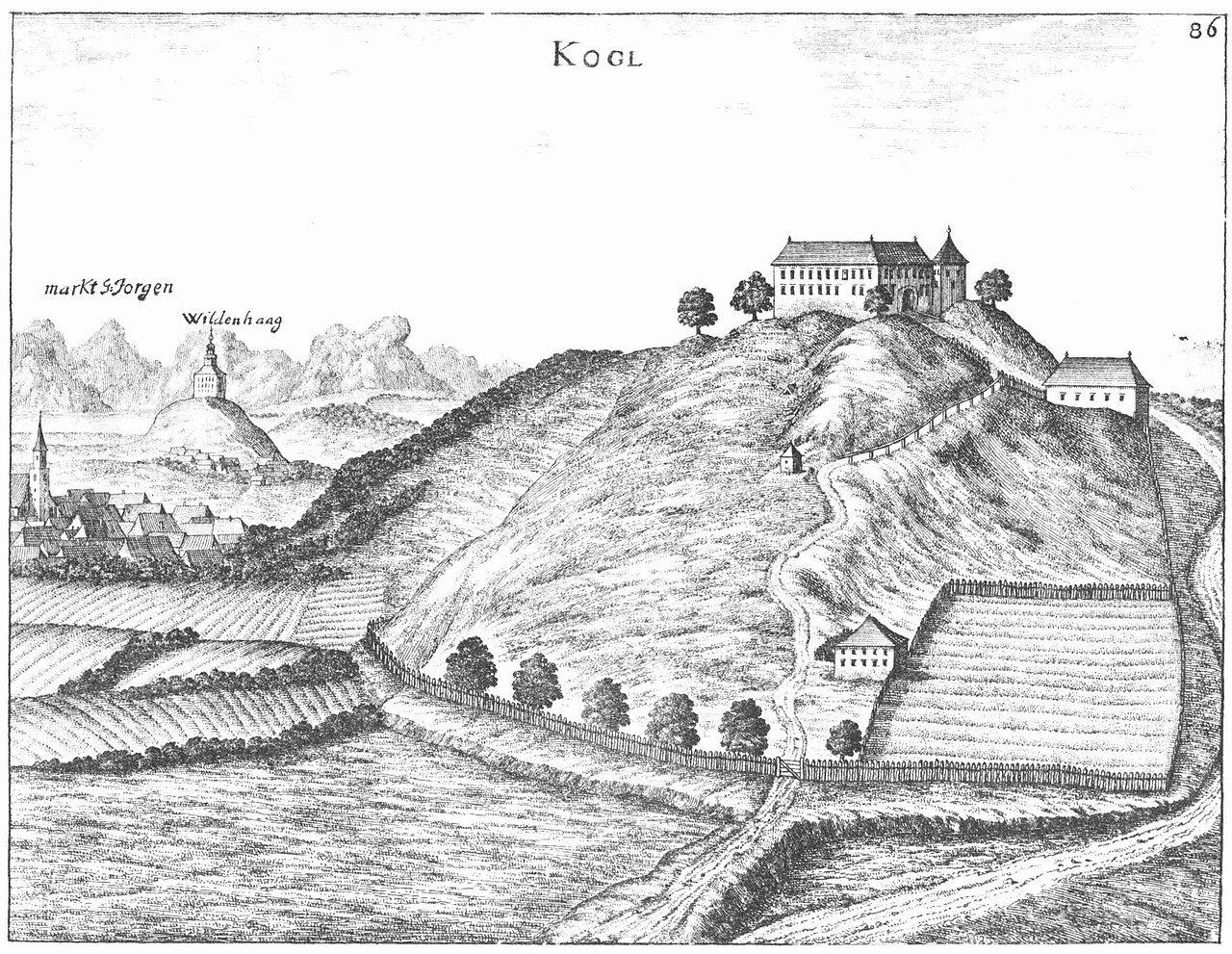
The remains of the castle can be visited
Kogl Castle

Kogl Castle is the ruined remains of a hilltop castle on the 680 m high Koglberg in the Kogl district of the municipality of St. Georgen im Attergau in the Vöcklabruck district of Upper Austria.
The palatinate "Atarhoven" (Atarnchova, Atterhof, Attersee) is mentioned as early as the 8th century as an Agilolfing possession and from 788 as a Frankish royal estate in the Attergau. The Diocese of Bamberg came into possession of the royal palatinate "Atarhoven" in 1007 due to a donation from Emperor Henry II. This was to support the construction of Bamberg Cathedral. Kogl Castle was built in 1264 at the instigation of Bishop Berthold of Bamberg in place of Attersee Castle, which was built in 1007. Initially, the castle was still called Neuattersee, but then the name Kogl became established.
The castle had frequently changing owners and was often given as collateral. Owners from 1249–1309 were Chunrad der Zizmann, Heinrich der Zizmann, and Haidfoch. The Bishop of Bamberg pledged the castle to the Schaunberger from 1309–1342; it then passed to Chunrad Kuchler and Hertel's son. In 1379, Kogl came to Duke Albrecht III of Austria as a Bamberg fief. The Habsburgs later "overlooked" that they themselves only held the castle as a fief and in turn granted Kogl as a princely fief or pledged the property. The first pledge lord was Count Herrmann von Cilli. He was followed by Heinrich von Wallsee (1411), and Hans Eitzinger was the pledge holder until 1416. In 1453, King Ladislaus ordered the administrator Michael Albrechtsheimer to hand over Kogl to Gilg Vischmeister. Reinprecht von Wallsee then took over Kogl from Ortolph Geymann. After the extinction of the Wallsee family (1483), Emperor Frederick III seized Kogl as an escheated fief. His successor, Emperor Maximilian I, pledged the lordship of Kogl to his governor Wolfgang von Polheim (1499). Since the Pollheimers were Protestants, the property was given by King Ferdinand I to Hans Hofmann. In 1550, King Ferdinand allowed his chamberlain Johann Hofmann von Grünpichl to redeem Kogl from the pledge of Cyriak von Pohlheim. Emperor Rudolf II finally settled the pledge debt in 1570. Kogl became a separate regional court in 1581. Finally, Emperor Rudolf II decided in 1581 to sell Kogl, as well as Kammer Castle and Frankenburg Castle, to his ambassador in Madrid, Hans Freiherr von Khevenhüller. His successor was his Protestant brother Batholomäus, who was followed by his Catholic son Franz Christoph. In 1594, Kogl Castle was considered one of the defensible refuge castles in times of war. In 1619, Kogl was leased to Abraham Grünpacher. In 1620, Kogl was captured by the Protestant Hans Geymann (Geumann); he also drove out the pastor of Lochen, plundered the rectory, and had the loot brought to Kogl. During the religious disputes, the Protestant Karl von Jörger occupied the castle. Geymann was appointed administrator, but had to flee from the advancing Bavarian troops.
The Khevenhüllers decided in the beginning of the second half of the 18th century to abandon the outdated and difficult-to-access building. In 1750, they built the new Kogl Castle at the foot of the Koglberg. Since the castle was no longer permanently inhabited afterwards, it fell into disrepair.
Kogl Castle Ruin Today+
Only a few sections of the castle walls remain. The castle site is still surrounded by a moat, but it is so overgrown that it is barely recognizable. The ruin is not a protected monument.
Take Mobile History with you
You are reading this text for free. Premium adds what matters on the road: descriptions read aloud, sites found through your camera, whole regions taken offline.
- Every description, including the ~17,700 Premium sites
- Audio guide: have descriptions read to you on location
- AR finder: see sites through your camera, with distance and bearing
- Unlimited saved sites
14 days free, then from €2.99 a month. Cancel anytime.
Source: Wikipedia · Licence: CC BY-SA 4.0 · Image: Georg Matthäus Vischer / Public domain via Wikimedia Commons
This description draws on the facts documented in the linked Wikipedia article; Wikipedia content is licensed under CC BY-SA 4.0. Wording and editing: Mobile History.
Location: 47.9380, 13.4628