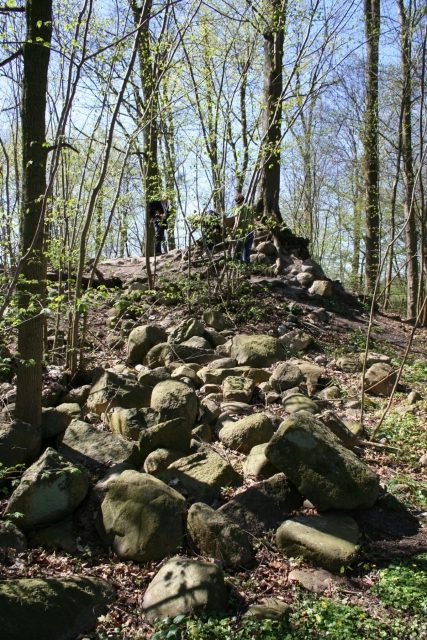
The remains of the castle can be visited
Linau Castle

Linau Castle is a lost castle complex, the remains of which are located in the area of the present-day municipality of Linau in the district of Herzogtum Lauenburg in Schleswig-Holstein.
The still existing foundation walls of the keep suggest that they were over two meters thick, consisting of unhewn boulders, connected with Segeberg lime. The superstructure presumably consisted of bricks, the remains of which can be found below the earth's surface. The castle site would have been about 500 × 100 meters, not including the farm buildings, which must have been located somewhat further away. The actual castle lay on an elevation of about 3 ½ meters. The moat, a part of which can still be seen today, was connected to the Bille, which originates nearby.
It is - besides the former sovereign castle Glambek on Fehmarn - probably the only medieval stone castle in Schleswig-Holstein still preserved as a modest ruin with standing masonry, whose once numerous noble castles from the 11th to 15th centuries of the Motte type (cf. the freely reconstructed motte-and-bailey castle Lütjenburg) were mostly built of wood on earth mounds.
Linau was first mentioned in 1230. At the end of the 13th century, the robber knights of Scharpenberg built the fortified castle here. The castle allowed a view over the old Hamburg-Lübeck road, and thus the monitoring of passing travelers and merchants. In 1291, the Wendish princes and cities as well as the Dukes of Lauenburg united against the robber knights, among whom the Scharpenbergs at Linau Castle held a prominent position. One of the goals was the destruction of Linau Castle. In the Peace of Deitzow, it was agreed that the Scharpenbergs should raze their castle themselves. This happened, but it did not prevent the robber knights from rebuilding the castle afterwards and continuing their activities.
In 1312, Count Gerhard II marched against Linau Castle and bombarded it with trebuchets. The castle withstood all attacks unscathed.
In 1326, Count Johann the Mild built Trittau Castle near the Holstein border for defense against the Linauers and stationed a garrison there. A battle took place in Borstorf, from which Count Johann emerged victorious with many prisoners and rich spoils. But even this victory could not prevent further raids by the Scharpenbergs.
In 1338, another futile attack by Hamburg and Lübeck on the castle took place.
Only in 1344 was the power of Linau Castle broken amicably, when the Dukes of Lauenburg, Erich the Elder and the Younger, bought the castle from the brothers Heino and Lüdeke von Scharpenberg. Although Linau Castle no longer posed a threat – the Scharpenbergs relocated and caused mischief from Dartsingen Castle (now Amt Neuhaus) on the Elbe. From here they eventually even recaptured Linau Castle.
In 1349, however, after having held their own for about 70 years, the Scharpenbergs were finally put out of business. Counts Gerhard and Johann of Holstein, Adolf of Schaumburg, Duke Erich of Lauenburg, as well as the Lübeckers and Hamburgers formed an alliance and besieged Linau Castle for three weeks. Hamburg and Lübeck alone had raised 2500 men.
Although the Scharpenbergs were well provisioned, they could not withstand this superior force. After Hamburg sent reinforcements, the Scharpenbergs surrendered on September 23, 1349. 1500 Hamburgers and Lübeckers tore down the walls and the tower, so that the fortress of Linau was razed to the ground. The foundation walls of the tower are still present today. The Scharpenbergs remained in possession of the Linau lands after their defeat.
Take Mobile History with you
You are reading this text for free. Premium adds what matters on the road: descriptions read aloud, sites found through your camera, whole regions taken offline.
- Every description, including the ~17,700 Premium sites
- Audio guide: have descriptions read to you on location
- AR finder: see sites through your camera, with distance and bearing
- Unlimited saved sites
14 days free, then from €2.99 a month. Cancel anytime.
Source: Wikipedia · Licence: CC BY-SA 4.0 · Image: http://de.wikipedia.org/wiki/Datei:RK_0704_00487_Burg_Linau.jpg
This description draws on the facts documented in the linked Wikipedia article; Wikipedia content is licensed under CC BY-SA 4.0. Wording and editing: Mobile History.
Location: 53.6459, 10.4680