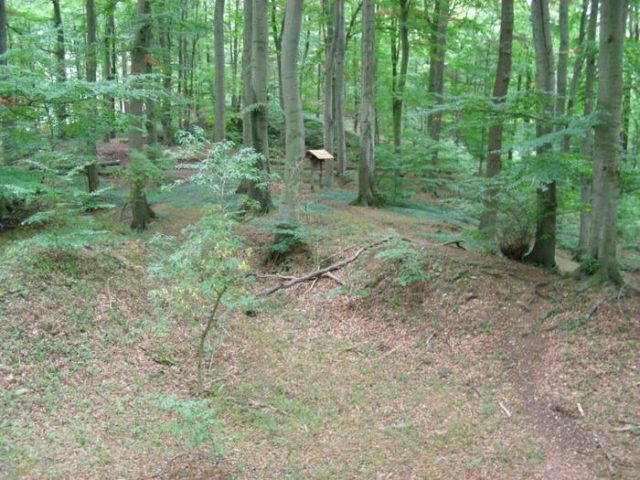
The remains of the castle can be visited
Roden Castle

Roden Castle, also spelled Rohden, is a vanished hilltop castle on a plateau of the Amelungsberg ridge in the Süntel. The remains of the castle complex are located near the Rohden district of the municipality of Hessisch Oldendorf in the Hameln-Pyrmont district in Lower Saxony.
The castle was built between 1130 and 1140 by the Counts of Roden to expand their sphere of influence into the Weser valley. At this time, the counts, like the Counts of Holstein-Schaumburg, were vassals of Henry the Lion in his dispute with Emperor Frederick Barbarossa. The Schaumburg Castle, located about 4 km away, was built shortly before around 1100. In 1181, an open conflict arose between the Schaumburgers and the Counts of Roden with the aim of expelling them from the Weser valley. At the end of the 12th century, the Roden family withdrew to the Wunstorf - Limmer area and left the castle to the Schaumburgers.
Description+
The castle complex consisted of an outer bailey and a slightly smaller main castle, which adjoined each other directly. The elevated castle plateau of the main castle, which was secured with an outer rampart and a ditch, measures approximately 22 by 26 meters. A ring ditch 3 to 5 meters deep secured the castle hill. The main castle was surrounded by a wall, to which a two-part palas was attached in the west and an economic building in the east. The inner courtyard was probably paved. The outer bailey had an area of 20 x 40 meters. Individual wall remains indicate that the outer bailey was secured by a surrounding wall.
Later, the buildings served the population as a quarry. The current castle site (Burgstall) shows only barely recognizable structural remains, while the rampart and ditch system are still visible.
Archaeological investigations took place in 1926, 1950, and 1958. During these, an outer ring wall and building walls, which were executed in opus spicatum, were excavated. The finds, such as pottery, keys, knife parts, nails, horseshoes, game pieces, and a coin (1435), indicated a period of use of the castle from the 12th to the 15th century. Written traditions about the castle are not known.
Approximately 1 km to the east, on the Amelungsberg, is the prehistoric to medieval ring fort Amelungsburg.
Take Mobile History with you
You are reading this text for free. Premium adds what matters on the road: descriptions read aloud, sites found through your camera, whole regions taken offline.
- Every description, including the ~17,700 Premium sites
- Audio guide: have descriptions read to you on location
- AR finder: see sites through your camera, with distance and bearing
- Unlimited saved sites
14 days free, then from €2.99 a month. Cancel anytime.
Location: 52.2003, 9.2531