Castle ruins can be visited
CastleLangenenslingen-Egelfingen
Schatzberg Castle
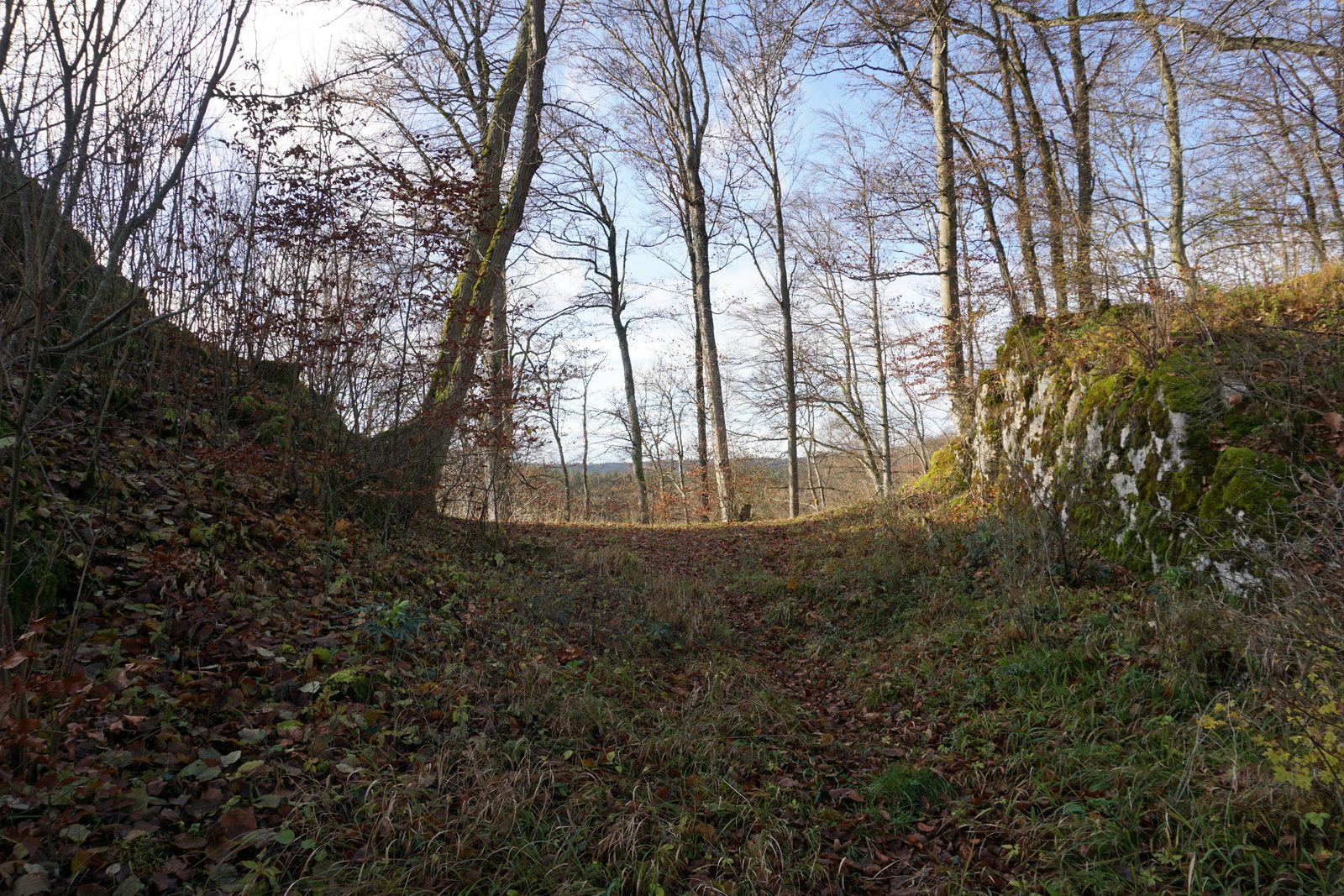
Schatzberg Castle, also called Schatzburg, is the ruin of a spur castle near Egelfingen, a district of the municipality of Langenenslingen in the Biberach district in Baden-Württemberg. The former castle complex had a ring wall with a thickness of 0.9 meters and a keep with a base area of 9.5 by 7.5 meters and a wall thickness of 2 meters.
Geographical location+
The ruin lies on the outermost border against Sigmaringen, on a 703 m above sea level high spur, very high with a wide view to the south as far as the Alps.
History+
The construction of the castle cannot be historically determined, but already in 1250, Knight Konrad von Hornstein zu Schatzberg is mentioned for the first time in documents. Schatzberg Castle formed part of the knightly lordship of Wilflingen and was connected with its own estate, which was left to the Egelfingers for an annual rent; a large area of forest also belonged to the castle. The farmsteads were fallow or hereditary fiefs. The knightly lordship of Wilflingen were vassals of the Counts of Veringen.
Schatzberg Castle was, alongside Bittelschieß and Hertenstein castles, the third castle in the immediate vicinity of the ancestral Hornstein Castle, where collateral branches of the Hornstein family resided simultaneously. The Lords of Hornstein zu Schatzberg also called themselves von Wülflingen, as the village of Wülflingen belonged to Schatzberg. Unlike the other Hornstein line, the Schatzbergers were quite quarrelsome.
Line of Hornstein zu Schatzberg+
Knight Konrad von Schatzberg (1250–1267) was a liegeman of Count Hartmann I von Grüningen. Johannes, Knight of Schatzberg (1282–1323), called von Wülflingen, was a judge over the Heiligenberg count's rights and held Schatzberg as an Austrian fief in 1313. Peter von Hornstein (Johannes' brother) was a knight (1286 to 1315). He owned estates in Altheim (near Riedlingen), Andelfingen, and Hitzkofen. Another brother, Hermann von Hornstein (1293–1333), was a church lord in Blochingen, Seekirch, and owned estates in Riedlingen, Grüningen, Altheim (near Riedlingen), and Heudorf near Meßkirch. Heinrich von Hornstein zu Wilflingen was presumably the owner of Schatzberg from 1327–1350. His son, Hans III von Hornstein zu Schatzberg (1339–1412), also had a share in Hornstein Castle. He sold Hasenweiler and Ilmensee. Through his feuds with the Geroldseckers, who, according to the Zimmer'sche Chronik, were a very restless family, he was able to significantly improve his financial situation. In 1385, Hans zu Schatzberg became a citizen of the city of Rottweil for 5 years. He opened his fortress Schatzberg and lived in Wilflingen in 1394. On September 21, 1400, Duke Leopold of Austria and Hans zu Schatzberg agreed on access to the church in Bingen (Büngen). Hans von Schatzberg was married to Agnes von Neuneck, daughter of Volz von Neuneck (Glatten) zu Neckarburg. Hans IV von Hornstein zu Schatzberg (son of Hans III) was mentioned from 1399–1440. Heinrich v. Hornstein, Hans III's son, resided in Hornstein and was married to Agnes von Seckendorf. He bought the tower in Hornstein. Jos von Hornstein zu Schatzberg (1438–1485) was a son of Hans IV and the last knight on Schatzberg Castle. Simultaneously with Schatzberg Castle, Jos also held the significant pledged lordship of Hohenberg Castle near Spaichingen. Jos inherited the paternal property of Schatzberg fortress with Egelfingen and the estates in Langenenslingen, which remained after the sale of Wülflingen and Emerfeld. The Schatzbergers served the Dukes of Austria with their fortress. The life of Knight Jos zu Schalksberg, who was married to Anna von Rechberg, mostly revolved around feuds; he always sought to obtain justice for himself and others with the sword. Together with Konrad Scharpf von Freudenberg and some other knights, he attacked the Bishop of Augsburg. The Bishop found help from the Emperor, who commissioned Counts Ludwig and Ulrich von Württemberg to support the Bishop. These had the Schatzberg fortress, from which the attack had taken place, burned down by Count Friedrich von Helfenstein. A siege or defense of the fortress does not seem to have taken place, as Konrad von Hornstein, a cousin of Jos, complains that the castle was burned down when Jos stood defenseless. From then on, Jos led a very unsettled life. He sold the remains of his property (Schatzberg castle site) to his cousin Konrad von Hornstein. In 1455, Jos was outlawed by the Empire and was still in it in 1461.
Source: Wikipedia · Licence: CC BY-SA 4.0 · Image: Von Peter Kreuzmann, CC BY-SA 4.0, https://commons.wikimedia.org/w/index.php?curid=95984649
This description is a machine translation of an excerpt from the linked Wikipedia article. The source text was written by its authors, the translation is by Mobile History; like the original it is licensed under CC BY-SA 4.0.
Location: 48.1418, 9.3008