RuinAlsbach - Hähnlein

Alsbach Castle

Alsbach Castle

The remains of the Castle can be visited

Alsbach Castle near Alsbach-Hähnlein on the Bergstraße, in the district of Darmstadt-Dieburg, is more of a fortress and was formerly called Bickenbach Castle.

It is located south of Darmstadt near Alsbach on the edge of the Odenwald on the Hessian Bergstraße, north of Bensheim. The castle was built on the western tip of a mountain ridge, about 260 meters high and now forested compared to its construction era, below the Melibokus, overlooking the Rhine plain. It thus stands about 150 meters above the lowlands stretching from north to south to its west.

Its northern neighbor is Frankenstein Castle near Nieder-Beerbach and its southern neighbor is the castle ruin "Schloss Auerbach" above Auerbach (a district of Bensheim).

Bickenbach Castle was built around 1235 by the Lords of Bickenbach on the 257 m high hill above the village of Alsbach, which was first mentioned in the Lorsch Codex in 773. Its predecessor was probably a motte near Alsbach, on the so-called Weilerhügel. From the 14th century, the castle was a Ganerbenburg (a castle owned jointly by several families) in the common possession of six owners. After robberies by one of the co-heirs, Hartmann (also Hamman) Ulner von Dieburg, on merchants from the city of Frankfurt am Main, the city besieged the castle in 1463 and burned it down. However, the complex was soon rebuilt.

From 1483 to 1502, one of the co-heirs, Erasmus Schenk von Erbach († 1503), succeeded in buying out almost all the other co-heirs (including the Archbishop of Mainz and the Counts of Mansfeld) and bringing 5/6 of the castle and lordship into his own possession, and as early as 1488 he called himself "Lord of Erbach and Bickenbach".

When the Landshut War of Succession, the so-called "Bavarian Feud", broke out in 1504, Ruprecht von der Pfalz was placed under the imperial ban by King Maximilian I on April 23 due to his inheritance dispute with Duke Albrecht IV of Bavaria. Landgrave Wilhelm II of Hesse, entrusted by Maximilian with the execution of the ban, first captured the Palatinate castle of Otzberg and then, since the Schenken von Erbach were Palatinate vassals, besieged Alsbach Castle. The castle commander Hans Gans (von Otzberg) did not let it come to a storm and handed over the keys of the castle to the Landgrave on June 9, 1504. After the end of the War of Succession, Landgrave Wilhelm did not return the castle and the office of Bickenbach. Wilhelm's son Philipp the Magnanimous had the defensive works repaired and reinforced. In his will, he transferred the castle and the office of Bickenbach to his sons from his morganatic marriage with Margarete von der Saale, the Counts of Diez. They seem to have held it as early as 1562. After the last of the Counts of Diez died in 1575, the property fell to Landgrave Georg I of Hesse-Darmstadt in 1577.

In the course of the 17th century, but especially in the 18th century, the castle increasingly fell into disrepair, so that the complex is now preserved only as a ruin.

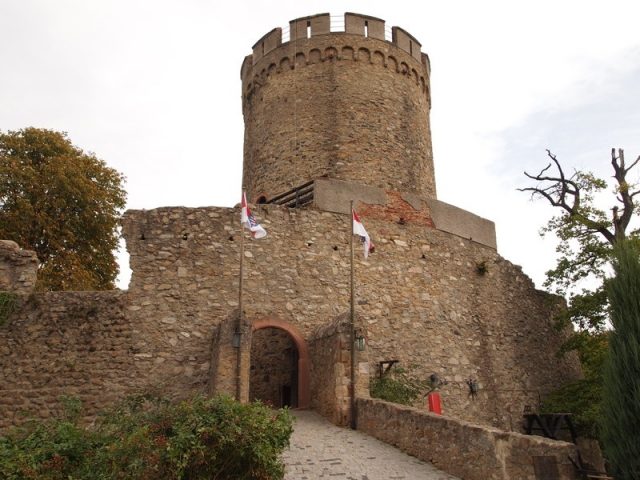
The core castle was laid out in a classic triangular shape. Parts of the outer ring wall and a narrow zwinger (outer bailey) are also preserved. The most impressive feature is certainly the mighty - restored - keep, which is accessible, among other things, from the curtain wall.

Historical and Cultural Support Association Schloss Alsbach e. V.+

The complex is now managed by the citizens' association Historischer und kultureller Förderverein Schloss Alsbach e. V., which has administered the complex on behalf of the State of Hesse since 2000. Numerous events are offered to finance the preservation of the castle. The association was founded on September 18, 1997, on the recommendation of the property administration of the State of Hesse (Landesvermögensverwaltung), by the Alsbach heraldist and historian Dieter Krieger. Its goal is to promote the castle ruin, to maintain, care for, beautify, and restore it. Furthermore, the association aims to present the Hessian cultural heritage of Alsbach Castle attractively to visitors through cultural events and to make it a popular and worthwhile excursion destination for the whole family. Since 2000, the association has managed the castle independently.

Rhine-Main Coat of Arms Roll+

In the RMWR, families and corporations can register coats of arms. This is documented with a decorative coat of arms letter and a publication in the coat of arms book of the HKF Schloss Alsbach e. V.

Events+

Alsbach Castle is known for its diverse events. Especially at the Arts and Crafts Market at Pentecost, the largest market in the region, the unique atmosphere among knights, jugglers, craftsmen's and merchants' stalls is captivating. The events for children, such as the Children's Knight Festival and the Pressing Festival, are a highlight of the region. In 2005, a new knight group was formed, which cultivates pseudomedieval life as a modern custom in the spirit of the so-called medieval markets. In addition to the recreation of a historical camp, a forge was built. During events, old crafts such as blacksmithing and carpentry, baking and cooking, as well as the tailoring of contemporary garments are demonstrated.

Castle Garden+

Several herb gardens have been set up in the entrance area and in the outer bailey. They are divided into a historical part with herbs from the garden of Hildegard von Bingen and the Capitulare of Emperor Charles I, the Great from 795, and a modern garden with contemporary herbs. Another highlight is the Rosarium with a medieval grass bench. Here, historical, fragrant roses can be admired almost all year round. The floral part of the complex is rounded off with its own wine cultivation within the castle. The castle wine "Barbakan" from the Regent grape has already astonished many wine connoisseurs. Approximately 200 half-liter bottles are bottled annually.

The Alsbach Pocket Sundial+

A spectacular find at Alsbach Castle in autumn 1999 forced a rewriting of the history of time measurement in Germany. A visitor to Alsbach Castle found a bronze disc with Roman numerals, 32 mm in diameter, while walking through the castle grounds. As it soon turned out, this is the first known German pocket-sized sundial (travel clock). It is designed in Gothic style and balanced in its features. Art historically, it can be assigned to the period around 1500.

Take Mobile History with you

You are reading this text for free. Premium adds what matters on the road: descriptions read aloud, sites found through your camera, whole regions taken offline.

  • Every description, including the ~17,700 Premium sites
  • Audio guide: have descriptions read to you on location
  • AR finder: see sites through your camera, with distance and bearing
  • Unlimited saved sites

14 days free, then from €2.99 a month. Cancel anytime.

Source: Wikipedia · Licence: CC BY-SA 4.0 · Image: http://www.wehrbauten.de/thread.php?threadid=971

This description draws on the facts documented in the linked Wikipedia article; Wikipedia content is licensed under CC BY-SA 4.0. Wording and editing: Mobile History.

Location: 49.7335, 8.6271