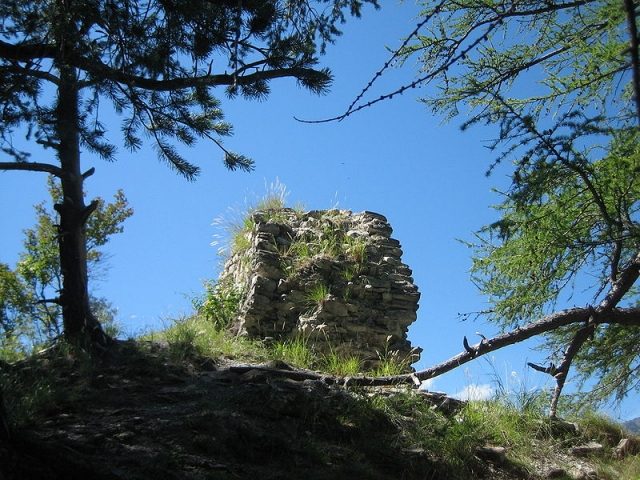
The remains of the Castle can be visited
Old-Aspermont Castle

The ruins of Alt-Aspermont Castle are located above Trimmis in the Rhine Valley in the Swiss canton of Graubünden.
Location+
The ruin is situated high above and to the south of the "Molinära" estate, the former episcopal Meierhof, on a rocky spur and can be easily reached via a marked steep hiking trail in about 20 minutes. The complex is protected on the mountain side by a natural saddle-shaped ridge.
Complex+
Foundations of a rectangular tower on the highest point of the rock have been preserved. A joint between the walls indicates that the northwestern wall remnant is older than the southwestern one. The tower collapsed on April 11, 1878; a photograph from 1875 still shows it with three walls, rising five stories high. The southern part has slipped away. A cistern on the lower terrace to the southwest, still observed by Erwin Poeschel in 1930, is no longer visible.
Alt-Aspermont was probably founded by the Lords of Aspermont, who are first mentioned in a document in 1170 with Swiker, Ulrich, Heinrich with his son Ulrich as witnesses. Later they are mentioned as ministeriales of the Bishop of Chur. According to an entry in the "Buoch der Vestinen", Bishop Heinrich von Montfort (1251–1272) bought the castle: ...vesti Aspermunt ob den hag dem Gotzhus zuobracht und kouft. In 1275, the Barons of Vaz received the castle as a life annuity; it remained in the possession of the Vaz until 1284. Subsequently, disputes arose until an arbitration court in 1299, in which Johann von Vaz renounced his claims.
In 1328, the castle was pledged by Bishop Johann to Ulrich von Aspermont, and after his death in 1338, to the brothers Ludwig and Walter von Stadion. In 1354, it was further pledged by the bishop to Heinrich and Martin Buwix. After various changes of ownership, Alt-Aspermont was besieged in 1452 during the Schamserfehde by the Gotteshausleute; in a federal arbitration award, the episcopal garrison was assured free withdrawal. In 1496, the bishop sold the castle to Knight Hartmann Rordorff in Zurich. Until 1524, Aspermont was administered by episcopal bailiffs and also served as a prison at times. After the 2nd Ilanzer Article, which abolished the bishop's power in secular matters, the castle was abandoned and began to decay.
Take Mobile History with you
You are reading this text for free. Premium adds what matters on the road: descriptions read aloud, sites found through your camera, whole regions taken offline.
- Every description, including the ~17,700 Premium sites
- Audio guide: have descriptions read to you on location
- AR finder: see sites through your camera, with distance and bearing
- Unlimited saved sites
14 days free, then from €2.99 a month. Cancel anytime.
Source: Wikipedia · Licence: CC BY-SA 4.0 · Image: http://de.wikipedia.org/wiki/Datei:Alt_Aspermont_Mauerabbruch_Osten.jpg
This description draws on the facts documented in the linked Wikipedia article; Wikipedia content is licensed under CC BY-SA 4.0. Wording and editing: Mobile History.
Location: 46.9133, 9.5722