CastleSangerhausen-Morungen

Alt-Morungen Castle
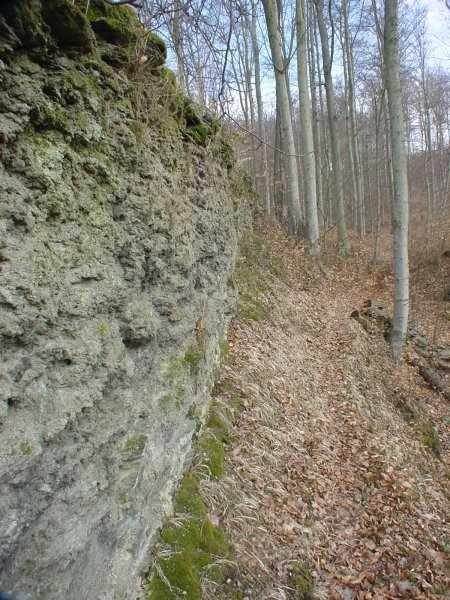
Alt-Morungen Castle

The remains of the castle can be visited


Alt-Morungen Castle is located about 500 meters west of the village of Morungen, a district of Sangerhausen, in the federal state of Saxony-Anhalt. The castle was a small imperial ministerial castle. It has been a ruin since the 13th century. For a long time, it was considered the original Morungen Castle and the birthplace of the Minnesinger Heinrich von Morungen.

The hilltop castle is an approximately trapezoidal complex measuring only about 20 by 30 meters on a rock spur above the Bettelmannsbach stream. A ridge connects it with the mountain ridge to the east, which is cut by two unfinished moats. The central castle area is surrounded by a deep moat carved into the rock and is bordered to the north, east, and south by the remains of the curtain wall.

The castle site is freely accessible.

The first mention of the castle dates from the first half of the 11th century. A Count Goswin the Elder of Leige (Großleinungen) was named as the owner of Morungen. Around 1030, he handed over the castle with all its appurtenances as a dowry for his daughter Sigena von Leinungen on the occasion of her marriage to Wiprecht, the lord of the Balsamer Land. Their son was also named Wiprecht and went down in history as Wiprecht von Groitzsch. As a partisan of Henry IV and later Henry V, Wiprecht von Groitzsch initially gained great influence at the imperial court. Later, however, he and his son of the same name came into conflict with the imperial house. To ransom his son, who had been imprisoned since 1110, Wiprecht had to return his possessions in Morungen to Emperor Henry V in 1112, among other things. The emperor enfeoffed Count Hoyer von Mansfeld with the castle. Only after the Battle of Welfesholz in 1115, in which the Saxon noble opposition defeated the imperial forces and Hoyer fell, did Wiprecht regain his possessions.

In 1157, the family of the Counts of Groitzsch sold the lordship to Emperor Frederick I. Around this time, the Lords of Morungen became known as castellans. The Minnesinger Heinrich von Morungen (1150–1220) came from this lineage. It is unclear whether his person is to be associated with Alt- or Neu-Morungen or both complexes.

Around 1200, the castle was abandoned in favor of the newly built Neu-Morungen Castle and fell into disrepair.

New research, which takes into account a siege rampart nearby and ceramic finds from the castle, suggests that the castle was planned in the 13th century as a secondary castle to Neu-Morungen Castle. It was probably abandoned during construction, perhaps after a siege by Landgrave Albrecht of Thuringia in 1266.

Directly below the castle, about 80 m west of the stream flowing past it, there is a larger iron smelting site with numerous slags. In the streambed, the smelting area can be traced in a north-south direction for 20 m; its eastward extent cannot be determined without excavation, and to the west, it is limited by a hillside. At the foot of the slope, smaller ore residues consisting of limonite are found. After further searching, the ore mining could be localized approximately 1.5 km north of the castle. Due to the nature of the slags and melted wall remnants, a connection between the smelting site and the castle is very likely. On the grounds of the small outer bailey, there are larger quantities of lime mortar. It gives the impression that renovation or expansion work on the castle was suddenly interrupted. According to the condition found, the mortar had already been mixed and was then dumped there unprocessed.

Take Mobile History with you

You are reading this text for free. Premium adds what matters on the road: descriptions read aloud, sites found through your camera, whole regions taken offline.

  • Every description, including the ~17,700 Premium sites
  • Audio guide: have descriptions read to you on location
  • AR finder: see sites through your camera, with distance and bearing
  • Unlimited saved sites

14 days free, then from €2.99 a month. Cancel anytime.

Source: Wikipedia · Licence: CC BY-SA 4.0 · Image: http://de.wikipedia.org/wiki/Datei:Alt-Morungen_6.JPG

This description draws on the facts documented in the linked Wikipedia article; Wikipedia content is licensed under CC BY-SA 4.0. Wording and editing: Mobile History.

Location: 51.5146, 11.2277