CastleWildon

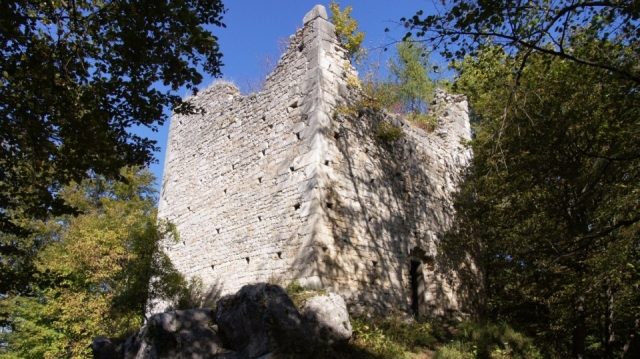
Alt-Wildon Castle

Alt-Wildon Castle

The remains of the Castle can be visited

In the early Middle Ages, around the year 1000, the Hengistburg, the center of the then Mark on the middle Mur, was probably also located on the Wildoner Schlossberg. It was intended to secure the border to the east.

Since the 12th century, several coexisting castles followed the Hengistburg. In 1173, the castle hill came into the possession of Hartnid von Riegersburg. He moved here and probably built Alt-Wildon Castle at the end of the 12th century. His family now called themselves after Wildon. Since Alt-Wildon was hardly effectively defensible due to its elevation, a new castle, called Neu-Wildon, was built on the eastern summit around the middle of the 13th century. Alt-Wildon was left to decay.

In the second half of the 13th century, Ulrich von Wildon ceded the "novum castrum" to Otto von Liechtenstein, the son of the minnesinger Ulrich. Otto had married a daughter of his brother Leuthold. The family originally owned Wildon as a fief of the Archbishop of Salzburg. However, the sovereign managed to acquire this fief. The Wildoners had to content themselves with a sub-fief. In 1262, Przemysl Ottokar II took possession of the lordship. After the fall of the Bohemian king, the Wildoners reoccupied their lordship. In 1278, the lordship was divided between Herrand and Hartnid von Wildon.

In 1292, he participated in the Styrian noble conspiracy. However, a year later he had to surrender his castles to the Truchsess von Emmerberg, who had besieged them. Hartnid was forced to cede the fortress to the Duke. Wildon remained under ducal rule until 1625. The Wildoners had already died out in 1325 with Hartneid IV. In 1435, King Frederick the Fair pledged Wildon to Christof Wolfsauer. In 1440, the lordship was handed over to Leuthold von Stubenberg. In 1445, Frederick III appointed Frederick von Herberstorf as administrator.

In 1469 and 1470, Andreas Baumkircher captured Wildon twice in his feud against the Emperor. After the imperial troops succeeded in finally driving out Baumkircher, Count Wilhelm von Diernstein was entrusted with its care. Still in the 90s of the 16th century, the pledged lordship came into the possession of Hans Christof von Gera, but soon the pledgees changed more and more frequently. Emperor Ferdinand II redeemed Wildon again and sold it in 1624 to Johann Ulrich Prince of Eggenberg. In 1715, Johann Friedrich Baron von Stampfer acquired the lordship.

In 1780, the heavily indebted lordship came to the industrialist Mayerhofer, who was followed in 1792 by the lawyer Dr. Josef Ritter von Griendl. In 1866, the noble Josef von Neupauer bought the ruins. After the Second World War, the castle hill with the ruins belonged to Hofrat Dipl. Ing. Lui von Frizberg. His family is still its owner today.

Take Mobile History with you

You are reading this text for free. Premium adds what matters on the road: descriptions read aloud, sites found through your camera, whole regions taken offline.

  • Every description, including the ~17,700 Premium sites
  • Audio guide: have descriptions read to you on location
  • AR finder: see sites through your camera, with distance and bearing
  • Unlimited saved sites

14 days free, then from €2.99 a month. Cancel anytime.

Source: Wikipedia · Licence: CC BY-SA 4.0 · Image: http://www.wehrbauten.at

This description draws on the facts documented in the linked Wikipedia article; Wikipedia content is licensed under CC BY-SA 4.0. Wording and editing: Mobile History.

Location: 46.8842, 15.5105