CastleHüttenberg-Althaus

Althaus Castle
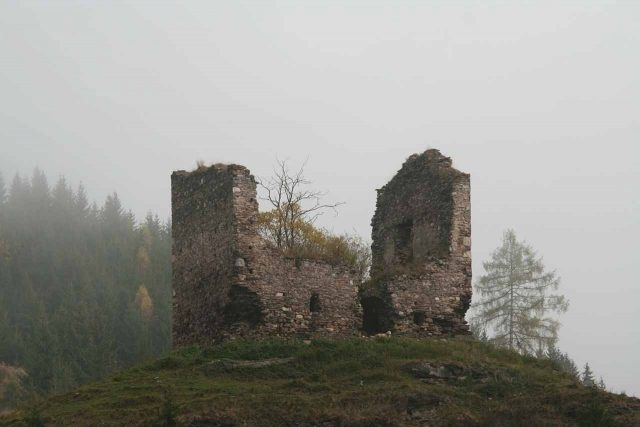
Althaus Castle

The remains of the Castle can be visited

The castle ruin Althaus (Altenhaus) is located on a rocky hill in the Carinthian Görtschitztal valley, about twelve kilometers north of Hüttenberg.

In the High Middle Ages, the term "Hus" stood for a fortified residence, and such a residence was first documented here in 1247. Since mineral resources had been mined in the area since the early Middle Ages, it cannot be ruled out that a defensive structure existed at this location much earlier.

In the 13th and 14th centuries, the area around the castle was owned by the Archdiocese of Salzburg, which assigned the administration of the property to feudal lords. The lineage of Wulfingus de Huse, mentioned as owner in 1247, died out in the male line in 1279. Subsequently, Archbishop Friedrich appointed Ortlof von Saurau as administrator, who had previously married Matza von Haus. At this time, the castle was called "vetus domus", meaning "Althaus", so a newer fortress must have already existed. This may have been Silberberg, located a little downstream on the other side of the valley.

In 1396, Archbishop Gregor appointed Bishop Konrad von Lavant as caretaker of Althaus. In 1449, Althaus was described as dilapidated but was made habitable again. In the 16th century, although the owners preferred Silberberg as their residence, the importance of Althaus increased again, as it had to protect the numerous mines that had been put into operation in the area since the beginning of the 16th century. After the mines were exhausted, however, the castle's days were also numbered; it was abandoned and fell into disrepair. The last news about the castle is a letter from 1628, in which Regina Grimmigin, née Teuffenbach, asserted inheritance rights.

The area where the remains of the castle are located today belongs to a neighboring farm.

Description+

The complex is located above the Görtschitztal road (B 92) leading from Hüttenberg to Neumarkt, on a rocky hill about 30 meters high. Of the Romanesque castle, the ruin of the mighty, thick-walled residential tower remains, which also constituted the essential part of the entire complex. Around the tower castle, there are no remains of a usual curtain wall. On the north side of the Burgkogel, however, a former crescent-shaped rampart is recognizable in the terrain.

The once four stories of the rectangular double tower were built in the first half of the 13th century, the oldest building parts probably dating back to the end of the 12th century. In the basement, there are two vaulted rooms separated by a barrel-vaulted corridor, and on the first floor, there are still traces of the castle chapel.

Take Mobile History with you

You are reading this text for free. Premium adds what matters on the road: descriptions read aloud, sites found through your camera, whole regions taken offline.

  • Every description, including the ~17,700 Premium sites
  • Audio guide: have descriptions read to you on location
  • AR finder: see sites through your camera, with distance and bearing
  • Unlimited saved sites

14 days free, then from €2.99 a month. Cancel anytime.

Source: Wikipedia · Licence: CC BY-SA 4.0 · Image: http://commons.wikimedia.org/wiki/File:Ruine_Althaus_in_M%C3%BChlen.jpg

This description draws on the facts documented in the linked Wikipedia article; Wikipedia content is licensed under CC BY-SA 4.0. Wording and editing: Mobile History.

Location: 47.0099, 14.5013