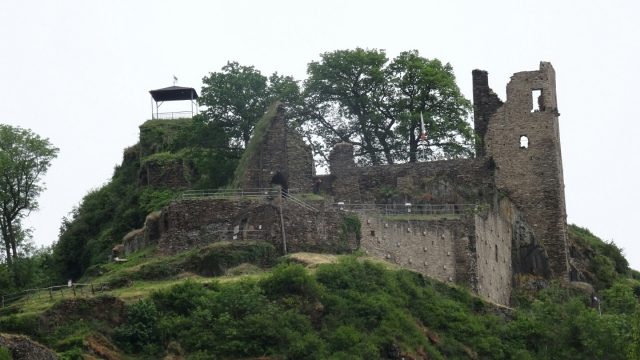
CastleAltenahr

Are Castle

Are Castle

The remains of the Castle can be visited

Are Castle is the ruin of a hilltop castle at 240 m above sea level, above the municipality of Altenahr in Rhineland-Palatinate. It was built around 1100 by Count Dietrich I of Are and first mentioned in a document in 1121.

Since 1965, the Are-Gymnasium in Bad Neuenahr-Ahrweiler has borne the name in reference to the castle and the noble family of the same name.

Construction Description+

The castle's floor plan is a quadrangle. In addition to parts of the outer bailey and a gate – the so-called Gymnicher Porz – remnants of the defensive wall are also preserved. Furthermore, an old gate tower (also called Schellenturm) stands on the south side of the complex, next to the ruin of the palas, which once had a heated bishop's chamber. The first keep presumably stood on the pointed rocky peak in the north corner. North of it, extensive remains of the Romanesque castle chapel from the 12th century are preserved.

Gymnicher Porz Gatehouse+

Below Are Castle lie the remains of the Gymnicher Porz, with Porz standing for gate. It was a lower gate system on the access path to the castle, which sealed off the castle hill in conjunction with a wall. The complex consisted of a gatehouse over the access path, an attached castle house with a basement and two floors with living quarters, and an adjoining castle tower. The naming is based on the noble family of Gymnich. Some members were temporary pledgees of the castle in the 14th and 16th centuries. It is presumed that the gate system was built during this time. For a time, the Gymnicher Porz served as an independent castle fief of the Gymnich family.

Renovation+

From 1997 to 1999, the ruin was secured at great financial expense and placed under monument protection. Since then, it has been accessible to the public again. The renovation, which began in March 1997, primarily served to ensure public safety. There was a risk that stones from the complex could fall onto the federal road below. A Hughes 500 helicopter transported the building material to the castle ruin on a load rope. After 30 flights, the loaded helicopter crashed on April 9, 1997, because the load rope had become entangled in the skids. The pilot suffered fatal injuries.

In autumn 1997, the 22-meter-long palas wall with its two side walls was restored. To ensure the stability of the walls, 65 anchors were driven up to 14 meters deep into the slate rock.

In 1246, Count Friedrich von Hochstaden, provost of Xanten, with the consent of his brother Konrad von Are-Hochstaden, donated the county with the castles of Are, Hardt, and Hochstaden to the Archdiocese of Cologne. The extensions with extensive defensive walls were built during the 14th and 15th centuries in the Electorate of Cologne era to protect the Electorate's possessions in the Ahr region. In the 16th and 17th centuries, there were only minor changes to the building fabric through repairs and replacement constructions. For a time, the castle also served as a prison where the Archbishops of Cologne had troublesome opponents incarcerated to make them compliant. For a long time, Are Castle was the spiritual and cultural center for the entire region.

The Archbishops of Cologne frequently pledged Are Castle with the Altenahr office. The pledgees were appointed as bailiffs and often resided in the castle. For longer periods, the structural condition of the castle complex was poor, as the pledgees did not carry out the necessary repairs. An exception with a structurally very good condition was the time of Heinrich von der Horst, who died in 1625.

In 1690, the castle was conquered for the first time after a nine-month siege by French troops. The castle had been severely damaged by the bombardment. In 1697, the French withdrew, but reoccupied the castle from the beginning of the War of the Spanish Succession in 1701. In 1706, troops from the Electorate of Cologne took over the castle and made the area unsafe. For this reason, Elector Joseph Clemens of Bavaria had the walls blown up in 1714 with the consent of the villagers. Since then, the castle has been a ruin. Still usable materials, such as wood and stones, served as building material for the new construction of the administrative building at the foot of the castle hill.

The Counts of Are-Hochstaden+

A Sigewin von Are, Archbishop of Cologne, is first mentioned in a document in 1087. Dietrich I von Are is considered the founder of the Are line. The count's family named themselves after the course of the Ahr river, whose surrounding area they owned. In 1140, the lines Are-Hochstaden and Are-Nürburg split. Sons of the family are:

  • Gerhard von Are, from 1124 to 1169 provost of the Cassius Abbey in Bonn, who had the Bonn Minster church extended
  • Friedrich II von Are, 1152 to 1168 Bishop of Münster
  • Lothar von Hochstaden, 1192/93 Bishop of Liège
  • Dietrich II von Are, 1197 to 1212 Bishop of Utrecht
  • Konrad von Hochstaden, from 1238 to 1261 Archbishop of Cologne and builder of Cologne Cathedral.

Take Mobile History with you

You are reading this text for free. Premium adds what matters on the road: descriptions read aloud, sites found through your camera, whole regions taken offline.

  • Every description, including the ~17,700 Premium sites
  • Audio guide: have descriptions read to you on location
  • AR finder: see sites through your camera, with distance and bearing
  • Unlimited saved sites

14 days free, then from €2.99 a month. Cancel anytime.

Source: Wikipedia · Licence: CC BY-SA 4.0 · Image: Jörg Heldt

This description draws on the facts documented in the linked Wikipedia article; Wikipedia content is licensed under CC BY-SA 4.0. Wording and editing: Mobile History.

Location: 50.5174, 6.9947