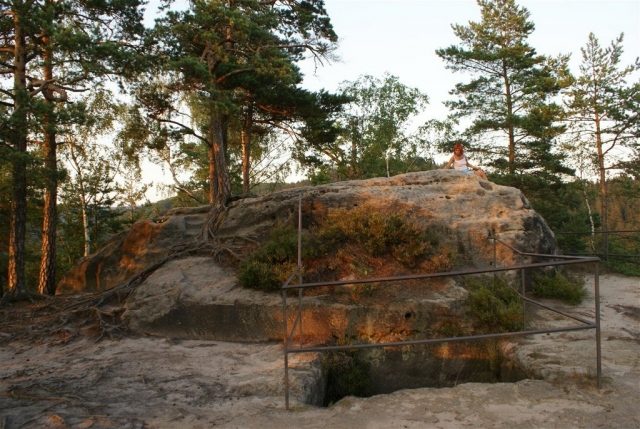
The remains of the castle can be visited
Arnstein Castle

Arnstein Castle, popularly known as Ottendorfer Raubschloss (Ottendorf Robber Castle), is a castle ruin located on the right side of the Kirnitzsch Valley on the mountain of the same name (327 m above sea level). Today, beam bearings, stone stairs, a castle dungeon, rock clamps, beam bearings for the former keep, the cistern, a cave with traces of processing, and rock drawings can still be found.
Location and Surroundings+
Arnstein is located in the Rear Saxon Switzerland at the confluence of the Dorfbachgrund, which descends from the Ottendorf district of the city of Sebnitz, into the Kirnitzsch. In the immediate vicinity – located in the Kirnitzschtal – are the old sawmills Neumannmühle and Buschmühle. The Arnstein Cave, which was significantly involved in the construction of the castle, has the number 5051/SH-03 in the Saxon Cave Register.
The first documented mention of Arnstein Castle dates back to August 4, 1436, when the hilltop castle was pledged by its owners, the Berken von der Dubá, to Siegmund von Wartenberg († 1438) from Tetschen, a Bohemian nobleman.
Since the then warlike Siegmund von Wartenberg also threatened Saxon and episcopal-Meissen territories and the trade routes of the Upper Lusatian Six Towns during his raids, the castle was besieged in 1436 by the Electorate of Saxony and the Six Towns League. The knight surrendered, signed an armistice, and on October 19, 1436, a peace treaty followed before Emperor Sigismund in Prague.
Half a year later, a mercenary of the knight, the Tetschen citizen Rauchfuß, known as Bauernfeind (Peasant Enemy), attacked six villages including Krippen, Schöna, and Reinhardtsdorf. The farmers of the villages lost their entire livestock (360 cattle, 120 horses, and 200 sheep) and the villagers were abducted to Arnstein and held captive there.
Thereupon, on August 17, 1437, the Saxon princes allied with Heinrich von der Dubá von Wildenstein, the castle was besieged again and burned down in the process. Siegmund von Wartenberg surrendered and was forced into the peace treaty of Altenburg on April 17, 1438. To prevent further disputes, Siegmund von Wartenberg had to sell Arnstein Castle to the Elector of Saxony for 500 groschen. The castle was then handed over to the Berken von der Dubá auf Wildenstein, who, however, only hastily restored it.
Structure+
In the first construction period in the 14th and early 15th centuries, the residential tower, the living and kitchen buildings, the gate systems of the core castle, and the economic buildings and fortifications of the outer bailey were erected. The entire structure could certainly compete with the nearby Wildenstein Castle and was at that time one of the larger castle complexes in the area of Saxon Switzerland.
Due to the destructions in the years 1437/38, a second but significantly smaller construction period can be assumed afterwards. The lowest rock of the core castle was abandoned and access was moved directly from the outer bailey to the middle core castle. This seems to have been accompanied by a relinquishment of any representative claim of the castle, as it could now only be entered through a narrow and difficult-to-pass rock crevice. With the transfer of the castle to Saxony, the final decay of the complex began.
Access+
The most convenient starting point for a visit to Arnstein is the Buschmühle in the Kirnitzschtal. From there, a marked footpath leads up to the castle rock in 20 minutes. In addition, several marked hiking routes pass by Arnstein.
Legend+
The legend of Arnstein Castle tells that the last robber knight was broken on the wheel on a southern outcropping rock and died a cruel death. He is said to have hidden a treasure in the castle. However, he never revealed the hiding place. Due to the stories in the legend, excavations were carried out in the cistern in 1987/88. However, no treasure was found.
Take Mobile History with you
You are reading this text for free. Premium adds what matters on the road: descriptions read aloud, sites found through your camera, whole regions taken offline.
- Every description, including the ~17,700 Premium sites
- Audio guide: have descriptions read to you on location
- AR finder: see sites through your camera, with distance and bearing
- Unlimited saved sites
14 days free, then from €2.99 a month. Cancel anytime.
Source: Wikipedia · Licence: CC BY-SA 4.0 · Image: Roland Neubert, Halle (Saale)
This description draws on the facts documented in the linked Wikipedia article; Wikipedia content is licensed under CC BY-SA 4.0. Wording and editing: Mobile History.
Location: 50.9288, 14.2893