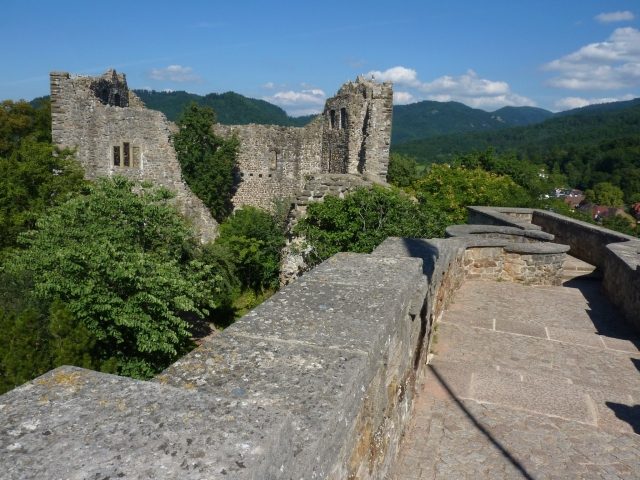
The remains of the Castle can be visited
Baden Castle

Baden Castle, also known as Badin Castle or Badenweiler Castle, is a castle ruin on a hill above the spa park in the middle of the municipality of Badenweiler in the Breisgau-Hochschwarzwald district in Baden-Württemberg. It is considered the landmark of Badenweiler and is not identical to the castle ruin of Neuenfels, which is located near Badenweiler.
Excavations in the castle and on the castle hill prove that the hill was settled before 1122. Finds show that the Romans built a fort to protect Aqua Villa. Later, the Alamanni built a hilltop castle to secure their territory. This was taken over by the Franks.
From 1122, the castle was owned by the Zähringer to protect their silver mining. In 1147, the castle came into the possession of the Welfs as a dowry. Through exchange, the castle came to the Staufer in 1157, as an inheritance in 1268 to the Counts of Freiburg, and through marriage in 1303 to the Counts of Strassberg. In the 14th century, outer fortifications were built due to constant disputes with neighboring lordships. Through inheritance, the castle came into the possession of the Princely House of Fürstenberg in 1363, then to the Counts of Freiburg and temporarily also to the Habsburgs. The castle was damaged in 1409 by soldiers of Humbrecht von Neuenburg, the Prince-Bishop of Basel, and then rebuilt. After the Council of Constance, it returned to the Counts of Freiburg. Through the donation of the last Count of Freiburg, it came to the Margraves of Hachberg-Sausenberg in 1444 and to the Margraviate of Baden in 1503.
On April 6, 1678, the castle was blown up in the Dutch War by the retreating French occupiers under Marshal Crequi. After that, it was not rebuilt. Until its demolition, the castle was continuously inhabited by bailiffs of the respective territorial lords.
To protect the ruin from decay and to make it accessible for tourism, it was restored. The keep can be climbed as a viewing platform. The many high preserved walls of the ruin show various rooms and the palas. The castle ruin can be entered via a steep path. This is lined with walls and leads past the round tower. To the north-east, in the palas with its three subdivisions, it can still be seen that the castle had several floors. The shapes of the windows are still preserved.
Sights on the Castle Hill+
The castle hill is part of the spa park.
Monument to Grand Duke Friedrich I of Baden
On the west side of the promenade around the castle hill, known as the Kaffeemühle, with a view of the Vosges, stands the monument to Grand Duke Friedrich I (1826-1907); it was created in 1912 by Karl Friedrich Moest of the Karlsruhe Art Academy and initially erected on the Schlossberg. It is the largest monument in Badenweiler and at the same time symbolizes a significant epoch of the Baden region as an independent state. The popular sovereign often came to Badenweiler and celebrated his 80th birthday here in 1906 as Europe's longest-serving monarch.
Anton Chekhov Monument
Also with a view of the Vosges, the new Chekhov monument was erected on the castle hill in 1992. In 1904, the Russian writer, novelist, and dramatist Anton Pavlovich Chekhov died in Badenweiler. The world's first monument to him stood in the same place from 1908 to 1918, but fell victim to the metal collection campaign in World War I. Today, a memorial plaque commemorates it. On the occasion of the 100th anniversary of his death, a "Symbolic Cherry Orchard" was planted on July 15, 2004, by prominent representatives from Russia and Badenweiler in the vicinity of the monument as a sign of a new peaceful Europe in the spirit of Chekhov. The Literary Museum "Chekhov Salon" has been located in the meadow wing of the Kurhaus at the foot of the castle hill since 1998.
Hildegard von Bingen Garden and Gutedel Garden
The spa park includes a "Hildegard von Bingen Garden," where the healing knowledge of Abbess Hildegard von Bingen (1098-1179) is displayed in beds along the retaining wall with a variety of medicinal plants. This is followed by the Gutedel Garden. This viticultural show garden displays various varieties of the Gutedel grape.
Belvedere
The Belvedere was built between 1811 and 1816 according to the plans of the Baden architect Friedrich Weinbrenner as a stately "tea and pleasure house." Later it was also used for church services, as a local history museum, painter's studio, gymnasium, or for exhibitions. Today, it is available for weddings by the civil registry office of the municipality of Badenweiler during the summer months.
Promenade Hall
The Promenade Hall was built in 1882/1883 as one of the formerly most important cast-iron halls in southwestern Germany, with a length of 45.5 meters and a width of 4.5 meters, at the site of today's Kurhaus, and was intended to allow promenading even in bad weather. Parts of the old Promenade Hall were re-erected in 1969 at the Neuen Vogesenblick.
Take Mobile History with you
You are reading this text for free. Premium adds what matters on the road: descriptions read aloud, sites found through your camera, whole regions taken offline.
- Every description, including the ~17,700 Premium sites
- Audio guide: have descriptions read to you on location
- AR finder: see sites through your camera, with distance and bearing
- Unlimited saved sites
14 days free, then from €2.99 a month. Cancel anytime.
Source: Wikipedia · Licence: CC BY-SA 4.0 · Image: Joachim Schneeleopard
This description draws on the facts documented in the linked Wikipedia article; Wikipedia content is licensed under CC BY-SA 4.0. Wording and editing: Mobile History.
Location: 47.8025, 7.6682