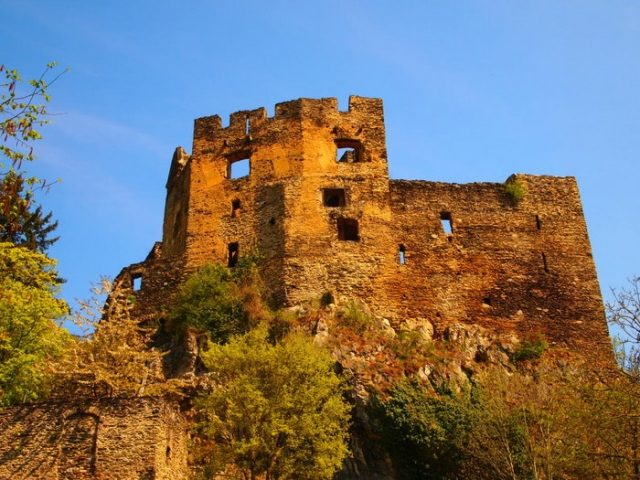
The remains of the Castle can be visited
Balduinstein Castle

Balduinstein Castle is the medieval ruin of a rock castle in Balduinstein in the Rhein-Lahn district in Rhineland-Palatinate. It is privately owned, its outbuildings are used as a youth castle, and the ruin is occasionally the venue for events.
The castle is located on a rock above Balduinstein and the lower Lahn. Not far from the castle are Schaumburg Castle and the octagonal Port Tower.
The castle dates back to Archbishop Balduin of Trier, who began construction of a fortified castle in 1319 below Schaumburg, where the Lords of Westerburg, who were hostile to him, resided. The town was granted city rights in 1321 by Emperor Ludwig the Bavarian. Balduin elevated the settlement to an office and handed over the office and castle to the knight Dietrich von Staffel in 1335. In 1339, Balduin pledged the castle to Dietrich von Staffel. The Knights of Staffel remained in possession of the castle until their male line died out in 1683.
With the construction of the lower castle in 1443 within the city, Balduinstein Castle gradually lost importance. After several expansion phases of the castle in the 14th and 15th centuries and its connection to the city fortifications, decay began in the mid-17th century. After the end of the Thirty Years' War in 1648, the Elector of Trier granted demolition permission in 1665, and by 1680 only the walls remained.
After the extinction of the Knights of Staffel, the castle was pledged to the Knights of Reifenberg and the Knights of Eltz-Rübenach. In the 19th century, the castle ruin was used as a quarry.
Current Use+
Since 1974, the 19th-century villa located on the castle grounds and its outbuildings have been used as Jugendburg Balduinstein (Balduinstein Youth Castle). The Jugendburg is a self-catering house for scouts and youth groups.
Layout+
Balduinstein Castle is a spur castle and has an oval floor plan. The outer walls, up to 1.60 meters thick, are partially preserved. The foundations of the three-story residential building still stand. In the southwestern corner of the castle, remnants of a small tower have been preserved. On the north side, the castle was protected by a neck ditch, which is still well preserved today, and on the northwest side by a lower bailey. Typical for castles of the late Middle Ages, a keep is missing.
Take Mobile History with you
You are reading this text for free. Premium adds what matters on the road: descriptions read aloud, sites found through your camera, whole regions taken offline.
- Every description, including the ~17,700 Premium sites
- Audio guide: have descriptions read to you on location
- AR finder: see sites through your camera, with distance and bearing
- Unlimited saved sites
14 days free, then from €2.99 a month. Cancel anytime.
Source: Wikipedia · Licence: CC BY-SA 4.0 · Image: http://www.wehrbauten.de/thread.php?threadid=932
This description draws on the facts documented in the linked Wikipedia article; Wikipedia content is licensed under CC BY-SA 4.0. Wording and editing: Mobile History.
Location: 50.3442, 7.9736