The remains of the Castle can be visited
CastleBeetzendorf
Beetzendorf Castle
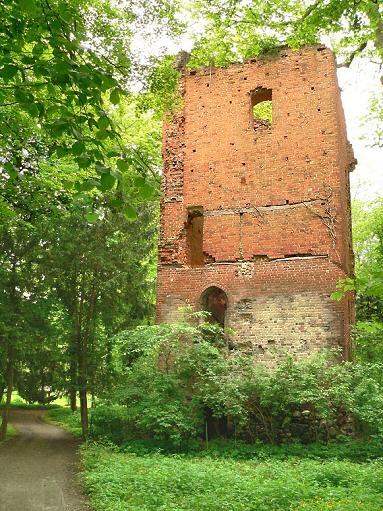
Beetzendorf Castle, formerly also called Becendorf, is the ruin of a lowland castle (moated castle) in the municipality of Beetzendorf in the Altmarkkreis Salzwedel in Saxony-Anhalt.
History and Layout+
The castle was built around 1140 in marshy terrain. The first mention was made in a document around 1204, where the castle complex came into the hands of the von der Schulenburg family as a pledge from the von Kröcher family. In 1319, the von Kröcher family still held Beetzendorf Castle as a pledge, with which they entered the service of Otto II the Strict. In 1323, a contract mentioned that Otto the Mild had acquired Beetzendorf Castle, which must have happened between 1319 and 1322. In 1332, the knights Bernhard I von der Schulenburg, Dietrich II von der Schulenburg and Werner III von der Schulenburg documented a foundation at Beetzendorf Castle. In 1340, a first real division of Beetzendorf Castle took place between the black and white branches of the von der Schulenburg family, the then owners of the castle. From this year, in addition to the first reliable mention of the von der Schulenburg family as owners of Beetzendorf Castle, there is also the oldest known mention of a chapel at the castle, whose patronage is no longer known. From 1343, according to Dehio, the castle was owned by the von der Schulenburg family, after they had left their ancestral seat, the Schulenburg near Stappenbeck near Salzwedel. Beetzendorf became the family's main seat in the following centuries. The possessions here and in Apenburg were their ancestral estates, which secured the core of their manorial rule until the 19th century. In 1424, the brothers Bernhard VI (documented 1406–1453) and Werner VIII (documented from 1411; † 1447 or 1448) von der Schulenburg, sons of Heinrich II von der Schulenburg, founded a chapel at the castle, which was dedicated to Mary (mother of Jesus) and was probably abandoned during the Reformation. By around 1600, Beetzendorf Castle was fortified with moats. The castle complex enhanced the status of the family, who from then on belonged to the upper class of the Altmark nobility as "schlossgesessen" (castle-seated).
Source: Wikipedia · Licence: CC BY-SA 4.0 · Image: User Axel Hindemith at de.wikipedia · Wikimedia Commons · Public domain
This description is a machine translation of an excerpt from the linked Wikipedia article. The source text was written by its authors, the translation is by Mobile History; like the original it is licensed under CC BY-SA 4.0.
Location: 52.7042, 11.0950