CastleGüglingen-Eibensbach

Blankenhorn Castle
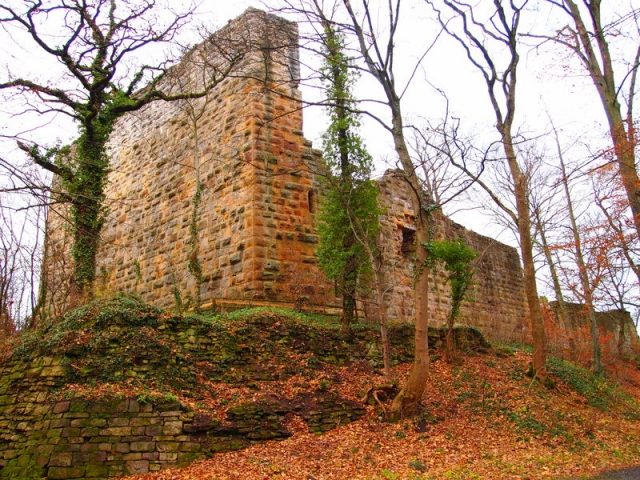
Blankenhorn Castle

The remains of the Castle can be visited

The ruin of Blankenhorn Castle is located above Eibensbach, a district of Güglingen in the Zabergäu region, Heilbronn district (Baden-Württemberg).

The hilltop castle was probably built around 1220/30 by the Lords of Neuffen and came into the possession of Württemberg by 1327. It once held strategic importance on the Rennweg, an old ridge path on the Stromberg. After the Rennweg lost its significance, the castle also lost its importance, fell into disrepair in the 15th century, and was dismantled and used as a quarry from 1479 onwards.

According to building findings on the oldest ashlar blocks, the castle was built as a shield wall castle around 1220 to 1230 and was first mentioned in 1241. At the time of its first mention, the castle was owned by the Lords of Neuffen, a Staufer ministerial family. Heinrich II von Neuffen served Emperors Frederick II and Heinrich (VII), his brother Berthold was protonotary at the royal court from 1212 to 1216 and later Bishop of Brixen. In 1180, nearby Güglingen was still Staufer allodial property, so the lands around Blankenhorn Castle probably came to the Neuffen family as a Staufer donation around 1200, and Heinrich II von Neuffen had begun construction of the castle there. The castle probably got its name from the Neuffen coat of arms, which shows three horns. The reason for choosing the site for the castle construction is to be found in the Rennweg, an old ridge path on the back of the Stromberg, along which numerous castles were built in the High Middle Ages, from which traffic was controlled and escort rights were exercised. In addition, the Lords of Neuffen tried to build up a larger, contiguous dominion around Güglingen, but they failed within two generations.

After the death of Heinrich II von Neuffen, the castle passed to his son, the minnesinger Gottfried von Neuffen, who divided the property among his children Rudolf and Maria. Maria married one of the Lords of Magenheim, whereby half of Blankenhorn Castle fell to this family. The Magenheim half of the castle came to Burkard von Hohenberg through two inheritances, who sold his share of the property to Württemberg in 1321. Rudolf von Neuffen first pledged his half of the castle with all of Güglingen to Konrad von Weinsberg, but sold the property to Gerlach von Breuberg in 1296. Rudolf's son-in-law Konrad von Flügelau reacquired the property and bequeathed it to the Counts of Eberstein in 1313. However, by 1327, this share of the property and thus the entire castle was also in Württemberg possession.

Württemberg initially pledged the castle to Mainz. In 1472, the castle came as a fief to Hermann von Sachsenheim, who, however, allowed the complex to fall into disrepair contrary to the conditions imposed on him. Apparently, the Rennweg had lost its importance by then, and with it the castle. From 1479, the dismantling of the castle began by forest master Bartel Luz, who sold timber and bricks from the castle. Later, the ruin served as a quarry.

The ruin is now a popular excursion destination. It is open and accessible all year round without admission. A covered barbecue area has been set up in the inner courtyard.

Layout+

The castle was built on a rectangular plan, with the narrow sides to the north and south. To the south, towards the moat, the castle was fortified by an 18-meter-high and 3-meter-thick shield wall built of sandstone ashlar blocks, which still forms the most impressive part of the ruin today. The former access to the castle was on the western long side of the complex, where a simple round-arched portal leads into the inner courtyard. In the southern part of the castle complex was a four-story residential building (palas), which leaned against the shield wall. The number of 2.20 to 3-meter-high floors can still be seen by corbels and beam holes in the masonry. To the north, the complex is largely destroyed, so there is no information about the further building stock. Blankenhorn Castle does not seem to have had a tower or keep. On the mountain side of the inner moat there is a sloping retaining wall, which is considered to be the only one of its kind north of the Alps. Comparable retaining walls can be found in the Apulian castles from the time of Emperor Frederick II.

Take Mobile History with you

You are reading this text for free. Premium adds what matters on the road: descriptions read aloud, sites found through your camera, whole regions taken offline.

  • Every description, including the ~17,700 Premium sites
  • Audio guide: have descriptions read to you on location
  • AR finder: see sites through your camera, with distance and bearing
  • Unlimited saved sites

14 days free, then from €2.99 a month. Cancel anytime.

Source: Wikipedia · Licence: CC BY-SA 4.0 · Image: http://www.wehrbauten.de/thread.php?threadid=1783

This description draws on the facts documented in the linked Wikipedia article; Wikipedia content is licensed under CC BY-SA 4.0. Wording and editing: Mobile History.

Location: 49.0414, 8.9911