CastleBoxberg

Boxberg Castle

Boxberg Castle

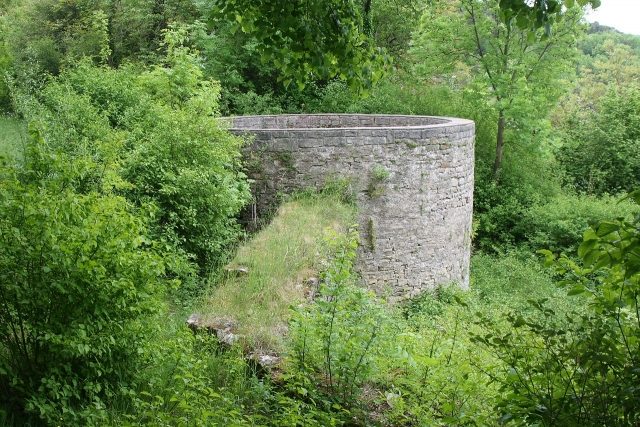
The remains of the Castle can be visited

Boxberg Castle is a castle ruin in Boxberg near Lauda-Königshofen in the Main-Tauber district in Baden-Württemberg.

A Boxberg Castle is already mentioned in the 11th century. In 1287, the Würzburg Bishop Berthold II von Sternberg exchanged the castle, which was a fief of the prince-bishopric, for Schweinberg Castle from the Knights Hospitaller in Wölchingen. A second complex was built on the foundations of the first castle in 1430. Boxberg Castle was then owned by the Rosenberg family. As early as 1470, the castle was destroyed by the very same parties against whom the Rosenbergs had conducted raids: Kurmainz, the Electoral Palatinate, and the Prince-Bishopric of Würzburg. After its destruction in 1523, a third complex was built, which existed from 1547 to 1857 and was then demolished.

The Fateful Year 1523

The end of the 15th century and the beginning of the 16th century marked a time of great upheaval, which led many formerly noble Franconian families to lose their possessions and often great wealth with the transition to a money economy. The Absberg family was also plagued by these problems, and so a representative of the family became known not as a noble lord, but as a robber knight: Hans Thomas von Absberg. This fellow, sometimes called "Hand-chopper," was the sworn enemy of the Swabian League, an alliance of Franconian and Swabian estates under the leadership of Nuremberg. He kidnapped merchants on their trade journeys and demanded a high ransom for their release. To reduce the growing risk of being caught, he sought allies who would support him in his raids and hide him in their castles if he was in danger of capture. Kuntz von Rosenberg, then owner of the Boxberg castle complex, also supported him, hoping to replenish his dwindling riches a little. In 1523, the Swabian League finally sent its troops to raze 23 "robber nests" to the ground, including Boxberg Castle. On June 14, they reached the complex and blew it up the following day. The property of the outlawed Melchior von Rosenberg fell to the Palatinate. In 1548, Albrecht von Rosenberg tried to assert his right of ownership to the castle, and consequently, it was finally sold to the Palatinate in 1561.

The Woodcut by Hans Wandereisen

The woodcut made by Hans Wandereisen vividly shows the appearance of the castle. The huge complex dominated Boxberg in the foreground. The castle is surrounded by a palisade fence, two moats, and a castle wall. All buildings that are part of the wall are already in flames. The palas and the inner castle grounds are collapsing. On the right side of the picture, a smaller complex can be seen, which will be the target of a cannon brought in, which is visible in the center of the picture. In the upper left corner of the picture, parts of the Swabian League's troops can be seen, consisting in this cut of two mounted trumpeters and about 30 foot soldiers. The captain, who has his back to the viewer, is also recognizable.

Description of the Complex+

Located in the center of the town of the same name, only sparse remains of the castle can be found today. According to a floor plan attached to the ruin, the castle had two curtain walls, two drawbridges, and several defensive towers. Three of these defensive towers still exist today; the one in the southwest has been rebuilt. A ditch originates from it, which also served as a Zwinger (outer bailey). Otherwise, not much of the complex, which must have been of considerable size according to the woodcut, can be discovered today. Only the casemates, which are located in the rock where the mighty shield wall once stood, and the re-excavated well in the core castle, along with the towers, remind us of the former complex. Boxberg Castle is, all in all, a special complex, as it is not very common for a castle that existed until the 19th century to almost completely disappear. In 1893, the complex came into the possession of the town, and a beautification society began to preserve it from decay. Finds from the castle can be seen in the Boxberg Local History Museum.

Take Mobile History with you

You are reading this text for free. Premium adds what matters on the road: descriptions read aloud, sites found through your camera, whole regions taken offline.

  • Every description, including the ~17,700 Premium sites
  • Audio guide: have descriptions read to you on location
  • AR finder: see sites through your camera, with distance and bearing
  • Unlimited saved sites

14 days free, then from €2.99 a month. Cancel anytime.

Source: Wikipedia · Licence: CC BY-SA 4.0 · Image: http://de.wikipedia.org/wiki/Datei:Boxberg_Burgruine_Ueberreste_6_20080517.jpg

This description draws on the facts documented in the linked Wikipedia article; Wikipedia content is licensed under CC BY-SA 4.0. Wording and editing: Mobile History.

Location: 49.4794, 9.6420