CastleGerstungen - Lauchröden

Brandenburg Castle
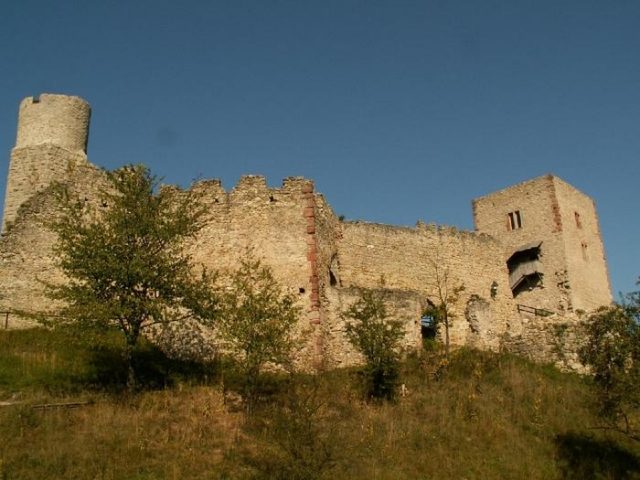
Brandenburg Castle

The remains of the Castle can be visited

The Brandenburg ruin is a castle ruin near the village of Lauchröden, a district of Gerstungen, in the Wartburg district of Thuringia. The ruin of Brandenburg is located in the middle Werra valley, about two kilometers east of the village of Lauchröden, directly opposite the Hessian municipality of Herleshausen. Hollow road traces on the slopes immediately behind the double castle prove an important high medieval road from East Hesse Bad Hersfeld to Eisenach with ford crossings near Sallmannshausen, Herleshausen and Neuenhof. The double castle thus secured a western access to Thuringia.

Prehistoric finds indicate that the ridge of the later castle hill was already settled in the pre-Roman Iron Age.

Middle Ages

The noble family of the Counts of Wartburg, who administered the Wartburg for the Landgraves of Thuringia, is documented since 1138 with Wigger von Wartburg. In 1224, Count Ludwig II of Wartberg also called himself von Brandenburg. It can be assumed that Brandenburg already existed at this time. In 1279/80, Albert II of Brandenburg sold the lordship with the castle to Landgrave Albrecht II the Degenerate. In 1290, he transferred the castle to his son Apitz. The Counts of Wartberg, co-owners of Brandenburg Castle on the Werra, also called themselves Counts of Brandenburg until 1224. Albert von Wartberg-Brandenberg was the last count with the title of count. From 1288 onwards, he appears in documents as an ordinary vassal. At the latest since the beginning of the 14th century, two independent complexes existed on the castle hill, which are distinguished as lower and upper castle or as west and east castle. Subsequently, the two castles - with brief interruptions - always had different owners:

The East Castle - also Upper Castle or Upper House

In 1322, Fritsche and Heinrich von Heringen received the castle as a landgravial fief. It was in the possession of the Lords of Heringen until 1359, but subsequently changed owners frequently, including the Lords of Witzleben, von Weberstadt and von Kolmatsch. From 1415 to 1892, it was in the possession of the Lords of Herda zu Brandenburg. After their extinction in 1895, it came to the sovereign.

The West Castle - also Lower Castle or Lower House

In 1306, the castle was in the possession of the city of Erfurt as a pledge. In 1322, Fritsche and Heinrich von Heringen received the castle as a landgravial fief. The Lords of Heringen pledged the castle again to the city of Erfurt in 1383, which stationed a permanent garrison on the castle. From 1390 onwards, it was in the possession of the Marshals of Thamsbrück, of Nesselröden and then of the Lords of Boineburg–Honstein. In 1405, the West Castle came to Helwig von Ruckus, through whose daughter Gertrud, who married Georg I von Reckrodt, the castle came to the Lords of Reckrodt in 1411, who held it until their extinction in 1703.

Modern Era

Having become militarily insignificant, the castles were abandoned at the latest after the Thirty Years' War. From then on, the castle complex fell into disrepair and was used as a quarry for the construction of castles and estates in Lauchröden and the surrounding communities. Only in 1841 was the demolition stopped by Grand Duke Carl Friedrich of Saxe-Weimar-Eisenach. The construction of the Thuringian Railway was linked to the development of the Werra valley for tourism. Already around 1870, Brandenburg was a popular excursion destination. In 1906/07, extensive structural safety work was carried out, especially on the East Castle, which continued in the 1920s. The Werratalverein, founded in Eschwege in 1883, formed a Brandenburg branch association in 1924. A Suhl architect created a very detailed, scale model of the double castle after extensive studies; it shows the (intact) castle complex in its 15th-century state of construction. During the years of German division, from 1962 onwards, Brandenburg was fenced off due to its proximity to the border and could no longer be visited even by the inhabitants of Lauchröden. Only from 1988 onwards could the castle be entered again under guard.

Renovation of the Castle Ruin

With the restoration of accessibility to the castle ruin, interested citizens of Lauchröden immediately initiated safety work. For this purpose, they founded an interest group, which joined the Werratalverein in 1990 as the legal successor of the Brandenburg branch association. This association, also called Brandenburgverein, in cooperation with the state of Thuringia, initiated the structural securing of the keep of the West Castle and the Kemenate (stone house) on the East Castle after damage mapping, which took place from 1990 to 1994.

Since biotopes with nature conservation status had developed during the decades of isolation of the castle complex, all monument preservation work was carried out taking these circumstances (area natural monument) into account.

All safety work was accompanied by archaeological monument preservation to gain data on the building history. In the process, the two cellars and the cistern of the East Castle were uncovered and examined, and wall remains and the castle moat were cleared of wild growth. In 1994, the castle complex was transferred to the Foundation Thuringian Castles and Gardens, which from that point on took over further monument preservation. The Brandenburgverein took over the castle administration of the foundation and the further development of the castle for visitors, which also included the establishment of the castle museum in the Kemenate and the connection to electricity and water supply, which took place in 2000. A rest and visitor parking lot and a network of hiking trails to the castle were created.

Events+
  • The Brandenburgverein also had the idea for holding a medieval festival; Europe-wide contacts were established, enabling an authentic historical re-enactment with a castle siege.
  • During the summer months, the Brandenburg Concerts take place at the castle.
  • The castle has repeatedly been a venue for the Open Monument Day.

Take Mobile History with you

You are reading this text for free. Premium adds what matters on the road: descriptions read aloud, sites found through your camera, whole regions taken offline.

  • Every description, including the ~17,700 Premium sites
  • Audio guide: have descriptions read to you on location
  • AR finder: see sites through your camera, with distance and bearing
  • Unlimited saved sites

14 days free, then from €2.99 a month. Cancel anytime.

Source: Wikipedia · Licence: CC BY-SA 4.0 · Image: http://www.wehrbauten.de/thread.php?threadid=615

This description draws on the facts documented in the linked Wikipedia article; Wikipedia content is licensed under CC BY-SA 4.0. Wording and editing: Mobile History.

Location: 50.9940, 10.1729