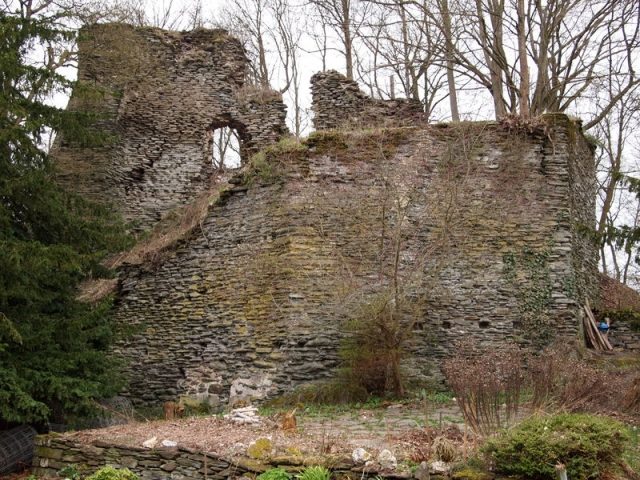
CastleAnhausen

Braunsberg Castle

Braunsberg Castle

The remains of the Castle can be visited

Braunsberg Castle is the ruin of a rock castle on the left slope of the Aubach stream in the municipality of Anhausen in the north of Rhineland-Palatinate. It is one of the ancestral castles of the Counts of Wied.

The ruin of the hilltop castle is located on a rock spur above the Aubach valley. It is therefore easily accessible from only one side. This attack and access side was optimally protected against attackers by a wide ditch dug into the rock as an approach obstacle and a natural rock. All other three sides are protected by quite steep slopes down into the Aubach valley and are therefore difficult to access. Storming the castle from these sides was out of the question, so the builders can be credited with great expertise in choosing the location.

From a landscape perspective, the castle ruin is located on the Burgberg (field name Braunsberg) on the Sayn-Wied plateau, which belongs to the Niederwesterwald, at an altitude of 265 m above sea level, approximately 2 km west-southwest of the village of Anhausen, north-northeast of the reservoir in the Aubach valley, on an imaginary line between Altwied (a district of the city of Neuwied) and Anhausen, approximately ¾ km northwest of the center of an imaginary line between Oberbieber (a district of the city of Neuwied) and Anhausen.

Braunsberg Castle was built around 1200 by Bruno I of Isenburg – later Isenburg-Braunsberg.

The castle site is owned by the princely Wied family and is still (as of 2010) the seat of a district forestry office of the princely Wied forest administration.

Layout+

Architecturally, it was a rare form of a multi-sided, compact residential tower. However, this is the result of later alterations and additions, as can still be seen from the preserved remains (as of September 2007). The original form cannot be reconstructed from the remains or from existing historical photographs from inside the ruin. An archaeological investigation could possibly provide information here. This option seems particularly interesting because the castle site has been largely abandoned since the 18th century, and therefore no large-scale overbuilding has taken place, meaning there are no disturbances. The walls, some of which still reached up to the rooflines, were almost completely destroyed in March 1945 by US artillery fire. Repairs to the war damage in the part of the lower castle used by the forestry office have created a modern-looking forestry operation with a residential area in the middle of the castle grounds. However, it is probable that the destructions in the conflict known as the "Braunsberg War" in regional historiography between the founder of Neuwied, Count Friedrich III of Wied, and electoral Cologne and electoral Palatinate troops in the period after the Thirty Years' War already severely disturbed the original character of the complex. There is said to have been a siege and deaths, so they were not squeamish - since cannons already played a decisive role in warfare at that time, the castle's defenses would have suffered.

Take Mobile History with you

You are reading this text for free. Premium adds what matters on the road: descriptions read aloud, sites found through your camera, whole regions taken offline.

  • Every description, including the ~17,700 Premium sites
  • Audio guide: have descriptions read to you on location
  • AR finder: see sites through your camera, with distance and bearing
  • Unlimited saved sites

14 days free, then from €2.99 a month. Cancel anytime.

Source: Wikipedia · Licence: CC BY-SA 4.0 · Image: http://www.wehrbauten.de/thread.php?threadid=990

This description draws on the facts documented in the linked Wikipedia article; Wikipedia content is licensed under CC BY-SA 4.0. Wording and editing: Mobile History.

Location: 50.4922, 7.5214