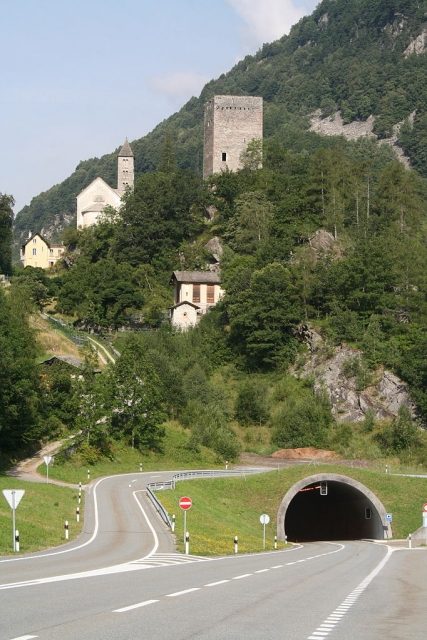
CastleBregaglia

Castelmur Castle

Castelmur Castle

The remains of the Castle can be visited

The ruins of the castle and dam of Castelmur are located on a natural rock bar in the municipality of Bondo in Bergell in the Swiss canton of Graubünden. The ruins of Castelmur are situated above the village of Promontogno on a natural rock bar that separates the valley step of Vicosoprano from the lower valley section of Bondo. The complex is now bypassed by the cantonal road in a tunnel.

Complex+

The complex of the Castelmur dam is essentially divided into three different elements, which were only partially connected.

Uppermost level: Turraccia

On the uppermost level, on a wide rock dome, there are remains of a tower with a footprint of approximately 10 × 10 meters. The elevated position allowed for a wide view over the valley. There was no structural connection to the middle level.

Middle level: Feudal castle and Nossa Dona Church

On an elongated rock ridge north of the Nossa Dona Church lie the ruins of the former feudal castle. A mighty residential tower with remains of the curtain wall and outbuildings has been preserved.

The five-story square keep was built around 1300. It has a footprint of 12 × 12 meters, and the wall thickness is 2.4 meters. The elevated entrance was in the east wall on the 2nd floor and was accessible via a wooden external staircase. On the 3rd and 4th floors, a slanted smoke vent for an open fireplace led outwards. On the 3rd floor of the west wall, a door led to a balcony or an adjacent building. On the south side was an exit to an arcaded walkway running around the entire tower, whose walking level is still recognizable by the beam holes. The tower was probably covered by a hip roof.

The complex was surrounded by a curtain wall running irregularly around the rock plateau, whose gate was on the south side. West and east of the tower are wall remains of outbuildings.

Saddle north of the castle

At the western and eastern ends of the lower saddle north of the castle, there are remains of a traverse that served to defend the castle. No building remains are recognizable.

Lowest level: Dam

The road barrier "Müraia" on the terrace above the Mera gorge formed the northernmost and lowest part of the complex. On the west and east sides, there was a wall about 3.70 meters thick with a gate. On the valley side, remains of a battlement have been preserved. The western wall has collapsed. The approximately 50 cm deep incisions in the eastern gate probably served to hold horizontally placed tree trunks. The upper end was formed by a battlement, which partly rested on pillars and round arches. North of the plateau are remains of a later erected enclosing wall. On the plateau, remains of Roman buildings were found in the 1920s, which belonged to the Roman road station "Murus" mentioned in the Antonine Itinerary; presumably a letzi-like fortification.

In the Rhaetian imperial property register from 831, the dam "Castellum ad Bregalliam" is first mentioned as a fief of a Constantin. In 960, Bergell came into the possession of the Diocese of Chur through an exchange with Emperor Otto I. In a document dated October 20, 988, the exchange with Emperor Otto III is confirmed; the fortress "Insuper bergallium cum castellum" is explicitly mentioned. Later confirmations in the 11th century also all concern the valley with castle, church, and customs.

Around 1121, the Chiavenners violently took possession of the castle. Pope Calixtus II twice urged the Bishop of Chur to persuade the members of his diocese in Chiavenna to return it. A document concerning the peace between the diocese and the city of Como from 1219 shows that the dam formed the border of Chur's sphere of influence.

The Lords of Castelmur first appear with Albertus de Castello Muro in 1190. The ministerial family named themselves after the castle, held it as a castle fief, and guarded it on behalf of the Bishop of Chur. In 1271, Bishop Heinrich documented at Castelmur. Around 1340, Bishop Ulrich pledged the castle to the Planta family for 200 marks. In 1393, he redeemed a quarter of the sum, but had to pledge the castle to Jacob Parutt von Castelmur around 1410. In 1430, Andreas von Salis-Soglio resided at Castelmur. In 1490, Bishop Ortlieb handed over the castle for life to Michael Pfannholz and his wife and daughter. They had to commit to keeping the roof, stairs, and rooms of the castle in good condition. In the 15th century, the castle lost its military significance. In 1538, chronicler Tschudi reported that the castle was "zum teyl abgegangen" (partially dilapidated). When the settlement of Castelmur was abandoned is not known.

Giovanni von Castelmur (1800–1871) commissioned the restoration of the ruins and had the Nossa Dona Church rebuilt around 1845.

Take Mobile History with you

You are reading this text for free. Premium adds what matters on the road: descriptions read aloud, sites found through your camera, whole regions taken offline.

  • Every description, including the ~17,700 Premium sites
  • Audio guide: have descriptions read to you on location
  • AR finder: see sites through your camera, with distance and bearing
  • Unlimited saved sites

14 days free, then from €2.99 a month. Cancel anytime.

Source: Wikipedia · Licence: CC BY-SA 4.0 · Image: http://commons.wikimedia.org/wiki/File:Castelmur_Lage.jpg

This description draws on the facts documented in the linked Wikipedia article; Wikipedia content is licensed under CC BY-SA 4.0. Wording and editing: Mobile History.

Location: 46.3396, 9.5617