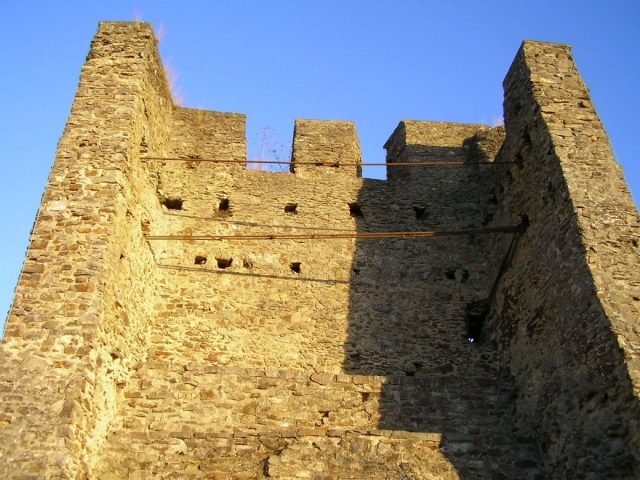
The remains of the Castle can be visited
Dasburg Castle

Dasburg is the ruin of a hilltop castle in the Southern Eifel in the German-Luxembourg Nature Park on a 356 m above sea level high hill near the municipality of Dasburg on the Our in the Eifelkreis Bitburg-Prüm in Rhineland-Pfalz.
The castle was probably built at the beginning of the 13th century as a defensive structure and refuge. In 1222, it was first mentioned as "Daysberhc castrum" in the commentary on the Prüm Urbar, which the former abbot of Prüm, Caesarius von Milendonk, compiled in 1222.
The counts held Dasburg and the lordship as a fief from the Abbey of Prüm. In return, the Vianden family had to provide protection to the abbey. Due to this situation, Dasburg always had well-known and great noble houses in its name: Vianden, von Sponheim, Nassau, and Orange. Even today, the Dutch King bears the addition "Lord of Dasburg" in his title.
In 1417, the castle was transferred to the Counts of Nassau-Dillenburg, from 1580 to 1604 in the possession of King William of Spain, and in the 17th to 18th centuries, Nassau-Orange property. In 1625, the then clergyman Pastor Jakob Pott listed 35 houses by name. The Lordship of Dasburg at that time fulfilled important strategic tasks for the protection of Vianden Castle as a safeguard for the through road from the west. The lordship comprised the bailiwicks of Dasburg, Daleiden, and at times Binscheid and Harspelt. As the seat of the lordship, Dasburg had its own court consisting of a Schultheiss and Schöffen. In 1794, it was occupied by the French revolutionary troops. This also resulted in the Klöppelkrieg (Clog War). The leader of the Klöppelkrieg army was the then Dasburg castle hunter Karl Bormann. In 1813, General Oudinot (he received Dasburg for his military services from Napoleon) had Dasburg Castle auctioned by the then notary Dupont.
After the Second World War, the castle ruin went to the state of Rhineland-Pfalz and was handed over to the state castle administration in 1965.
The castle is currently being restored. After the completion of the renovation work, the castle is to be leased. The lease agreement will be publicly advertised, as there are already several interested parties.
On January 22, 2012, large parts of the masonry of the round tower collapsed and slid down a slope onto the adjacent B 410.
Layout+
Of the medieval castle complex with a large dungeon, the foundations of the inner defensive wall, parts of the outer defensive wall with two half-towers, remnants of the entrance gate, and the north side of the 20 m high keep, which represented the center of the probably Staufer core castle, are still preserved, as well as a passage along the curtain wall, which originally had a bridge on its northern narrow side and was broken through by a gate access and some half-towers.
Take Mobile History with you
You are reading this text for free. Premium adds what matters on the road: descriptions read aloud, sites found through your camera, whole regions taken offline.
- Every description, including the ~17,700 Premium sites
- Audio guide: have descriptions read to you on location
- AR finder: see sites through your camera, with distance and bearing
- Unlimited saved sites
14 days free, then from €2.99 a month. Cancel anytime.
Source: Wikipedia · Licence: CC BY-SA 4.0 · Image: http://commons.wikimedia.org/wiki/File:Dasburg_Turm.jpg?uselang=de
This description draws on the facts documented in the linked Wikipedia article; Wikipedia content is licensed under CC BY-SA 4.0. Wording and editing: Mobile History.
Location: 50.0472, 6.1324