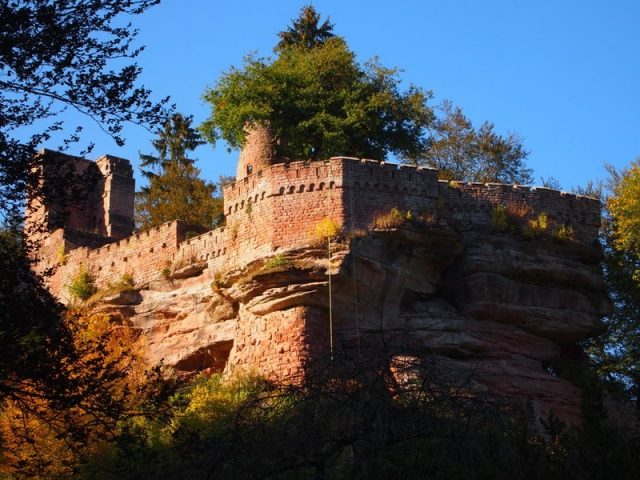
The remains of the Castle can be visited
Diemerstein Castle

Diemerstein Castle is the ruin of a spur castle at 280 m above sea level in the Glasbach Valley at the end of a long ridge on a steeply sloping rock plateau in the Diemerstein district of the municipality of Frankenstein in the Palatinate in Rhineland-Palatinate.
The castle hill was laid out as a landscape garden in the 18th century. However, this is only partially recognizable. Above the castle is a small open-air stage, where exclusively the play German Destiny - the events in Diemerstein Castle and Country House by Pastor Johann Jakob Hamm, last performed in 1986, was staged.
The exact date of construction and the name of the builder of Diemerstein are unknown. In 1216, Rudegar von Dimarstein was the first nobleman mentioned who named himself after the castle. In 1217, Nebelung and Rudiger von Dymerstein were mentioned, who were involved in disputes with Otterberg Abbey over the interest of the Sendelborn farm. Nebelung von Dymerstein also held the patronage rights of the church in Hochspeyer. In 1221, "Nebelung von Dimarstein" and "Berthold von Dyrmstein" handed them over to the Bishop of Worms.
In 1250, the Raugraves were named as owners of Diemerstein, who appointed the knight Gundelmann as castellan. There are no known documents about the acquisition. A village probably did not belong to the castle at that time, but only an extensive forest district. In 1362 or 1380, Diemerstein was pledged to the Trier Archbishop Kuno von Falkenstein. The castellan he appointed, Johann Schilling, also administered half of the nearby Frankenstein Castle. In 1397, the castle fell back to the Raugraves, who sold three quarters of the castle to various Palatinate nobles. Thus, the castle finally became a Ganerbenburg (a castle owned by several families). A quarter of the castle was inherited by Phillip von Daun (Daun-Oberstein). Phillip von Daun sold his share of the castle in 1418 to the Elector Palatine, who, together with eleven other nobles, was owner of the castle and concluded a detailed castle peace with them.
Gradually, the Electors acquired three quarters of the castle. Since 1478, the Lords of Weingarten were vassals of the Electors Palatine, the remaining quarter of the castle was their property. In 1521, Christoph Bonn von Wachenheim hosted the reformer Ulrich von Hutten at Diemerstein.
During the Thirty Years' War, the castle was destroyed and not rebuilt. It fell back to the Electoral Palatinate during these years. At the beginning of the 18th century, the castle and the Diemerstein forest came into the possession of the Counts of Wartenberg. In the 1840s, Paul Camille von Denis owned Diemerstein. He undertook a redesign and expansion of the ruin.
Current Use+
Diemerstein is a ruin that was redesigned in the mid-18th century in the taste of the time. Thus, the wall adorned with battlements dates from this period. Diemerstein is privately owned. The lower castle is freely accessible, the upper castle is closed by a gate.
Take Mobile History with you
You are reading this text for free. Premium adds what matters on the road: descriptions read aloud, sites found through your camera, whole regions taken offline.
- Every description, including the ~17,700 Premium sites
- Audio guide: have descriptions read to you on location
- AR finder: see sites through your camera, with distance and bearing
- Unlimited saved sites
14 days free, then from €2.99 a month. Cancel anytime.
Location: 49.4444, 7.9615