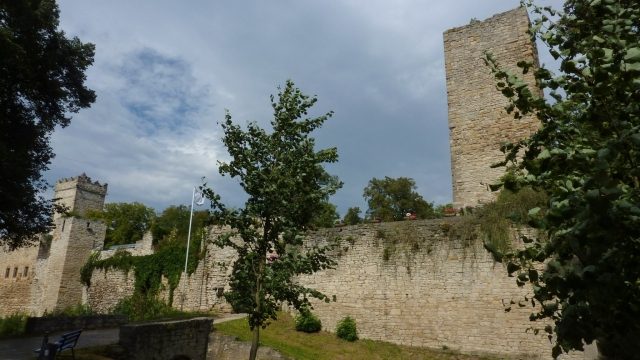
The remains of the Castle can be visited
Eckartsburg Castle

Eckartsburg, also known as Eckartsberga, is a partially preserved castle located on a ridge of the Finne landscape, more precisely on the southern edge of the foothills of the Finne mountain range, above the small town of Eckartsberga in the Burgenlandkreis, in the Saale-Unstrut-Triasland Nature Park, near the state border of Saxony-Anhalt with Thuringia. The castle is operated by a castle restaurant and is located on the Romanesque Road.
The castle consists of the core castle (main castle) and the outer bailey; it is entered through an 8.2 m long archway. The archway has a niche as a dwelling for the gatekeeper, which was also used as a prison. The main castle is accessible through a 10.4 m long and 2.8 m wide gate with 3 m thick walls.
The preserved, 22 m high keep is founded directly on the rock, has 2.50 m thick walls and served as a prison and torture tower. Inside the keep, the barrel vault has an opening through which prisoners were lowered into the prison. The tower door is located at a height of 9 m.
The only preserved living quarters are on the south side of the castle and are now used as a restaurant and innkeeper's apartment.
For the castle's 1000th anniversary in 1998, the palas was rebuilt and now serves cultural purposes. The Jungfernturm (Maiden's Tower) has windows and machicolations for defense.
The other (large) keep is 36 m high, can be climbed (for views) and has 5 floors. It was used as a watchtower and as accommodation. The first floor is now filled with rubble. A diorama and a smaller museum are now housed on the other floors. "The wall thickness is 2.5 m up to the 3rd floor, then approx. 1.5 m, so that a battlements walk of 1 m is present."
In the castle hall is the original velocipede of the forester Karl Freiherr von Drais, which he invented in Mannheim in 1817.
Imperial Castle
The Margrave of Meissen, Ekkehard I, is considered the builder of the castle. He was enfeoffed with the March of Meissen in 985 and is said to have built the castle in 998 on the Via Regia. However, there is no compelling evidence for this assumption. If the castle was indeed a foundation of the Ekkehardingers, it reverted to the Empire in 1046 with the extinction of the Eckardinger line. The complex remained an imperial castle until the Landgraves of Thuringia were enfeoffed with the lordship. The first reliable record of the castle's existence is a document issued by King Henry IV in Eckartsberga in 1066. In 1074, Eckartsburg was also directly named. For a short time between 1112 and 1115, the castle was enfeoffed to Wiprecht von Groitzsch II.
Ludowinger
In 1121, the Thuringian Count Ludwig the Springer received Eckartsburg as property in the course of the reconciliation of the Thuringian noble opposition with the emperor. Udo, Bishop of Naumburg and brother of Ludwig I, first documented his presence at the castle in 1134.
The events considered up to this point refer to a fortification that, with high probability, was not located on the present castle hill. Excavations carried out in 1901 found no remains of a predecessor castle. Possibly, the castle of the 10th/11th century was located in a rampart system known as Altenburg in the district of Mallendorf.
Since 1185, frequent stays of Ludwig III or his brother Hermann, Count Palatine of Saxony, in Eckartsberga have been documented. Hermann probably also built the walls of the core castle and the outer bailey, dating from around 1200 and forming an almost rectangular quadrangle. At that time, the castle consisted of the core castle, a western outer bailey, and two eastern outer baileys. Of the large easternmost outer bailey, the rampart and neck ditch, as well as remnants of a Romanesque keep (excavated in 1901, not visible), have been preserved. In the core castle, the Romanesque buildings created at the same time, consisting of the ring wall, keep, palas ruin, and chamber gate, are well preserved. Hermann I, Count Palatine of Saxony and later also Landgrave of Thuringia, is thus the founder and builder of the Romanesque Eckartsburg that still exists today.
However, the castles of the Landgraves not only had military significance, but they were also centers for the reception of art and culture. Here, the nobility cultivated literature, religion, historiography, music, painting, and handicrafts. A particularly famous patron of chivalric courtly culture was Landgrave Hermann I. In the decades around 1200, he resided not only at Wartburg and Neuenburg but also frequently at Eckartsburg.
The importance of Eckartsburg for the Ludowinger can also be seen in the awarding of the marshal's office to the ministerials of Eckartsberga. Since 1140, landgravial ministerials of Eckartsberga have been documented. The court office of marshal was associated for a long time with the family originating from Vargula, who called themselves von Eckartsberga in 1186.
Wettiner
After the death of Heinrich Raspe, a lengthy war of succession followed in Thuringia, into which Eckartsburg was drawn from the beginning. The Wettin Heinrich the Illustrious conquered the castle in 1247 and expanded it into a stronghold for the subsequent battles. As a result of these conflicts, which only ended in 1264, Thuringia lost its regional independence, as the Landgraviate of Thuringia was annexed to the Margraviate of Meissen. Thus, the Counts of Wettin, as Margraves of Meissen and Landgraves of Thuringia, had become one of the most important territorial powers in the German Empire.
A son of Heinrich the Illustrious, Albrecht the Degenerate, often stayed at Eckartsburg, which became one of his favorite residences. The town of Eckartsberga probably owes its elevation to a city in 1288 to him. In the following decades, the Wettin territorial rule had to overcome various problems and crises. Castle and town of Eckartsberga frequently changed owners. In 1388, for example, they were pledged to the Lords of Querfurt.
Eckartsburg also played a role in the 15th century as a place of exile for a high-ranking noble lady. This was related to the Wettin Duke Wilhelm III the Brave. He was considered on the one hand a pious man devoted to the church, on the other hand, his political behavior gave the "impression of a rigid and relentless personality". His personal circumstances were also subject to greater fluctuations. Thus, he repudiated his wife Anna of Austria, daughter of the Roman-German King Albrecht II, because of a dispute over the dowry and instead turned to his beloved Katharina von Brandenstein. Duchess Anna was brought to Eckartsburg in 1457 and, according to legend, imprisoned in the Jungfernturm (Maiden's Tower). She died in exile in 1462.
Very significant for the further history of Saxony and Thuringia – with repercussions into the 20th century – was the division of the Wettin territorial rule in 1485 into the lines of the "Ernestines" and the "Albertines". This territorial division of Leipzig between Elector Ernst and Duke Albrecht marked the beginning of the modern state history of Central Germany.
Eckartsberga and Eckartsburg fell to the Albertine line, to which the March of Meissen belonged. From then on, the Ernestine and Albertine princes went their separate ways, which led to ever further fragmentation, with the Albertine line remaining connected to Saxon history.
Modern Era
In 1657, the castle lay desolate, and in 1664 it was reported that only a few rooms were furnished for living. Inventory descriptions from the 18th century prove that the castle was rebuilt and used as a farmstead. In 1806, after the Battle of Jena and Auerstedt, Prussian troops retreated to Eckartsburg. Therefore, a diorama of the battle is also located in the castle.
Since 1815, the lordship of Eckartsberga was Prussian property. When the west tower threatened to collapse in 1815, demolition was forbidden for "reasons of antiquity". Frederick William III of Prussia donated the funds for its restoration. In 1850, the economic use, which had previously served predominantly as a grain storage facility, was abandoned. The building was threatened with gradual decay.
However, the increasing popularity of the ruin led to continuous maintenance and conservation work. Already in 1860, a restaurant was opened in the castle. It was located in the former grain loft on the south side of the complex.
Around 1900, the expansion of the castle into a large excursion center with a festival hall and shooting range was planned. However, for reasons of monument preservation and finances, the plans were not realized. Only in 1925 was the restaurant expanded into the "Old German" form that still exists today.
Take Mobile History with you
You are reading this text for free. Premium adds what matters on the road: descriptions read aloud, sites found through your camera, whole regions taken offline.
- Every description, including the ~17,700 Premium sites
- Audio guide: have descriptions read to you on location
- AR finder: see sites through your camera, with distance and bearing
- Unlimited saved sites
14 days free, then from €2.99 a month. Cancel anytime.
Source: Wikipedia · Licence: CC BY-SA 4.0 · Image: Joachim Schneeleopard
This description draws on the facts documented in the linked Wikipedia article; Wikipedia content is licensed under CC BY-SA 4.0. Wording and editing: Mobile History.
Location: 51.1215, 11.5591