CastleEspelkamp - Fiestel

Ellerburg Castle
Ellerburg Castle

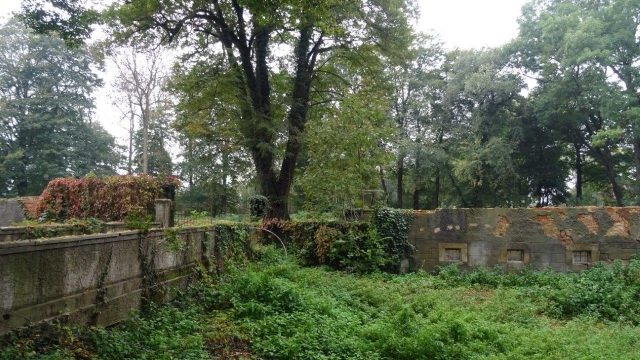
The remains of the Castle can be visited


The Ellerburg was a former moated castle in the village of Fiestel, part of the city of Espelkamp in the Minden-Lübbecke district. The castle complex was located east of the Große Aue river and north of the Mittelland Canal, at the transition from the Alsweder Niederung to the Rahdener Geest, and covered an area of about four hectares. Its buildings were severely dilapidated and in danger of collapse, and were therefore demolished down to their foundations.

The Ellerburger Wiesen nature reserve largely consists of former agricultural land belonging to the estate.

The estate was first mentioned in 1475. The owner at that time was Hardecke von Münch. In 1510, the estate was divided between two sons. Besides Ellerburg, this included the neighboring Benkhausen Castle. Imperial and Swedish troops clashed in a battle for the castle in 1633.

After a long dispute, Ellerburg passed to the von Ripperda family through female inheritance. The family spread across eastern Holland and Emsland to the Bishopric of Minden (Ellerburg). This was achieved not least through strategic marriages. The Prussian officer Friedrich Wilhelm Freiherr von Ripperda had the buildings rebuilt around 1795. He was temporarily stationed in the Minden fortress.

As the von Ripperda family had fallen into financial difficulties, the former Minden District President, Freiherr Karl von der Horst, acquired the estate in 1825, even though he himself had been put on temporary retirement on February 24, 1825, due to his own disordered financial affairs. His son Adolf von der Horst served as district administrator for the Lübbecke district from 1838 to 1870, primarily from Ellerburg. However, from 1840 he resided at Hollwinkel Castle. The estate remained in the possession of the von der Horst family until the 1990s and is now owned by the city of Espelkamp.

After various initiatives had campaigned for the preservation of the buildings, which had long been in danger of collapse, the demolition of the buildings was decided in March 2012. The park and parts of the ruin were to be preserved. In May 2014, the demolition excavator arrived and the castle was razed to its foundations.

Ellerburg Estate District

Around 1856, an Ellerburg estate district, which was equivalent to a municipality, was newly formed by separating it from the municipality of Alswede. On October 1, 1928, it was dissolved and incorporated into the then municipalities of Alswede (larger part) and Hedem.

Buildings and Park+

Originally, the manor house was located on a small moated island. The courtyard was accessible via a representative stone bridge. The "Ellerburger Mühle" (Ellerburg Mill), located north of the manor house, belonged to the estate. In 1595, Johann Monnich zur Ellerburg transferred it to Curdt von Aßweide, senior of the Minden Cathedral Chapter, to settle his debts. The water mill, driven by the dammed bypass of the Große Aue, was part of the Westphalian Mill Route.

A chestnut avenue, running along the southeast edge of the grounds, originally connected Ellerburg with Hollwinkel Castle. In the area of the building stand three very old lime trees, particularly noteworthy is the approximately 400-year-old lime tree in the castle courtyard.

Take Mobile History with you

You are reading this text for free. Premium adds what matters on the road: descriptions read aloud, sites found through your camera, whole regions taken offline.

  • Every description, including the ~17,700 Premium sites
  • Audio guide: have descriptions read to you on location
  • AR finder: see sites through your camera, with distance and bearing
  • Unlimited saved sites

14 days free, then from €2.99 a month. Cancel anytime.

Location: 52.3531, 8.5594